
In Newport Beach, the biggest threat to your investment isn’t a market downturn; it’s the friction between aggressive California state mandates and strict local municipal oversight. Achieving Newport Beach rental property legal compliance requires more than just a passing knowledge of the law; it demands a proactive strategy to avoid costly litigation. You likely feel the pressure of keeping up with ever-shifting rules while trying to maintain your property’s profitability. It’s exhausting to track whether a building constructed before 2011 falls under AB 1482 or if your security deposit return process meets the strict 21-day itemized receipt requirement.
This guide provides the definitive roadmap for 2026. We’ve simplified the intersection of local ordinances and state mandates to ensure your real estate assets remain protected. You’ll learn the specifics of the 10% Transient Occupancy Tax reporting, the 8.8% rent cap applicable to many local units, and the “Just Cause” eviction protocols that are now standard practice. This framework offers the True Transparency you need to manage your portfolio with calm, authoritative confidence and total peace of mind.
Key Takeaways
- Master Newport Beach rental property legal compliance by navigating the multi-tiered intersection of federal, state, and city-specific ordinances.
- Understand the 2026 updates to SB 567 and AB 1482 to ensure your “Just Cause” eviction processes and rent caps remain fully legal.
- Identify the specific zoning restrictions and permit requirements that separate short-term lodging from long-term residential leasing in the Newport market.
- Protect your asset by implementing the “Big Five” mandatory lease disclosures and maintaining strict habitability standards to avoid litigation.
- Discover how a proactive management partnership creates a protective barrier between your investment and the risks of accidental non-compliance.
Understanding the Newport Beach Compliance Landscape in 2026
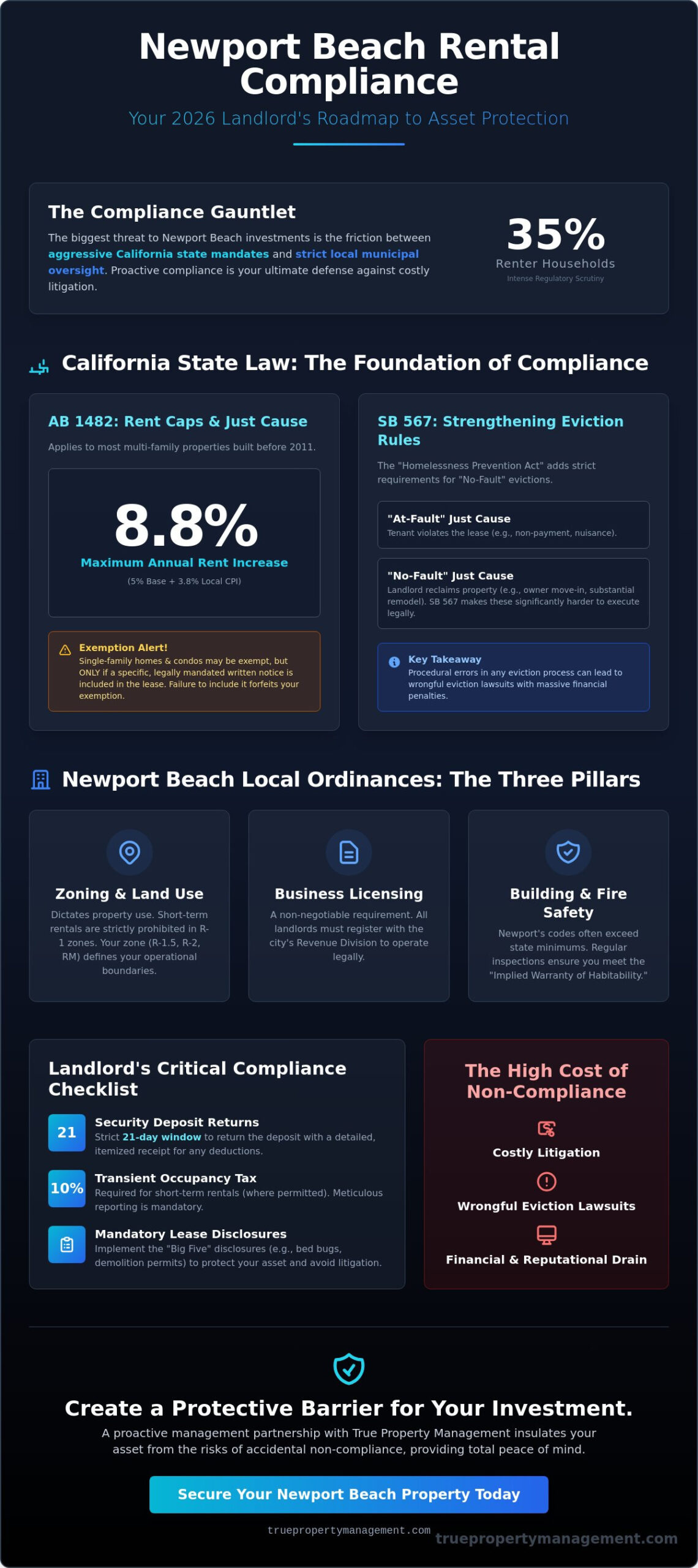
Managing a rental in Newport Beach isn’t just about collecting rent; it’s about managing a multi-tiered legal framework that demands precision. You’re dealing with federal fair housing mandates, state-wide tenant protections, and municipal codes that change with the seasons. Newport Beach’s status as a premier coastal market, where renter households make up approximately 35% of the population, brings intense regulatory scrutiny from both the city and the state. At True Property Management, we view compliance as the ultimate form of asset protection. It’s the proactive barrier that keeps your investment secure from litigation and financial drain. Newport Beach rental property legal compliance is the strategic alignment of local zoning ordinances with the evolving requirements of California’s 2026 Civil Codes.
The Three Pillars of Local Governance
Your compliance journey begins at the local level, where the City of Newport Beach exercises its authority through three distinct channels. First, Zoning and Land Use dictates how you can use your property. Whether your asset is in an R-1.5, R-2, or RM zone determines your operational boundaries, particularly since short-term rentals are strictly prohibited in R-1 zones. Second, Business Licensing is a non-negotiable requirement. All landlords must register with the city’s Revenue Division to operate legally. Finally, Building and Fire Safety standards in Newport often exceed basic state requirements. Regular inspections ensure your property meets the “Implied Warranty of Habitability,” preventing minor maintenance oversights from escalating into expensive legal disputes.
Why 2026 is a Turning Point for Landlords
2026 marks a significant shift toward increased tenant transparency and more aggressive enforcement. While the Costa-Hawkins Rental Housing Act continues to protect your right to set initial rental rates on single-family homes and newer builds, the Newport Beach City Council remains active in shaping local policy to manage housing density and community impact. This legislative environment requires a disciplined, tech-forward approach to management. You can’t afford to guess about “Just Cause” eviction notices or the 21-day security deposit return window. For a deeper look at the state-level foundation of these rules, see our California Landlord Tenant Law: 2026 Guide. We believe that by anticipating every possible hurdle, we provide the security and peace of mind you deserve as a local investor.
California State Laws: AB 1482 and SB 567 in Newport Beach
The “compliance trap” in Newport Beach often catches landlords who assume local ordinances are their only concern. In reality, the intersection of municipal rules and aggressive state mandates like the Tenant Protection Act (AB 1482) creates a high-stakes environment. With median rents in Newport Beach frequently exceeding $3,000 per month, a single procedural error in a rent increase or eviction notice can trigger a “wrongful eviction” lawsuit with massive financial consequences. Achieving Newport Beach rental property legal compliance means mastering these state-level nuances before they become liabilities. You can find a detailed breakdown of these protections on the official California landlord-tenant laws resource page provided by the Department of Justice.
For 2026, the rent cap under AB 1482 remains a critical calculation for owners of multi-family properties built before 2011. Based on the 3.8% Consumer Price Index (CPI) for the Los Angeles-Long Beach-Anaheim area, the effective rent cap for applicable properties is currently 8.8%. However, many Newport Beach owners overlook the specific exemptions available to them. Single-family homes and condominiums are generally exempt from these caps, but only if they aren’t owned by a corporation or REIT and the landlord has provided the tenant with a specific, legally mandated written notice of exemption. If you haven’t included this language in your lease, you’ve likely surrendered your exemption without even knowing it.
Navigating ‘Just Cause’ Eviction Requirements
The 2026 updates to SB 567, known as the Homelessness Prevention Act, have made “No-Fault” evictions significantly more difficult to execute. If you intend to move into your property or perform a substantial remodel, you must follow strict timelines. For an owner move-in, you or your relative must occupy the unit within 90 days and remain there for at least 12 months. Failing to meet these criteria can lead to a lawsuit for triple damages. At True Property Management, we use a disciplined documentation method to ensure every lease violation is recorded with “True” accuracy, protecting your right to an “At-Fault” eviction if a tenant breaches their agreement. If you’re feeling overwhelmed by these risks, our risk management experts can help insulate your portfolio from accidental non-compliance.
Rent Increase Limitations and CPI Calculations
Correctly timing your rent adjustments is just as vital as the calculation itself. Under California law, any increase above 10% requires a 90-day notice, while increases at or below 10% require a 30-day notice. Since the current cap for covered units is 8.8%, most Newport Beach landlords will fall under the 30-day rule. It’s essential to understand how these regulatory burdens impact your bottom line. To see how professional oversight fits into your financial strategy, review our guide on Property Management Fees in Orange County. We provide the clarity you need to maximize ROI while maintaining total legal security.
Short-Term vs. Long-Term Rentals: Navigating the Divide
In Newport Beach, the legal distinction between a vacation stay and a residential tenancy is exactly 30 days. If you rent your property for fewer than 30 consecutive days, you’re operating a short-term rental (STR), which triggers a completely different set of compliance requirements. While some investors are lured by high nightly rates, they often underestimate the regulatory friction and community pushback involved. Newport Beach rental property legal compliance for STRs involves aggressive municipal oversight, mandatory 24/7 local contacts, and strict occupancy caps that don’t apply to traditional leases. We believe in providing the clarity you need to choose the strategy that best protects your financial future.
The Short-Term Lodging Permit (STLP) Hurdles
Obtaining and keeping a Short-Term Lodging Permit (STLP) is becoming a complex administrative task. The city enforces strict zoning, prohibiting STRs in R-1 districts to protect neighborhood character; exceptions only exist for rare “grandfathered” permits. For those in R-1.5, R-2, or RM zones, you must navigate an $89 annual renewal fee and designate a local contact who can respond to any property issue within 30 minutes, 24 hours a day. With the 2026 implementation of SB 346, the city now uses platform data sharing to ensure every dollar of the 10% Transient Occupancy Tax (TOT) is remitted. You can review the full Newport Beach Short-Term Rental regulations to see the administrative burden for yourself.
The city’s enforcement is robust. Beyond the permit fees, you’re responsible for filing monthly TOT reports even if you had zero bookings for the month. Occupancy is also strictly capped at two people per bedroom plus two additional guests, with a general limit of 10 people. If your guests violate noise or parking ordinances, you’re the one held accountable by the city. This high-intensity management style often leads to burnout for owners who wanted a passive investment but ended up with a second job.
Long-Term Rental Advantages in 2026
For serious investors, long-term rentals (LTR) offer a more sustainable path to wealth and security. By focusing on leases of 30 days or longer, you bypass the 10% TOT and the constant threat of noise or parking citations that can lead to permit revocation. LTRs provide a predictable ROI and significantly lower turnover costs compared to the high-intensity management required for vacation rentals. This stability allows you to focus on long-term asset protection rather than policing guest behavior or filing monthly tax reports. If you want to learn more about optimizing your strategy, check out our guide on how to Maximize Rental Income in Newport Beach. We help you build a portfolio that thrives on reliability and True Transparency.
Mandatory Disclosures and Habitability Standards
Achieving Newport Beach rental property legal compliance requires more than a handshake; it demands a rigorous, documented paper trail. Under California Civil Code 1941.1, the “Implied Warranty of Habitability” is a non-negotiable baseline. Your property must provide essential services like effective weatherproofing, functional plumbing, and reliable heat. In our unique coastal environment, moisture management is a significant legal flashpoint. If you fail to address window leaks or rising dampness promptly, you’re vulnerable to “constructive eviction” claims where a tenant may legally withhold rent until repairs are completed. Additionally, failing to provide a written Move-In/Move-Out inspection report can forfeit your right to retain any portion of the security deposit for damages, regardless of the property’s condition at vacancy.
Required Disclosures for 2026 Leases
Omitting any of the mandatory disclosures can invalidate your lease or lead to statutory damages. Every Newport Beach agreement must include:
- Lead-Based Paint: Required for all properties built before 1978.
- Mold: A written notice disclosing any known mold or moisture issues.
- Bedbug History: Information about past infestations and general prevention.
- Flood Zones: Disclosure if the property is in a designated flood hazard area.
- Megan’s Law: A notice regarding the registered sex offender database.
We use a “True” Disclosure Checklist to ensure every document is signed before the move-in date. This disciplined approach protects your real estate asset from the start and fosters a high-level partnership based on mutual transparency.
Maintenance as a Legal Defense
Proactive upkeep is your best defense against tenant disputes. California law dictates that essential repairs, such as a lack of hot water or electricity, must be addressed within 24 hours. For standard repairs, you typically have 30 days. Maintaining a clear log of all maintenance requests and response times creates a protective barrier between you and potential litigation. To stay organized, follow our Rental Property Maintenance Checklist. If you’re ready to offload the stress of habitability management, contact our expert team today to secure your investment’s future.
How True Property Management Insulates Owners from Risk
Landlords in Newport Beach face a relentless tide of legislative changes. We’ve seen how a single missing disclosure or a miscalculated rent cap can turn a profitable asset into a legal liability. True Property Management acts as your protective barrier, standing between you and the logistical headaches of modern management. We don’t just react to problems; we anticipate them. Our mission is to redeem the reputation of property management by providing a service rooted in reliability and authoritative expertise. Achieving Newport Beach rental property legal compliance shouldn’t be a source of stress for you; it should be the standard operation of your investment.
We maintain a steady, disciplined pulse on California’s evolving civil codes. Our legal compliance and risk management division utilizes attorney-vetted lease agreements that are specifically updated for 2026 mandates. These aren’t generic templates found online; they’re high-level legal instruments designed to protect your ROI. By ensuring every document meets the exact standard for Newport Beach rental property legal compliance, we eliminate the ambiguity that often leads to tenant disputes. This creates a sense of momentum and competence, as if the hurdles have already been cleared before they even appear.
Our Proactive Compliance Audit
Before your property ever hits the market, it undergoes a rigorous “True” audit. We review every square foot to ensure it meets the “Implied Warranty of Habitability” standards discussed earlier in this guide. Our team verifies that your specific zoning allows for your intended rental strategy and that all municipal business licenses are current. Once a tenant is placed, our 24/7 emergency response system fulfills the strict legal requirement for essential service repairs, ensuring you stay on the right side of the 24-hour rule. This proactive stance is essential for Expert Property Management in Newport Beach.
Stress-Free Ownership Through Expertise
The cost of a single legal mistake in a high-rent district like Newport Beach can easily exceed the annual cost of professional management. A “wrongful eviction” lawsuit or a failed security deposit return can result in triple damages and thousands in attorney fees. We provide “True Transparency” through detailed financial and legal reporting, giving you a clear view of your portfolio’s health without the stress of daily oversight. Our relationship is built on mutual respect and your financial success. We’re too busy being efficient to engage in fluff, valuing your time and money above all else. Protect your investment with True Property Management and experience the security of a high-level partnership.
Secure Your Newport Beach Portfolio for 2026
The landscape of Newport Beach rental property legal compliance is too complex to navigate through guesswork. From the 8.8% rent cap calculations to the rigorous 21-day security deposit itemization rules, the margin for error is razor-thin. You don’t have to carry the burden of legislative monitoring alone. Since 2014, Michael Chiusano and the team at True Property Management have served as a protective barrier for local landlords. We specialize in the nuances of SB 567 and AB 1482, ensuring your assets remain insulated from the threat of litigation. Our No Hidden Fees Guarantee provides the True Transparency you deserve, allowing you to maximize ROI without administrative headaches. Guesswork is a liability. It’s time to trade your stress for the peace of mind that comes with professional oversight. Experience a high-level partnership that prioritizes your financial success and property security.
Secure Your Newport Beach Investment with a Free Compliance Consultation
We’re ready to help you thrive in the 2026 market with confidence and clarity.
Frequently Asked Questions
Is rent control active in Newport Beach for 2026?
Yes, state-wide rent control under AB 1482 applies to many multi-family properties in Newport Beach. For 2026, the maximum annual increase is capped at 5% plus the local Consumer Price Index, which was 3.8% for the Los Angeles-Long Beach-Anaheim area in 2025. This sets the effective rent cap at 8.8% for covered units built before 2011. Properties constructed within the last 15 years remain exempt from these specific price controls.
Do I need a business license to rent out my house in Newport Beach?
Every property owner renting out a residential unit in Newport Beach must obtain a business license from the city’s Revenue Division. This is a mandatory requirement for both long-term leases and short-term stays. Maintaining this license is a fundamental step in Newport Beach rental property legal compliance, as operating without one can lead to city penalties and weaken your standing in landlord-tenant disputes.
What is the maximum security deposit I can charge in California?
As of 2026, California law limits security deposits to a maximum of one month’s rent for most residential rental properties. You must return the deposit or an itemized accounting of deductions within 21 calendar days of the tenant vacating the property. If deductions for repairs or cleaning exceed $125, you’re legally required to provide copies of receipts to the former tenant to avoid potential litigation.
Can I evict a tenant in Newport Beach to move into the property myself?
You can evict a tenant for an owner move-in, but you must strictly follow the “Just Cause” requirements under SB 567. The owner or a direct relative must move into the unit within 90 days of the tenant’s departure and use it as a primary residence for at least 12 consecutive months. Failing to meet these specific occupancy deadlines can result in the tenant suing for triple damages and relocation costs.
What happens if I rent my property short-term without a permit?
Operating a short-term rental without a permit in Newport Beach triggers aggressive enforcement and significant financial penalties. The city uses data-sharing technology under SB 346 to monitor platforms and identify unpermitted hosts. Beyond the risk of fines, you’re still responsible for the 10% Transient Occupancy Tax on all income earned from stays under 30 days, even if you failed to register the property correctly.
Are single-family homes exempt from AB 1482 in Newport Beach?
Single-family homes and condominiums are typically exempt from state rent caps, provided they aren’t owned by a corporation, REIT, or LLC with a corporate member. However, this exemption isn’t automatic. To maintain your Newport Beach rental property legal compliance, you must provide your tenant with a specific, legally mandated written notice in the lease agreement stating that the property is exempt from AB 1482.
How much relocation assistance is required for no-fault evictions?
If you’re terminating a tenancy for a “No-Fault” reason, such as an owner move-in or a substantial remodel, you must provide relocation assistance equal to one month’s rent. This payment must be made to the tenant within 15 days of serving the notice. Alternatively, you can choose to waive the final month’s rent in writing, but the value must equal at least one full month of the current rent price.
Does Newport Beach have specific rules for Accessory Dwelling Units (ADUs)?
Newport Beach allows ADUs but enforces strict rules regarding their occupancy and use. While these units are excellent for long-term residential housing, they are generally prohibited from being used as short-term rentals if the property is located in an R-1 zone. We ensure your ADU strategy aligns with current zoning to protect your investment and prevent accidental violations of local municipal codes.