
Your standard homeowners insurance policy is likely the single biggest risk to your Tustin rental property. While it feels like a safety net, using the wrong policy type can lead to a total claim denial when you need protection most. Understanding the specific Tustin landlord insurance requirements for 2026 is no longer a task you can ignore; it’s a critical component of professional asset protection. We understand the frustration of rising California premiums and the confusion surrounding new mandates like the SB-610 disaster response obligations. It’s a lot to manage, but you don’t have to handle these hurdles alone.
In this guide, you’ll learn exactly how to master the essential coverage needed to shield your investment and why liability limits of at least $1 million are now the industry standard. We’ll preview the impact of the January 1, 2026 habitability laws and explain how a high-level management partnership provides a protective barrier against logistical headaches. You’ll gain the clarity needed to ensure full legal compliance and the peace of mind that your rental income remains secure.
Key Takeaways
- Learn why a standard homeowners policy creates a dangerous coverage gap and how to transition to a landlord-specific DP-3 policy to avoid claim denials.
- Identify the specific Tustin landlord insurance requirements for 2026, including the recommended liability limits needed to protect your assets from rising legal costs.
- Discover the financial benefits of mandating tenant renters insurance to protect your deductible and ensure coverage for tenant-caused damage.
- Understand the strategic necessity of naming your property manager as an “Additional Insured” to create a unified and proactive defense against liability claims.
- Explore how our “True Transparency” model simplifies risk management through rigorous vendor vetting and comprehensive insurance compliance audits.
Why Standard Homeowners Policies Fail Tustin Landlords in 2026
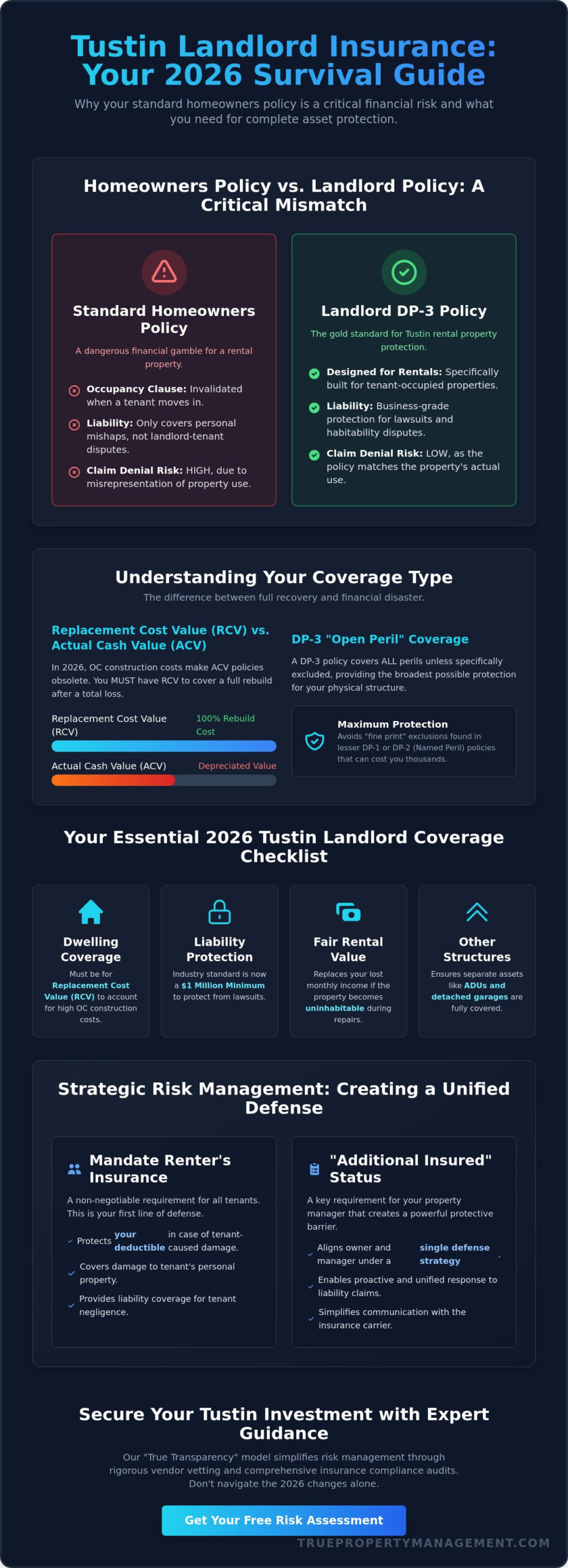
Many investors believe their primary residence policy can simply extend to cover a rental. This assumption is a dangerous financial gamble. Most homeowners policies contain a strict “Occupancy Clause” that requires the policyholder to reside in the home as their primary residence. Once you move out and a tenant moves in, the risk profile changes entirely in the eyes of the insurance carrier. If a kitchen fire or a major flood occurs and you haven’t updated your coverage, the company can legally deny the claim based on a material misrepresentation of the property’s use. It isn’t enough to hope for the best; you must ensure your contract is valid before a crisis occurs.
Adhering to landlord insurance policies standards is about more than just physical damage. Tustin landlord insurance requirements in 2026 demand a shift from personal liability to business-grade protection. A standard homeowners policy protects you against personal mishaps, like a guest tripping on a rug during a dinner party. However, it rarely covers the complex liability issues that arise from a landlord-tenant relationship, such as habitability disputes or legal fees from a tenant lawsuit. Transitioning to a dedicated landlord policy immediately is the only way to safeguard your ROI and maintain the proactive asset protection we prioritize at True Property Management.
The DP-3 Policy: The Gold Standard for Tustin Rentals
A DP-3 policy operates on an “Open Peril” basis, which means it covers every type of damage unless the policy specifically excludes it. This is significantly more robust than DP-1 or DP-2 policies, which only cover “named perils” like fire or wind. For serious investors, DP-3 insurance is the primary vehicle for OC rental protection because it provides the broadest possible safety net for the physical structure. Choosing a lesser policy leaves you vulnerable to “fine print” exclusions that can cost you tens of thousands in repairs. Understanding these Tustin landlord insurance requirements ensures you don’t find yourself paying out of pocket for a covered event.
The Financial Danger of Under-Insuring in Orange County
In 2026, Tustin construction costs have reached levels that make older valuations obsolete. If your policy is based on “Actual Cash Value” (ACV), you’ll only receive a payout for the depreciated value of your property. This won’t cover a full rebuild in today’s market. You need “Replacement Cost Value” (RCV) to ensure you can actually restore your asset to its original state after a total loss. We recommend consulting with a local expert to verify your 2026 valuation. This prevents the ACV trap that ruins long-term ROI and ensures your property remains a viable financial engine for years to come.
Essential Coverage Requirements for Orange County Rental Properties
Meeting Tustin landlord insurance requirements means looking beyond the four walls of the main house. Dwelling coverage must account for the specific wildfire risks prevalent in Orange County and the skyrocketing costs of local labor. You also need to protect “Other Structures.” Many Tustin owners have invested in ADUs or detached garages to increase their property value. These assets require separate line item protection to ensure a total loss doesn’t leave you with a massive financial gap. The California Department of Insurance provides detailed frameworks for these coverages, but your local strategy should be even more precise.
Liability protection is the second pillar of your defense. It guards against legal fees and medical claims if someone is injured on your property. In a litigious environment like Southern California, a small oversight can lead to a massive lawsuit. We believe in building a protective barrier around your assets. This involves more than just buying a policy; it requires a proactive approach to maintenance and safety that reduces the likelihood of a claim ever being filed. If you’re unsure if your current limits meet today’s standards, our team can help you review your risk management strategy.
Fair Rental Value: Protecting Your Monthly Cash Flow
Your cash flow is the heartbeat of your investment. If a fire or severe smoke damage makes your property uninhabitable, Fair Rental Value coverage steps in to replace that lost income. Most 2026 policies offer 12 or 24 months of coverage. In a high demand market like Tustin, reconstruction can take longer than expected due to permitting and contractor availability. Having this protection ensures you can still pay your mortgage and property taxes while the building is offline. It’s a vital safety net that keeps your business running even when the property is empty.
Liability Limits: How Much is Enough for Tustin?
A $300,000 liability limit might have worked a decade ago, but it’s dangerously low today. Recent jury verdicts for habitability and personal injury in California now frequently exceed $1 million. We recommend a base liability limit of $1 million for all single family rentals. If you own multi unit properties, a $2 million to $5 million umbrella policy is a smart move. This is a core part of any plan to maximize rental income while protecting your entire portfolio from a single, devastating lawsuit.
The Tenant Side: Requiring Renters Insurance in Tustin
Mandating a renters insurance policy (HO-4) is a non-negotiable step for any serious investor. It serves as a critical secondary barrier that protects your own policy from minor, tenant-caused incidents. Without this requirement explicitly stated in your lease, you’re often left holding the bill for a tenant’s negligence. Integrating this mandate into your Tustin landlord insurance requirements strategy ensures that the responsibility for personal accidents stays exactly where it belongs. It’s a simple, proactive measure that saves thousands of dollars in potential out-of-pocket expenses over the life of a tenancy.
The liability shift is perhaps the most significant benefit of this requirement. When a tenant’s pet causes an injury or a small kitchen fire occurs, their insurance carrier handles the medical costs or repair fees. This keeps your claims history clean, which is the only effective way to combat the rising premiums we’re seeing across California in 2026. This strategy also protects your deductible. If a tenant causes $2,500 in water damage and your deductible is $5,000, you’d normally pay the full repair cost yourself. With a mandated policy in place, the tenant’s insurance can cover that damage, preserving your cash flow and maintaining your ROI.
Naming the Landlord as “Additional Interested”
We emphasize True Communication during the tenant screening process to ensure applicants understand their insurance obligations. You should always be listed as “Additional Interested” on their policy. Unlike the Additional Insured Requirement often found in commercial contracts, being “Additional Interested” (or a “Party of Interest”) ensures the insurance company notifies you if the tenant cancels their policy or lets it lapse. This provides a hassle-free way to verify that coverage remains active throughout the entire lease term without you having to manually check in every month.
What Renters Insurance Does Not Cover
It’s essential to educate tenants on what their policy actually covers to avoid future conflict. While their HO-4 policy protects their personal belongings and liability, it never covers the building’s physical structure. Clarifying this early is a hallmark of True Transparency. If a tenant loses their expensive electronics in a flood caused by a pipe burst, they need to know their policy is their only recourse. Setting these expectations during onboarding eliminates the “who pays for what” argument before it starts, ensuring your management experience remains professional and organized.
Strategic Risk Management: The ‘Additional Insured’ Requirement
Naming your management firm as an “Additional Insured” on your landlord policy is a non-negotiable standard for high-level asset protection. It’s fundamentally different from the “Additional Interested” status we discussed regarding tenant policies. This specific endorsement creates a “Unity of Interest” between you and the team handling the daily risks of your property. Without it, your insurance carrier could pay a claim and then sue your property manager to recover their losses through a process called subrogation. This creates a massive conflict of interest and unnecessary legal friction. In 2026, most reputable carriers allow you to add this to your Tustin landlord insurance requirements for little to no cost, ensuring the party managing the risk is actually protected by the policy.
Professional management involves making hundreds of small decisions that impact your liability. From coordinating a roof repair to handling a tenant dispute, your manager acts as your agent. If a lawsuit arises from these actions, both parties are usually named in the suit. By including your manager as an “Additional Insured,” you ensure that one insurance company handles the entire defense. This prevents finger-pointing between different carriers and keeps your legal strategy cohesive. If you want to see how this fits into a broader strategy for your portfolio, contact us for a risk audit today.
Legal Defense and Shared Liability
A unified defense is critical during a habitability claim or a personal injury suit. It allows for a streamlined response and ensures your management team can act decisively in emergencies without worrying about personal liability gaps. This is a standard requirement for property management Newport Beach CA because it protects the financial success of the partnership. When the manager and owner are on the same page, the insurance carrier can resolve claims faster and with less overhead.
Common Insurance Compliance Gaps
Many landlords fail to update their policies when they transition from self-management to professional oversight. Professional management requires specific coverage nuances, including endorsements for “Wrongful Eviction” or “Libel and Slander,” which protect against the unique risks of the rental industry. Regular policy audits with your Orange County residential property managers are the only way to catch these gaps before they become expensive mistakes. We prioritize True Transparency by ensuring every management action is backed by proper, up-to-date coverage.
How True Property Management Secures Your Tustin Investment
True Property Management doesn’t just manage buildings; we manage risk. Our True Transparency approach means we conduct deep insurance audits to ensure you meet all Tustin landlord insurance requirements before a tenant ever receives a key. We take the logistical headache of paperwork off your plate by directly coordinating with your insurance agent to secure the Additional Insured endorsement. This proactive stance extends to our rigorous vendor vetting process. We verify that every contractor entering your property carries active General Liability and Workers Compensation coverage. This prevents a simple repair from turning into a devastating lawsuit against you or your management firm.
We integrate these insurance standards into our comprehensive california landlord tenant law compliance checks. It isn’t enough to have a strong lease if your insurance coverage doesn’t mirror those legal obligations. By aligning your policy with current state mandates, we create a unified shield for your asset. We act as a protective barrier, positioning ourselves between you and the inevitable logistical hurdles of property ownership. Our goal is your financial success and the long term security of your Orange County portfolio.
Proactive Maintenance as Risk Mitigation
Older Tustin homes often face claim denials due to deferred maintenance. Insurance carriers in 2026 have become much stricter about property condition before they’ll honor a claim. Our rental property maintenance checklist is designed to catch small issues like slow leaks or frayed wiring before they trigger a major loss. Keeping your property in top condition does more than just satisfy your tenants. It helps stabilize your insurance premiums by proving to carriers that the asset is well managed and low risk. This disciplined approach is how we maximize your ROI while minimizing your exposure.
Your Partner in Tustin Asset Protection
Asset protection in the local market requires a partner who is intimately familiar with the Tustin landscape. We’re on a mission to redeem the reputation of property management through integrity and modern, tech forward efficiency. You shouldn’t have to spend your nights worrying about liability gaps or tenant lawsuits. We offer a free rental analysis and risk review to identify exactly where your current strategy might be failing you. Let us handle the complexities while you enjoy the rewards of your investment. Protect your Tustin rental with True Property Management and experience the peace of mind that comes with a professional partnership.
Secure Your Tustin Rental Portfolio for 2026
Protecting your investment in today’s market requires more than just a basic policy. You’ve seen how transitioning to a DP-3 structure and mandating tenant insurance creates a multi-layered defense against claim denials and rising liability costs. Mastering the current Tustin landlord insurance requirements is the difference between a secure asset and a financial liability. We founded True Property Management in 2014 with deep OC roots to provide the specialized, boutique residential management that local owners deserve. Our team stands as a protective barrier, handling the technical endorsements and compliance audits that keep your portfolio safe.
We believe in absolute integrity, which is why we offer a No Hidden Fees Guarantee. You’ll never have to guess about your management costs or the quality of your coverage. Our proactive approach ensures that every risk is anticipated before it impacts your bottom line. Take the next step toward a hassle-free management experience today.
Get a Professional Risk Assessment for Your Tustin Rental and gain the peace of mind that comes with a true partnership. Your financial success is our priority.
Frequently Asked Questions
Is landlord insurance legally required in Tustin, CA?
California state law does not mandate that landlords carry insurance. However, your mortgage lender will almost certainly require a policy as a condition of your loan to protect their financial interest. Most professional property management firms also make specific coverage a requirement of their service agreement to ensure proper risk management and asset protection for all parties involved.
How much does landlord insurance typically cost in Orange County in 2026?
While the statewide average is approximately $810 per year, Tustin landlords should expect different rates based on specific risk factors. For a low risk single family rental, annual costs typically range between $900 and $1,200. If your property is located in a wildfire prone area, premiums can exceed $2,000 due to increased rebuilding costs and stricter 2026 underwriting standards.
Does landlord insurance cover tenant-caused damage?
Your policy generally covers accidental damage caused by tenants, such as a fire or a sudden pipe burst. It’s important to remember that the landlord is typically responsible for paying the deductible in these scenarios. This financial gap is a primary reason why we advocate for requiring tenants to carry their own insurance to help offset these costs and protect your long term ROI.
Can I require my Tustin tenants to have renters insurance?
You can and should mandate renters insurance in your lease agreement. This requirement ensures that the tenant’s personal property is protected and provides a liability shield for incidents like dog bites or small kitchen fires. It’s a standard part of meeting modern Tustin landlord insurance requirements and maintaining a proactive, professional management strategy that reduces your personal exposure.
What is the difference between “Additional Insured” and “Additional Interested”?
“Additional Insured” status provides the named party with actual liability coverage and a shared legal defense under your policy. In contrast, “Additional Interested” is simply a notification status. It ensures that the property manager or landlord receives an alert if the tenant’s policy is cancelled, changed, or allowed to lapse during the tenancy, allowing for immediate corrective action.
What happens if my rental property is vacant for more than 30 days?
Most standard landlord policies contain a vacancy clause that may reduce or void coverage if the home is empty for more than 30 or 60 consecutive days. Vandalism and glass breakage are often the first coverages excluded during vacancy. If you’re between tenants for an extended period, you should notify your agent to add a vacancy rider to maintain your protection.
Does landlord insurance cover flood or earthquake damage in Tustin?
Standard landlord policies specifically exclude damage caused by floods or earth movement. Given the regional risks in Orange County, you must purchase separate policies or specific endorsements for these perils. We recommend reviewing your property’s flood zone status and seismic risk with an expert to determine if this additional layer of asset protection is necessary for your portfolio.
Why won’t my homeowners insurance cover my rental property?
Homeowners insurance is designed for owner occupied residences and includes a strict occupancy clause. Once you stop living in the home and start collecting rent, the risk profile changes significantly. If you fail to switch to a landlord specific policy, your carrier can deny claims for major events like fires or liability lawsuits because the property’s use was misrepresented on the original application.