
Would you hand over $2,993 of your rental income just to reclaim your own property? In the current market, a single “no-fault” eviction notice for a two-bedroom unit in Costa Mesa triggers exactly that in mandatory relocation assistance. It’s understandable if you feel overwhelmed by the growing list of administrative hurdles and shifting state mandates. You shouldn’t have to feel like a legal expert just to manage your own doors, yet the friction between California’s AB 1482 and local ordinances makes it harder than ever to protect your bottom line. Understanding landlord rights in Costa Mesa California is no longer just about knowing the law; it’s about securing your financial future against costly compliance errors.
We believe your property should be an asset, not a source of legal anxiety. This guide provides the definitive roadmap for 2026 to help you stay ahead of the latest 8.7 percent rent increase caps and the city’s specific “Just Cause” requirements. You’ll learn how to navigate the new mandatory appliance standards under AB 628 and why the recent decision to forgo a local rental registry changes your immediate reporting obligations. We are here to provide the local expertise and professional confidence you need to maintain a high-performing portfolio while avoiding the disputes that drain your time and resources.
Key Takeaways
- Learn to balance California’s AB 1482 rent caps with Costa Mesa’s specific Just Cause ordinances to ensure your property remains profitable and compliant.
- Identify the critical legal differences between at-fault and no-fault evictions to avoid mandatory relocation payments and potential litigation.
- Master your landlord rights in Costa Mesa California regarding property entry and maintenance to protect your physical asset while respecting current privacy laws.
- Understand the 2026 standards for security deposit limits and electronic refund requirements to streamline your move-out financial processes.
- Discover how professional property management bridges the “compliance gap” to shield your investment from evolving local regulatory risks and administrative burdens.
Understanding Landlord Rights in Costa Mesa: State vs. Local Ordinances
Operating a rental property in Orange County requires a precise understanding of how state mandates intersect with city specific rules. While California’s Tenant Protection Act (AB 1482) established a statewide framework for rent caps and “just cause” evictions, the city of Costa Mesa has implemented its own layer of local protections that take precedence in several key areas. For investors, landlord rights in Costa Mesa California are fundamentally tied to a “compliance first” strategy. You maintain the right to manage your property and generate a return, but these rights are contingent upon strictly following a complex hierarchy of laws.
The Costa-Hawkins Rental Housing Act remains a vital shield for your investment, as it prevents the city from imposing rent control on single family homes or setting “vacancy control” prices. This means you still have the right to set rent at market rates when a new tenant moves in. However, once a tenant is in place, you must adhere to the current 8.7 percent rent increase cap effective through July 2027. Your right to profit is legally protected only when your administrative workflow is bulletproof.
The Impact of Costa Mesa Ordinance 23-1412
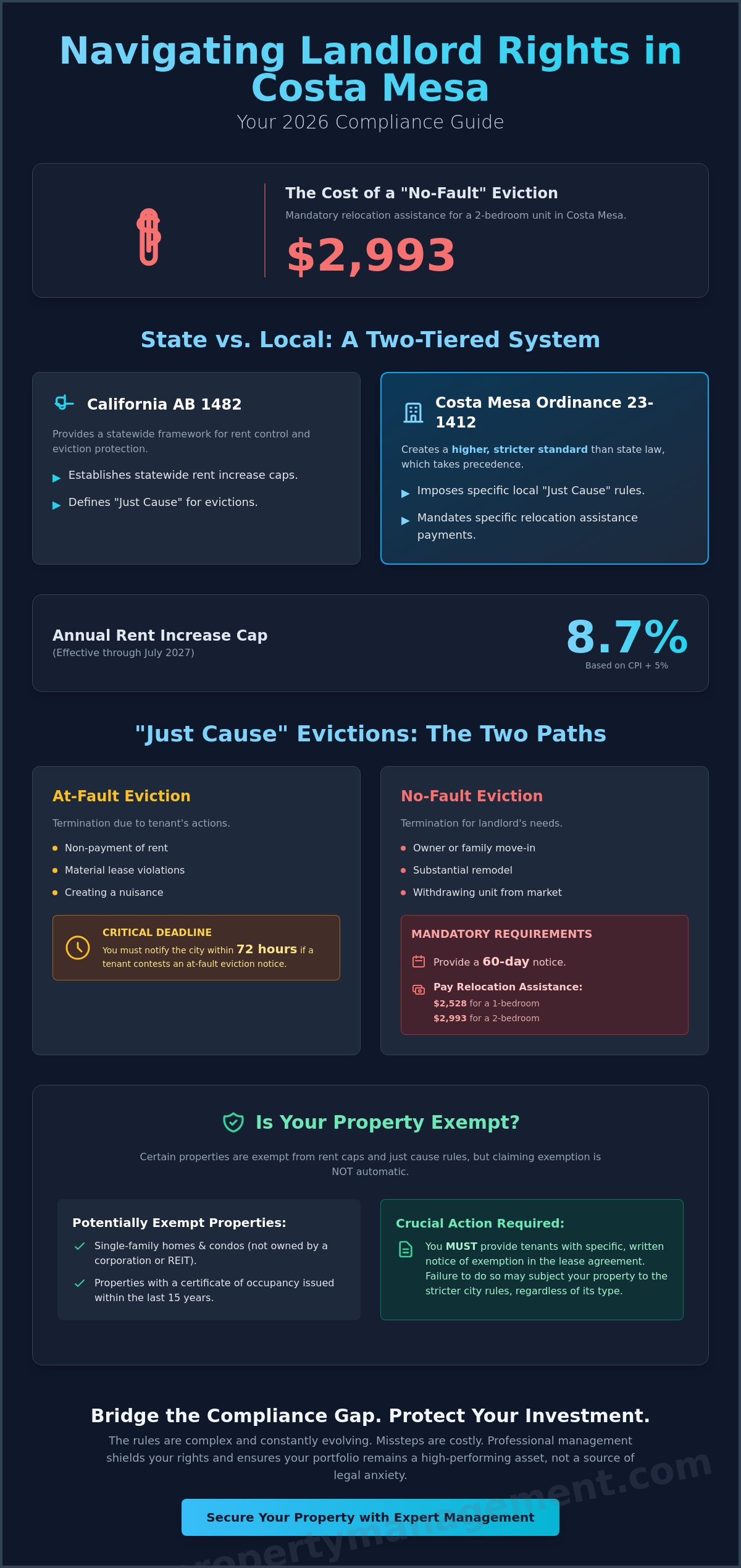
Costa Mesa’s local “Just Cause” ordinance, which became effective November 7, 2023, creates a higher bar for owners than standard state law. Under this ordinance, your right to terminate a tenancy is divided into “at-fault” and “no-fault” categories. If you’re pursuing a no-fault eviction, such as for a substantial remodel or owner move-in, you must provide a 60 day notice. Most importantly, you’re required to pay relocation assistance equal to one month of the Fair Market Rent (FMR). As of June 2026, this means a payout of approximately $2,528 for a one bedroom or $2,993 for a two bedroom unit. Failing to offer this payment correctly can void your entire eviction proceeding.
Exemptions and Coverage: Does the Law Apply to You?
Not every property is subject to these restrictive local rules, but claiming an exemption isn’t automatic. Generally, single family homes and condos that are not owned by a corporation or REIT are exempt from the rent caps and just cause rules. Newer builds, specifically those issued a certificate of occupancy within the last 15 years, also fall outside these constraints. To secure your landlord rights in Costa Mesa California, you must provide your tenants with a specific written notice of exemption. If this language isn’t included in your lease or a separate disclosure, you may be held to the stricter standards regardless of your property type. Documenting your property’s status today is the only way to prevent a costly legal dispute tomorrow.
Just Cause Evictions: Your Right to Terminate Tenancy in 2026
Terminating a tenancy in Costa Mesa requires more than just a valid reason; it requires a surgical approach to documentation. While the law recognizes your right to remove tenants who violate their lease, your success depends on how you categorize the termination. Under current California Landlord-Tenant Law, every eviction must fall under “At-Fault” or “No-Fault” just cause. You maintain the right to evict for non-payment of rent, material lease violations, or maintaining a nuisance. However, the city now monitors these actions closely to ensure they aren’t used to bypass rent caps.
A critical shift for 2026 involves the city’s new reporting requirement for disputed claims. If a tenant formally contests an at-fault eviction notice, you must notify the city within 72 hours. This reporting window is exceptionally tight. Failing to meet this deadline can stall your legal proceedings, even if the tenant is clearly in the wrong. To protect your landlord rights in Costa Mesa California, you need a system that tracks these communications in real time. Our team at True Property Management specializes in these administrative workflows, ensuring your rights are never compromised by a missed deadline.
Navigating At-Fault Evictions and Disputed Claims
A “contested” eviction occurs the moment a tenant provides a written response challenging the grounds of your notice. Whether they claim the repairs were never made or dispute the late rent calculation, the 72 hour clock starts immediately. You must maintain a rigorous paper trail of all warnings and lease violations to defend your position. For a deeper look at how these local rules fit into the broader regional legal landscape, see our guide to the eviction process in Orange County.
No-Fault Evictions and Relocation Rights
Your right to reclaim your property for an owner move-in or substantial remodeling is protected, but it comes with a financial obligation. In Costa Mesa, no-fault terminations require you to pay relocation assistance equal to one month of the Fair Market Rent. For 2026, this ranges from $2,528 to $2,993 depending on unit size. You must also respect the “Right of First Refusal.” If you renovate a property and return it to the market, you must offer the previous tenant the opportunity to move back in at the previous rent plus allowed increases. Missing a single notice requirement in this process can completely invalidate the termination, forcing you to start the 60 day notice period over from scratch.
Protecting the Asset: Rights to Entry, Maintenance, and Security Deposits
Your property is more than just a source of monthly income; it’s a physical asset that requires diligent oversight. While tenant privacy is a cornerstone of California law, it doesn’t strip you of your right to protect your investment. Landlord rights in Costa Mesa California include the legal authority to enter your property under Civil Code 1954 for essential inspections, necessary repairs, and showings to prospective buyers or tenants. Exercising these rights correctly is your first line of defense against deteriorating property conditions and “habitability” claims that can derail your financial returns.
Effective January 1, 2026, AB 628 mandates that landlords must provide and maintain a working stove and refrigerator in most residential units. This new requirement reinforces the need for a robust maintenance strategy. You have the right to enforce “House Rules” that require tenants to maintain a specific standard of cleanliness and care. By being proactive, you mitigate the risk of legal disputes. If a tenant’s negligence leads to damage beyond normal wear and tear, you maintain the right to deduct those repair costs from the security deposit, provided you follow the strict documentation protocols required by the state.
Legal Entry and Notice Protocols in Costa Mesa
Standard procedure requires a 24 hour written notice before entering a tenant’s home. This notice must state the date, approximate time, and purpose of the entry. Emergency exceptions, such as a burst pipe or a gas leak, allow for immediate access without prior notice. We recommend using proactive property inspections to document the unit’s condition at least twice a year. If a tenant repeatedly refuses access for valid reasons, they’re in breach of their lease agreement. You have the legal right to issue a “perform covenant or quit” notice to resolve these access issues before they escalate into a larger dispute.
Security Deposits and 2026 Compliance
The landscape for security deposits shifted significantly with AB 12, which limits the maximum deposit to one month’s rent for all units. In 2026, you must also comply with AB 414. This law requires that if a tenant pays rent electronically, you must refund their deposit electronically unless you both agree otherwise in writing. You still have 21 days after move out to provide an itemized statement and return the remaining funds. To survive a challenge in Small Claims court, every deduction must be backed by “documented” repair costs, including photos of the damage and copies of the invoices. Clear communication during the move out process protects your reputation and your wallet.
The Costa Mesa Rental Registry: Compliance as a Right-Protector
The landscape of rental property oversight in Costa Mesa reached a turning point on March 18, 2026. After significant deliberation, the City Council decided not to implement a mandatory rental registry. This decision is a major victory for owners who were concerned about the administrative burden and privacy implications of a centralized database. However, this victory comes with a new set of expectations. While there’s no city database to join, your landlord rights in Costa Mesa California are now more dependent than ever on your internal record-keeping. The city has shifted its focus toward the “Network for Renters’ Solutions,” an educational initiative designed to ensure both parties understand their legal standing.
Even without a formal registry, your right to issue rent increases or proceed with an eviction is tied to your ability to prove compliance. If a dispute reaches the city’s new network or a courtroom, you must be able to produce a clear history of rent levels, lease disclosures, and maintenance records. The “Right to Compliance” means that in the absence of a government registry, you must act as your own registrar. Failing to maintain these records leaves you vulnerable to “bad faith” claims from tenants that can stall your investment goals. To ensure your documentation is bulletproof, consider our Legal Compliance and Risk Management services to bridge the gap between city expectations and your daily operations.
Registration Requirements and Local Oversight
While you aren’t required to upload data to a housing database, you must still maintain a valid Costa Mesa business license. This remains the primary way the city tracks rental activity. During the registry debate, the city identified specific data points they value, including unit counts and occupancy status. We recommend keeping this information organized and ready for disclosure if a tenant initiates a mediation through the city. Verifying your business license status and having your 2026 exemption notices documented will prevent tenants from successfully claiming you are operating outside of local law.
The Network for Renters’ Solutions and Eviction Tracking
The city uses the Network for Renters’ Solutions to monitor the health of the local housing market. Although there are no penalties for “non-registration” of a unit, there are severe consequences for failing to report contested at-fault evictions within the 72 hour window discussed earlier. Accurate, voluntary reporting of your property’s status is your best defense against accusations of retaliatory behavior. By maintaining consistency between your lease agreements and the data you provide to city mediators, you project an image of a disciplined, professional investor who is fully in control of their operations. This transparency often de-escalates conflicts before they turn into costly legal battles.
Professional Management: Shielding Your Rights in a Changing Market
The “Compliance Gap” is the space where good intentions meet bad outcomes. For many self-managed owners, the sheer volume of 2026 legislative updates is staggering. Between the 8.7 percent rent cap and the specific notice requirements for Costa Mesa’s Just Cause ordinance, a single misstep can cost you thousands in relocation fees or lost rent. Professional oversight isn’t just a convenience; it’s a financial necessity. True Property Management serves as a robust shield, ensuring your landlord rights in Costa Mesa California are defended through proactive Legal Compliance and Risk Management.
Our team understands that Newport Beach, Irvine, and Costa Mesa each have distinct local nuances. While state law provides the foundation, these local variations determine the actual success of your investment. By positioning ourselves as a protective barrier, we handle the logistical burdens so you can focus on your financial growth. We don’t just react to changes; we anticipate them. This high-level partnership is based on mutual respect and a shared goal of long-term financial success, moving you away from the friction of daily property hurdles.
True Property Management’s Approach to Costa Mesa Compliance
We maintain a constant presence at city council meetings and monitor every legislative shift in real time. Our proprietary systems are designed for precision, handling everything from electronic security deposit refunds to the mandatory 72-hour reporting of contested evictions. Even with the city’s decision to forgo a formal registry, our automated tracking ensures you’re always ready to prove your property’s legal standing. This level of detail is how we maximize rental income while keeping your portfolio strictly within the lines of the law.
Peace of Mind for Real Estate Investors
Investing in real estate should provide security, not stress. When disputes arise, the emotional toll can be as heavy as the financial one. We act as the professional buffer, managing tenant dialogues and regulatory requirements with calm, authoritative confidence. Our methodology reduces the cost of eviction disputes by ensuring every notice is served correctly the first time. You deserve a partner who values your time as much as your resources and possesses the regional expertise to navigate a complex market. Protect your investment with True Property Management’s expert oversight.
Securing Your Portfolio’s Future in Costa Mesa
The landscape of rental ownership in Orange County has evolved into a high-stakes environment where precision is the only path to peace of mind. Protecting your landlord rights in Costa Mesa California requires more than just a standard lease agreement; it demands a proactive approach to the 8.7 percent rent caps and the city’s specific relocation assistance mandates. By mastering the 72-hour reporting window for contested evictions and maintaining documented repair costs for security deposits, you transform compliance from a burden into a strategic advantage. These steps ensure your physical asset and your financial returns remain protected against shifting legal tides.
Founded in 2014 by Michael Chiusano, True Property Management has spent over a decade refining a proprietary methodology that shields owners from logistical and legal friction. We provide the deep expertise in Orange County local ordinances and comprehensive Legal Compliance and Risk Management you need to maintain your ROI without the administrative stress. You don’t have to navigate these shifting regulations alone. Secure Your Rental Investment with True Property Management and reclaim your time. We’re ready to help you thrive in the 2026 market.
Frequently Asked Questions
What are the new Just Cause eviction rules in Costa Mesa for 2026?
Costa Mesa Ordinance 23-1412 requires landlords to provide a specific written notice for all evictions, classifying them as either at-fault or no-fault. For 2026, the primary focus is on the city’s heightened tracking of no-fault terminations. You must provide a 60-day notice for no-fault cases and follow strict city-mandated language to preserve your landlord rights in Costa Mesa California. Failing to include specific legal disclosures can lead to the immediate dismissal of your case in court.
Do I have to pay relocation assistance if I evict a tenant in Costa Mesa?
Yes, you must pay relocation assistance for no-fault evictions equal to one month of the Fair Market Rent. As of June 2026, this typically amounts to $2,528 for a one-bedroom unit and $2,993 for a two-bedroom unit. This payment is a mandatory requirement under local law and must be provided within 15 days of serving the notice. If you fail to provide these funds on time, the eviction notice is considered legally invalid.
What is the Costa Mesa Rental Registry and is it mandatory for all landlords?
As of March 18, 2026, the Costa Mesa City Council decided not to implement a mandatory rental registry. While this relieves the immediate administrative burden of a centralized database, you are still required to maintain a valid city business license. You should keep meticulous internal records of all lease agreements and rent levels. These documents are essential to defend your compliance during any city-led mediation or dispute resolution through the Network for Renters’ Solutions.
Can I still evict a tenant for non-payment of rent in Costa Mesa?
You maintain the right to evict for non-payment of rent, as this remains a recognized at-fault just cause. The process begins with a standard 3-day notice to pay or quit. If the tenant contests the notice, you must comply with the new local reporting rule. This requires you to notify the city of the dispute within 72 hours to ensure your legal proceedings remain on track and compliant with local oversight.
How often can I increase the rent on my Costa Mesa property in 2026?
You can increase the rent once every 12 months, provided the increase does not exceed the state-mandated cap. For the period ending July 31, 2027, the maximum increase is 8.7 percent for covered properties. This figure is calculated as 5 percent plus the 3.7 percent Consumer Price Index for the region. Always verify if your specific property type is subject to these caps, as newer builds and certain single-family homes may be exempt.
What happens if I fail to report a contested eviction to the City of Costa Mesa?
Missing the 72-hour reporting deadline for a contested at-fault eviction can significantly delay your legal timeline. The city monitors these reports to prevent retaliatory behavior and ensure transparency. If you fail to notify the city within this window, a judge may view the omission as a procedural error. This could force you to restart the entire eviction process from the beginning, resulting in months of lost rental income and additional legal fees.
Are single-family homes exempt from Costa Mesa’s local tenant protections?
Most single-family homes and condos are exempt from local rent caps and just cause rules if they are not owned by a corporation or REIT. However, this exemption is not automatic. To protect your landlord rights in Costa Mesa California, you must provide your tenants with a specific written notice of exemption. This disclosure must be included in the lease agreement or provided as a separate addendum to be legally enforceable under current state and local standards.
How does AB 1482 interact with Costa Mesa’s local ordinances?
AB 1482 provides the statewide baseline for tenant protections, but Costa Mesa’s local ordinances take precedence whenever they offer greater protections. In practice, this means you must follow the stricter local rules for relocation payments and notice periods while still adhering to the statewide 8.7 percent rent cap. Navigating this intersection requires careful attention to both city and state timelines to avoid compliance gaps that could leave your investment vulnerable to litigation.