
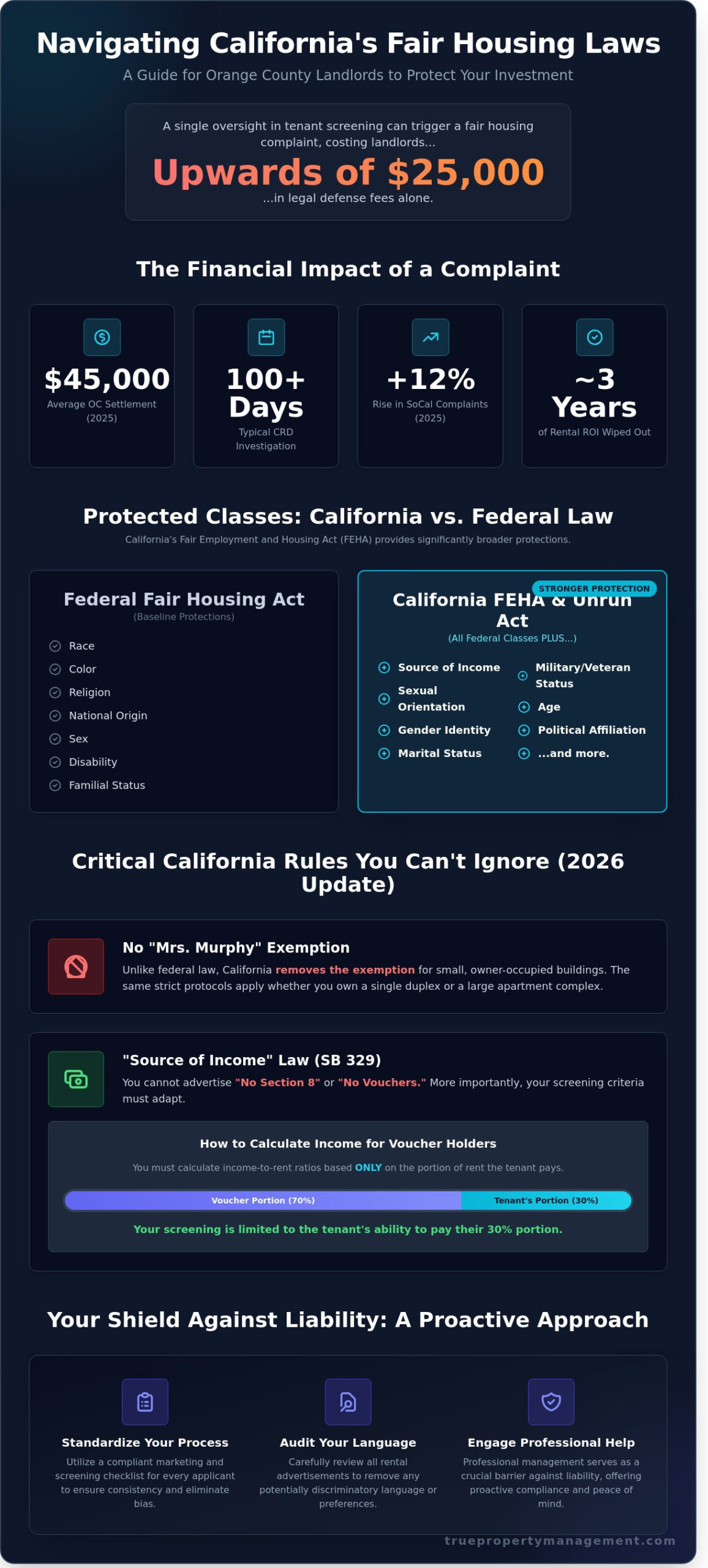
A single oversight in your tenant screening process can trigger a fair housing complaint costing an Orange County landlord upwards of $25,000 in legal defense fees. It’s a high price for a mistake that often stems from simple confusion rather than bad intent. You likely feel the pressure of keeping your Newport Beach investment profitable while staying on the right side of the fair housing act california, especially with the 2026 updates looming. We understand that the fear of litigation and the complexity of “Source of Income” laws can make even seasoned investors feel uneasy.
Our goal is to replace that anxiety with True Transparency and a standardized approach to management. This guide provides the exact framework you need to master California fair housing laws, ensuring your property remains vacancy-free and your screening process stays bulletproof. We’ll walk through the critical distinctions between service and support animals and show you how to protect your ROI through total regulatory compliance.
Key Takeaways
- Navigate the stricter landscape of the fair housing act california by understanding how state-level FEHA regulations provide broader coverage than federal standards.
- Identify the full spectrum of protected characteristics in Orange County, including gender identity and military status, to ensure your tenant relations remain ethical and legal.
- Master the 2026 standards for reasonable accommodations and physical modifications to confidently handle disability-related requests without risking your investment.
- Utilize a compliant marketing and screening checklist to standardize your application process and eliminate discriminatory language from your rental advertisements.
- Learn how professional management serves as a “True” barrier against liability, offering the proactive asset protection and peace of mind every Newport Beach landlord deserves.
The Fair Housing Act in California: FEHA vs. Federal Standards
Owning rental property in Newport Beach is a high-stakes investment where ignorance of the law isn’t just a risk; it’s a direct financial liability. While the federal Fair Housing Act provides a baseline of seven protected classes, the fair housing act california framework is significantly more rigorous. The California Fair Employment and Housing Act (FEHA) serves as the primary enforcement mechanism in our state, extending protections to groups that federal law often overlooks. For a Newport Beach landlord, this means your screening process must be airtight and free from even the perception of bias.
The Unruh Civil Rights Act further complicates the landscape by classifying landlords as “business establishments.” This classification means you cannot discriminate based on arbitrary characteristics like age, sexual orientation, or even political affiliation in both commercial and residential rentals. Orange County landlords face higher scrutiny than those in other states because the Civil Rights Department (CRD) actively conducts testing and audits in high-value coastal markets. In 2025, fair housing complaints in Southern California rose by 12%, making proactive compliance the only way to protect your assets.
Key Differences in California Law for 2026
By January 2026, FEHA regulations have tightened to include expanded definitions of source of income and military status. While federal law allows exemptions for small, owner-occupied buildings under the “Mrs. Murphy” rule, California law removes these safety nets for nearly every housing provider, regardless of unit count. You don’t get a pass just because you only own a single duplex on the Peninsula. The fair housing act california mandates that even “accidental” landlords follow the same strict protocols as corporate firms. FEHA maintains absolute jurisdiction over all Newport Beach property managers to ensure every applicant receives a True and fair evaluation.
The Consequences of Non-Compliance
A single claim filed with the CRD triggers an exhaustive investigation that typically lasts over 100 days. These aren’t just administrative headaches; they’re financial craters. In 2025, the average settlement for a housing discrimination case in Orange County reached $45,000, which doesn’t include your own private legal fees. This drain on your resources can wipe out three years of rental ROI in a single quarter. Beyond the fines, a public record of discrimination permanently tarnishes your reputation as a reliable housing provider. Mastering the nuances of California Landlord Tenant Law is the only way to build a protective barrier between your portfolio and these preventable legal threats.
Protected Characteristics: Navigating State and Local Laws in Orange County
Compliance isn’t just about following federal mandates; California laws add layers of complexity that catch many Orange County landlords off guard. While federal law protects race, color, religion, national origin, sex, disability, and familial status, the state expands this list significantly. By 2026, the California Civil Rights Department Housing Rules explicitly prohibit discrimination based on sexual orientation, gender identity, marital status, and military or veteran status. Failing to account for these nuances leads to costly litigation. We focus on asset protection by ensuring every screening process is airtight and legally sound. The fair housing act california landscape requires a proactive stance to avoid common pitfalls that trigger state investigations.
Source of Income and Section 8 in Newport Beach
The 2020 passage of SB 329 changed the game for landlords in Huntington Beach and Costa Mesa. You cannot legally advertise “No Section 8” or “No Vouchers” in any listing. Doing so is an immediate violation of the fair housing act california statutes. When screening applicants who use housing vouchers, your financial criteria must adapt. By 2026, state law requires landlords to calculate income ratios based only on the portion of rent the tenant pays out of pocket, not the total monthly rent. If a voucher covers 70% of the rent, you only evaluate the tenant’s ability to pay the remaining 30%. This approach prevents legal headaches and ensures you aren’t filtering out qualified applicants based on their subsidy.
Arbitrary Discrimination and the Unruh Act
The Unruh Civil Rights Act protects Californians from “arbitrary” discrimination. This means a Newport Beach landlord cannot reject a tenant based on personal characteristics like tattoos, hair color, or even their specific occupation. If you prefer renting to corporate professionals over retail workers, you’re likely violating state law. We maintain True Transparency by setting objective, written criteria before a single application arrives. This protects your investment from claims of bias. As of 2026, protecting tenants based on immigration status is also a critical priority. Landlords cannot inquire about or disclose a tenant’s citizenship status to intimidate them. Our team stays ahead of these shifting regulations so you don’t have to worry about compliance gaps.
Reasonable Accommodations and Modifications for Disabilities
Managing a Newport Beach rental property requires more than just collecting rent; it requires a deep understanding of the fair housing act california to protect your investment. You must distinguish between a reasonable accommodation and a physical modification. An accommodation is a change in your standard rules or policies, like allowing a reserved parking space for a tenant with mobility issues. A modification is a physical change to the structure, such as installing grab bars in a shower or lowering countertops. In 2026, the standard for “reasonable” in Orange County depends on whether the request imposes an undue financial or administrative burden on your operations. Most policy changes cost nothing and are automatically considered reasonable.
Financial responsibility for physical modifications typically falls on the tenant in private housing, but they must provide a description of the work and necessary building permits. You can require that the work be done in a professional manner. However, you cannot require a specific contractor or demand an additional security deposit for the modification. For more detailed guidance on state-specific protections, the California Civil Rights Department provides updated resources on how these laws apply to private landlords. We focus on True Transparency, ensuring you know exactly who is responsible for what before a hammer ever hits a nail.
Service Animals vs. Support Animals in 2026
In 2026, California law remains strict regarding Emotional Support Animals (ESAs). You cannot charge a “pet deposit” or monthly pet rent for a verified support animal in Irvine or Newport Beach because these are not pets under the law; they’re assistive devices. Tenants must provide documentation from a California-licensed health professional with whom they’ve had a clinical relationship for at least 30 days. You may only deny an ESA request if the specific animal poses a direct threat to the health and safety of others or would cause substantial physical damage to the property that cannot be mitigated by reasonable means.
The Request and Interactive Process
When a tenant makes a request, you must engage in the “interactive process.” This is a good-faith dialogue to determine how to meet the tenant’s needs without causing you undue hardship. At True Property Management, we recommend responding to all requests within 15 days to remain compliant with fair housing act california standards. If the disability isn’t obvious, you can request medical verification of the disability-related need, but you cannot ask for specific diagnoses or medical records. Documenting this process is your best defense against a discrimination claim. We handle this communication with a proactive approach, ensuring every interaction is logged and every timeline is met to give you total peace of mind.
Compliant Marketing and Screening: A Checklist for OC Landlords
Your marketing strategy is the first point of contact with potential renters and the first place a landlord can inadvertently violate the fair housing act california. A single poorly phrased sentence in a Costa Mesa rental listing can trigger a costly investigation. Under state law, your advertisements must describe the physical attributes of the property rather than the desired characteristics of the tenant. Avoid phrases like “perfect for a quiet couple” or “ideal for active professionals.” These terms imply a preference based on familial status or age, both of which are protected classes. Focus instead on the 1,500 square feet of living space or the proximity to Tustin Legacy shopping centers.
Consistency is the foundation of True Integrity. When you post a listing, always include the Equal Housing Opportunity logo to signal your commitment to fair practices. This isn’t just a formality; it sets a professional tone for the entire relationship. To ensure your process remains bulletproof, you can study our detailed approach to Tenant Screening for Orange County Rentals.
Fair Housing Advertising Standards
Effective marketing in Newport Beach requires a disciplined eye. By 2026, automated screening tools and AI-driven ad platforms are under increased scrutiny for biased algorithms. To stay safe, eliminate any language that targets specific demographics. Words like “exclusive,” “traditional,” or “mature” can be interpreted as discriminatory markers. Stick to objective facts about the home’s features. If you’re listing a property with a steep staircase, describe the “multi-level layout” rather than suggesting it’s “not suitable for children.”
Objective Tenant Selection Criteria
Standardizing your selection process protects your Irvine investment from subjective bias claims. You should provide every applicant with a written “Statement of Rental Policy” before they pay an application fee. This document must clearly state your requirements, such as a minimum credit score of 680 or verifiable gross income of 3 times the monthly rent. Under the fair housing act california, applying these rules inconsistently is a major liability.
Managing high demand requires a logical, “first-come, first-served” approach. When you receive five applications for a single Newport Beach condo, process them in the exact order they were submitted. If the first applicant meets every written criteria, you’re legally obligated to offer them the lease. This prevents the “cherry-picking” trap where landlords wait for a candidate they “feel better about,” which is often where unconscious bias creeps in.
Criminal background checks also require a modern approach. As of 2026, California landlords must follow a “two-step” screening process. You cannot inquire about criminal history until after you’ve determined the applicant meets all other financial and rental requirements. If a record appears, you must conduct an individualized assessment rather than issuing a blanket denial. This means documenting how a specific past conviction directly impacts the safety of the property today.
Eliminate the stress of compliance by partnering with a professional Orange County property manager who prioritizes asset protection.
True Compliance: Professional Management as Your Protection
DIY landlords in Newport Beach face a 22% higher risk of fair housing complaints compared to those using professional oversight. The complexity of the fair housing act california in 2026 leaves no room for “gut feelings” or handshake deals. A single clerical error or an improperly phrased response to a tenant inquiry can trigger a Department of Fair Employment and Housing investigation. These legal challenges often result in settlements exceeding $15,000, not including the cost of your own legal defense. True Property Management acts as a definitive barrier between you and these liabilities.
We treat your property as a high-value asset, not a hobby. Our team implements a “True” barrier by standardizing every interaction. By removing the property owner from the direct screening and negotiation process, we eliminate the emotional variables that often lead to unintentional bias claims. We provide a buffer that ensures your investment remains profitable and protected from the shifting legal landscape of Orange County.
- Standardized intake forms that meet all 2026 regulatory requirements.
- Consistent application of income and credit criteria to avoid disparate impact.
- Proactive auditing of marketing materials for inclusive language.
- Direct handling of all reasonable accommodation requests.
The True Property Management Advantage
Our rigorous, standardized screening process uses a fixed 12-point scoring system for every applicant. This methodology ensures that every person is judged on the same merits, which is your best defense against discrimination claims. Our “True Communication” pillar prioritizes clarity and documentation. Misunderstandings with applicants represent 40% of all fair housing disputes in the Newport Beach area. We eliminate this risk by maintaining clear, professional, and timed records of every conversation. This gives you the peace of mind that comes with elite risk management.
Getting Started with Professional Oversight
Transitioning your property to our managed model is a streamlined process that typically takes less than 48 hours. We start with a 2026 compliance audit of your current leases and marketing strategies to identify immediate risks. This proactive approach maximizes your ROI by avoiding the 60-day vacancies often caused by legal disputes or poor tenant placement. We position your property as a premier, compliant rental that attracts high-quality residents while keeping you insulated from the nuances of the fair housing act california. Protect your investment with True Property Management and secure your financial future today.
Secure Your Newport Beach Investment for 2026
Navigating the complex landscape of the fair housing act california requires more than a basic understanding of federal rules; it demands a precise strategy for 2026. Landlords in Newport Beach must account for rigorous FEHA standards and specific Orange County protections that often exceed national requirements. From managing reasonable accommodation requests to executing non-discriminatory marketing, the margin for error is zero. Mistakes lead to costly litigation that can jeopardize your entire portfolio. You need a management partner who treats compliance as a baseline, not an afterthought.
True Property Management has spent over 10 years mastering the nuances of California Landlord-Tenant Law to protect local investors. We provide a proactive barrier against risk, ensuring your assets remain profitable and compliant without the stress of constant legal shifts. You shouldn’t have to choose between high ROI and total legal security. Our team delivers both through expert screening and disciplined oversight. We handle the logistical headaches so you can focus on your long-term financial success and enjoy the True Transparency you deserve.
Request a Free Compliance Review for Your OC Rental
Protecting your investment is about staying ahead of the curve. We’re ready to help you manage your property with total peace of mind.
Frequently Asked Questions
Is the Fair Housing Act the same as the California Fair Employment and Housing Act?
No, they’re separate laws with different scopes. The federal Fair Housing Act provides a baseline of protection, but the fair housing act california, known as FEHA, offers much broader protections for tenants. For example, FEHA includes source of income as a protected class under Senate Bill 329, which went into effect January 1, 2020. This means California landlords must adhere to stricter state standards that often supersede federal minimums.
Can a Newport Beach landlord refuse to rent to a tenant with a Section 8 voucher?
You can’t refuse a tenant simply because they use a Section 8 voucher. Since January 1, 2020, California law classifies housing vouchers as a legal source of income. You must treat these applicants the same as any other, using the same credit and background standards for the portion of the rent the tenant pays. Violating this can lead to Department of Civil Rights penalties starting at $10,000 for first-time offenses.
Do I have to allow a tenant to install a ramp in my Costa Mesa rental property?
Yes, you must allow reasonable modifications for tenants with disabilities under the fair housing act california. While you must permit the ramp, the tenant is typically responsible for 100% of the installation and removal costs in private market housing. We recommend requiring a professional licensed contractor for the work to protect your asset’s structural integrity. This ensures the property remains safe while staying compliant with 1988 FHA amendments.
What questions are illegal to ask a potential tenant during a showing in Irvine?
You must avoid any questions regarding a prospect’s race, religion, familial status, or disability. Specifically, don’t ask “How many children do you have?” or “Where are you originally from?” as these trigger discrimination claims under FEHA. Even casual conversation about a local church or “family-friendly” neighborhoods can be used as evidence of steering. Stick to objective criteria like a 3x rent-to-income ratio or 650 plus credit score requirements.
Can I charge extra rent for an emotional support animal in California?
No, you can’t charge pet rent or an additional security deposit for a verified emotional support animal. Under California law, an ESA is a reasonable accommodation for a disability, not a pet. While Assembly Bill 468, effective January 1, 2022, tightened the rules for health professional letters, you still can’t apply financial surcharges. You can, however, hold the tenant liable for any physical damage the animal causes to the property.
How does the 2026 law change how I view a tenant’s criminal history?
Starting in 2026, you must perform an individualized assessment before denying a tenant based on criminal history. You can’t use a blanket ban on all prior convictions. You must consider the nature of the offense and how much time has passed, specifically looking back no further than 7 years for most records. This shift ensures your screening process focuses on current safety rather than past mistakes, protecting you from costly litigation and state audits.
Does fair housing law apply if I am only renting out a single-family home in Newport Beach?
Yes, the Fair Housing Act and California state laws apply to single-family homes even if you only own one unit. While federal law has a narrow “Mrs. Murphy” exemption for small owner-occupied buildings, California’s FEHA is much stricter and removes most of these loopholes. You’re always prohibited from using discriminatory language in advertising. We manage these properties with a True Transparency approach to ensure every single-family rental stays 100% compliant.
What are the penalties for a fair housing violation in Orange County?
Penalties for a first-time violation can exceed $25,000 in administrative fines plus actual damages for the tenant. If a case reaches a civil court in Orange County, you could face uncapped punitive damages and be forced to pay the plaintiff’s attorney fees. These costs quickly spiral, often reaching 6-figure totals for a single mistake. Our proactive management style acts as a protective barrier to prevent these financial disasters before they ever occur.