
Did you know that despite the City Council rejecting the proposed citywide rental registry in March 2026, Costa Mesa landlords are still subject to some of the most specific relocation payment mandates in Orange County? Staying compliant with Costa Mesa landlord-tenant laws requires more than just a passing glance at state manuals; it demands a hyper-local strategy. We understand the anxiety that comes with managing a property in a city where 60% of residents are renters and the legal landscape shifts with every council session.
It’s natural to feel overwhelmed by the intersection of the new 8.7% rent cap and the specific HUD Fair Market Rent values you must pay if a no-fault eviction occurs. You deserve the peace of mind that comes from knowing your investment is shielded from costly litigation and administrative errors. This guide provides the clarity you need to master 2026 compliance, from electronic security deposit refunds to the new appliance repair timelines under AB 628. We will examine the exact financial figures for relocation assistance and the essential “just cause” protections that keep your rental business running smoothly and profitably.
Key Takeaways
- Identify the specific 12-month residency threshold that triggers the Costa Mesa Tenant Protections Ordinance to ensure you apply “just cause” requirements correctly.
- Distinguish between at-fault and no-fault evictions to properly manage documentation and relocation assistance payments tied to HUD Fair Market Rent.
- Implement the 8.7% rent increase cap for 2026 and adhere to the one-month security deposit limits established by AB 12.
- Stay informed on the latest updates to Costa Mesa landlord-tenant laws, including the City Council’s 2026 decisions regarding rental registries and reporting mandates.
- Leverage professional legal compliance and risk management to bridge the gap between complex state laws and local ordinances, securing your investment’s future.
Understanding the Costa Mesa Tenant Protections Ordinance (TPO)
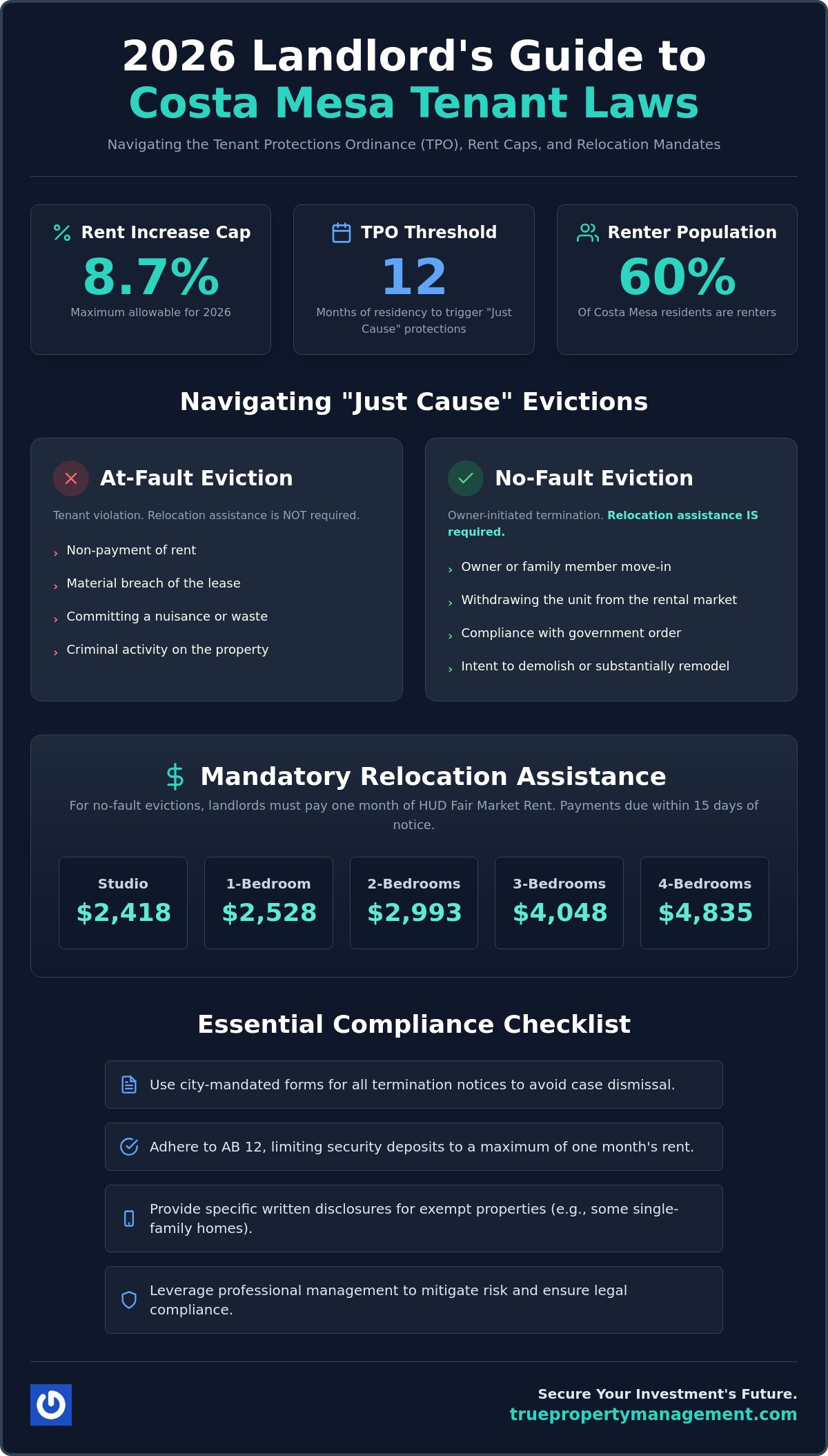
Costa Mesa’s Tenant Protections Ordinance (TPO), which took effect in late 2023, represents a significant shift in how owners must manage their local portfolios. While California state law provides a broad foundation, the city’s local ordinance adds specific layers of complexity that directly impact your operational risk and financial planning. The TPO primarily safeguards tenants who have occupied a unit for at least 12 months. Once this residency threshold is met, you cannot simply choose not to renew a lease. You must instead provide a “just cause” for termination. This requirement makes Costa Mesa landlord-tenant laws more stringent than many other Orange County jurisdictions. To remain compliant, owners must use specific city-mandated forms for termination notices, as any deviation in wording can lead to a dismissed case in court.
Costa Mesa TPO vs. California AB 1482
The interplay between local and state regulations often creates confusion for DIY landlords. AB 1482, the California Tenant Protection Act, serves as the baseline for much of the state, but the Costa Mesa TPO acts as a “gap” protection. It covers many residents who might otherwise fall through the cracks of state-level legislation. It’s vital to recognize that while statewide rent control laws limit the city’s ability to set price ceilings on certain newer buildings, the TPO still dictates the procedural mechanics of ending a lease. Certain single-family homes and condos are exempt from these rules, but only if the owner provides very specific written disclosures to the tenant. If you haven’t updated your lease agreements to include these local disclosures, you might be following state law while simultaneously violating Costa Mesa landlord-tenant laws.
Relocation Assistance Requirements
For no-fault evictions, such as an owner move-in or a necessary substantial remodel, the financial burden shifts directly to the landlord. Under the Costa Mesa TPO, you’re required to provide relocation assistance equal to one month of the current HUD Fair Market Rent (FMR). These figures are updated annually and represent a fixed cost you must budget for when planning property transitions. For 2026, the relocation amounts for Orange County are as follows:
- Studio: $2,418
- 1-Bedroom: $2,528
- 2-Bedrooms: $2,993
- 3-Bedrooms: $4,048
- 4-Bedrooms: $4,835
This payment must be provided to the tenant within 15 days of serving the termination notice. You can provide this either as a direct payment or as a rent credit for the final month of occupancy. Failing to provide these funds on time doesn’t just frustrate the process; it completely invalidates the termination notice. This means you’d have to start the entire legal process over, leading to extended vacancies and unnecessary legal fees. We prioritize precision in these calculations to ensure your transitions are seamless and your capital is protected.
Navigating “Just Cause” Evictions in Costa Mesa
The distinction between at-fault and no-fault evictions is the cornerstone of your legal safety net. Under Costa Mesa landlord-tenant laws, “at-fault” causes include non-payment of rent, material breach of the lease, or creating a nuisance. These are direct violations by the tenant. Conversely, “no-fault” causes occur when you, as the owner, choose to reclaim the property for reasons like an owner-occupancy move-in or withdrawing the unit from the market entirely. Each path carries a different set of procedural hurdles. Failing to categorize your termination correctly can lead to a summary judgment against you, often resulting in the tenant remaining in the unit while you foot the bill for their legal fees.
Documenting Lease Violations
In the current regulatory climate, “handshake” agreements or verbal warnings are practically invisible to the court. If a tenant is violating lease terms, you must utilize a formal “Notice to Cure.” This document gives the tenant a specific window to rectify the behavior. Without this paper trail, proving a “just cause” becomes nearly impossible. We find that the most effective way to avoid these confrontations is through rigorous tenant screening. By placing high-quality residents from the start, you significantly reduce the likelihood of ever needing to document a violation. Clear, written communication serves as your first line of defense.
No-Fault Termination Pitfalls
If you plan to move into your own property or house a direct relative, you must act in good faith. Costa Mesa rules require that the owner or relative actually occupy the unit as their primary residence for at least 12 months. Attempting a “bad faith” eviction just to reset market rents is a high-risk gamble that often leads to heavy penalties. Similarly, if you’re pursuing a substantial remodel, the work must be extensive enough to require a permit and at least 30 days of vacancy. Simple cosmetic updates like new flooring or paint don’t qualify as a “substantial remodel” under the law. You must also adhere to the Ellis Act if you’re withdrawing the property from the rental market entirely, which involves specific timelines and filings.
The local legislative landscape remains active and sometimes unpredictable. While the City Council recently considered The 2026 Costa Mesa Rental Registry and a proposal to report all contested evictions, both measures were rejected on March 17, 2026. This decision spares owners from additional fees and administrative reporting for now. However, the documentation required to defend an eviction in court remains as high as ever. If you’re feeling uncertain about your current lease language, our team at True Property Management can review your portfolio to ensure every document is airtight. We believe in proactive management that stops legal disputes before they begin, ensuring your Costa Mesa landlord-tenant laws compliance remains flawless.
Rent Control and Security Deposit Limits in 2026
Managing the financial aspects of your rental requires strict adherence to both state mandates and local expectations. Under AB 1482, the maximum allowable rent increase for covered properties in Orange County is 8.7% for the period beginning August 1, 2026. This figure is the sum of the 5% base and the 3.7% Consumer Price Index (CPI). If you fail to calculate this correctly or serve the notice improperly, you risk a legal challenge that could freeze your income for another year. Proper service requires a written 30-day notice for increases. In a city where half of the tenants are rent-burdened, precision in your Costa Mesa landlord-tenant laws compliance isn’t just about the law; it’s about maintaining a stable, professional relationship with your residents.
Security deposit regulations have also tightened significantly to lower the barrier for renters. As of July 2024, AB 12 capped most security deposits at just one month’s rent, regardless of whether the unit is furnished. While there’s a narrow exception for small landlords owning no more than two properties totaling four units or fewer, most owners must adapt to this lower threshold. Additionally, 2026 brings new rules like AB 1414, which mandates that landlords allow tenants to opt out of bundled third-party internet fees. These “junk fees” are increasingly targeted by California regulators, making transparent lease agreements essential for protecting your reputation and your bottom line.
Setting Market Rent in Costa Mesa
Underpricing your unit at the start of a tenancy is a mistake that can haunt your ROI for years. Because annual increases are capped, starting below the curve means you may never catch up to true market value. A professional market rent analysis ensures you begin at the highest defensible rate. This strategy balances the need for long-term tenant retention with the necessity of maintaining your property’s financial health against rising insurance and maintenance costs. We help you find that “sweet spot” where your income is maximized without increasing vacancy risks.
Security Deposit Accounting
The timeline for returning deposits remains one of the most litigated areas of Costa Mesa landlord-tenant laws. You have exactly 21 days after a tenant vacates to provide either a full refund or an itemized statement detailing any deductions. You cannot charge for “normal wear and tear,” such as minor scuffs or carpet aging. Mismanaging this process can lead to a lawsuit in small claims court where a judge might award the tenant treble damages. New for 2026, AB 414 requires you to offer electronic refunds if the tenant paid rent electronically, adding a layer of technological compliance to your move-out process.
The 2026 Costa Mesa Rental Registry: What Owners Must Do
On March 17, 2026, the Costa Mesa City Council made a pivotal decision that directly impacts your administrative workload. They officially rejected the proposal for a citywide rental registry and mandatory at-fault eviction reporting. This move followed intense debate regarding the costs and privacy concerns associated with such a database. While some proponents argued a registry would help track market rates and disputes, the council opted for a less intrusive approach. For now, you aren’t required to register your units or pay associated fees. This provides a significant reprieve, but it doesn’t mean you can relax your record-keeping standards. The legislative climate remains active, and the city is instead exploring a “Network for Renters’ Solutions” focused on education.
The proposed registry would have required owners to submit unit counts, current rent amounts, and vacancy statuses. It also included a controversial “3-day rule” for reporting contested at-fault evictions to the city. Although these mandates are off the table, staying current with Costa Mesa landlord-tenant laws still requires you to have these data points ready if a dispute arises. The absence of a formal registry actually puts more pressure on you to maintain impeccable internal records. If a tenant challenges a rent increase or an eviction, your internal documentation is the only thing standing between you and a costly legal setback.
Data Privacy and Landlord Rights
One of the primary reasons for the registry’s rejection was the concern over data privacy and the administrative burden on housing providers. Owners were rightly anxious about how their financial data and property details would be used or shared. The City Council recognized that a mandatory database could create a barrier to entry for smaller landlords, potentially decreasing the available housing stock. By avoiding a public registry, your proprietary business data remains private. We believe this respects the professional boundaries necessary for financial success and maintains the standard of veracity we bring to our management partnerships.
Registry Compliance Checklist
Even though registration isn’t mandatory, we recommend following a “shadow” compliance strategy. This ensures that if the city revisits this proposal or if state laws change, you’re already prepared. Use this checklist to audit your portfolio and ensure your Costa Mesa landlord-tenant laws compliance is airtight:
- Step 1: Audit all current lease agreements. Ensure every contract reflects the 2026 security deposit limits and the 8.7% rent cap disclosures we discussed previously.
- Step 2: Consolidate eviction and dispute history. Keep a clean, chronological ledger of all “Notice to Cure” filings and their resolution outcomes.
- Step 3: Update contact information. Ensure your business license and emergency contact info on file with the City of Costa Mesa are current to receive official legislative updates.
If you’re concerned about how these shifting local policies affect your long-term ROI, we can help. Our Legal Compliance and Risk Management services are designed to act as a protective barrier between you and the city’s evolving legislative environment. We handle the complex documentation and reporting requirements so you can focus on your portfolio’s growth with total peace of mind.
Mitigating Risk with Professional Property Management
The “compliance gap” is where many well-meaning owners find themselves when local rules diverge from state standards. DIY landlords are often targeted in legal disputes because they lack the rigorous documentation systems required by Costa Mesa landlord-tenant laws. Without a professional partner, it’s easy to miss a 30-day appliance repair deadline under AB 628 or fail to provide the mandatory internet service opt-out required by AB 1414. We bridge this gap by acting as a protective barrier, ensuring every disclosure is signed and every timeline is met. Viewing property management fees as a tax-deductible insurance policy is a strategic move for the modern investor. It transforms a logistical burden into a streamlined financial asset.
Habitability disputes are a primary source of legal friction in Costa Mesa. New state laws for 2026, such as AB 628, mandate that rental units include working refrigerators and stoves, with a strict 30-day window for repairs or replacements after a recall notice. Our 24/7 emergency response system ensures that these critical issues are addressed before they escalate into “repair and deduct” scenarios or health department complaints. By maintaining a high standard of care, we protect the physical integrity of your asset while shielding you from the aggressive litigation often seen in Costa Mesa landlord-tenant laws cases. This proactive stance on maintenance is the difference between a thriving investment and a legal liability.
Our Approach to Legal Compliance
Our methodology relies on automated systems that remove the guesswork from your operations. We track annual rent increases to ensure they never exceed the 8.7% cap, protecting you from the penalties of overcharging. Standardized move-in and move-out inspections are conducted with digital precision, creating a standard of veracity that defends your security deposit withholdings in small claims court. When it comes to property maintenance, we coordinate repairs with licensed vendors who understand the urgency of habitability mandates. This ensures your units remain compliant and your tenants remain satisfied, reducing the risk of costly turnover.
Peace of Mind for Real Estate Investors
Successful real estate investment is a marathon, not a sprint. By delegating the daily friction of tenant relations and legal filings to experts, you position your property for superior long-term appreciation. You shouldn’t have to carry the emotional weight of a contested eviction or the anxiety of a potential fair housing audit. We provide the security and peace of mind that allow you to focus on your broader financial goals. If you’re ready to secure your portfolio against the complexities of 2026, Schedule a compliance audit with True Property Management today. Let’s ensure your investment is built on a foundation of total legal clarity and professional excellence.
Secure Your Portfolio’s Future in Costa Mesa
The legislative landscape in 2026 demonstrates that local oversight is becoming more nuanced, even when specific measures like the rental registry are rejected. You must remain vigilant regarding the 8.7% rent increase cap and the specific relocation assistance payments tied to annual HUD Fair Market Rent values. Mastering Costa Mesa landlord-tenant laws is no longer a part-time job; it requires a dedicated system of documentation and a proactive approach to habitability. Failing to adapt to these hyper-local requirements can quickly turn a profitable asset into a legal liability.
We believe your success as an investor shouldn’t be overshadowed by the fear of non-compliance. With experience managing hundreds of units across Orange County, we provide the expert legal compliance and risk management you need to thrive. Our team handles everything from 24/7 proactive maintenance coordination to precise security deposit accounting, ensuring your properties remain both compliant and profitable. Protect your investment with True Property Management’s compliance experts and regain the peace of mind you deserve. Your investment is safe in our hands, and we’re ready to help you navigate the road ahead with confidence.
Frequently Asked Questions
Does Costa Mesa have its own rent control laws?
Costa Mesa does not currently have its own local rent control ordinance. Instead, the city adheres to the statewide rent cap established by AB 1482. For 2026, the maximum allowable rent increase in Orange County is 8.7%. This limit applies to most multi-family residential properties that are at least 15 years old. Owners must ensure their increases align with these state mandates to remain compliant with Costa Mesa landlord-tenant laws.
What is the “Just Cause” requirement for evictions in Costa Mesa?
The “Just Cause” requirement means that once a tenant has occupied a unit for at least 12 months, you cannot terminate the tenancy without a legally recognized reason. These reasons are split into at-fault causes, such as non-payment of rent, and no-fault causes, such as an owner move-in. The Costa Mesa Tenant Protections Ordinance (TPO) mandates that you use specific city-approved language in your notices to ensure the termination is legally valid.
How much relocation assistance do I have to pay a tenant in Costa Mesa?
For no-fault evictions, you must provide relocation assistance equal to one month of the current HUD Fair Market Rent (FMR). For 2026, these amounts for Orange County include $2,528 for a one-bedroom and $2,993 for a two-bedroom unit. This payment must be delivered to the tenant within 15 days of serving the notice. We recommend verifying the current FMR values annually to ensure your financial planning remains accurate and your legal risk is minimized.
Are single-family homes exempt from Costa Mesa landlord-tenant laws?
Some single-family homes and condominiums are exempt from the just cause and rent cap provisions, but only if the owner is not a corporation and has provided specific written disclosures to the tenant. If you haven’t included this exact language in your lease agreement, the property may still be subject to local protections. It’s vital to audit your contracts to confirm your exemption status and avoid unintentional legal exposure that could lead to costly litigation.
What is the 2026 Costa Mesa Rental Registry?
The proposed 2026 Costa Mesa Rental Registry was officially rejected by the City Council on March 17, 2026. This means landlords are not required to register their properties or pay registration fees at this time. The council chose instead to focus on educational resources for both owners and tenants. While the registry is not in effect, maintaining detailed internal records of rents and vacancies remains a best practice for professional risk management and future compliance readiness.
Can I evict a tenant in Costa Mesa to move into the property myself?
Yes, you can terminate a tenancy for an owner or relative move-in, which is considered a no-fault “just cause.” However, you must act in good faith and the person moving in must intend to occupy the unit as their primary residence for at least 12 months. This process also triggers the relocation assistance requirement, meaning you’ll need to pay the tenant the equivalent of one month’s Fair Market Rent as determined by HUD for the current year.
How often can I increase the rent on my Costa Mesa property?
Under statewide rules, you can increase the rent up to two times within any 12-month period, provided the total increase doesn’t exceed the annual cap of 8.7%. Each increase requires a formal written notice, usually 30 days in advance for increases under 10%. Consistent, incremental increases help you keep pace with rising property taxes and insurance costs without violating Costa Mesa landlord-tenant laws or triggering a dispute with your residents.
What happens if I fail to register my property with the city?
Since the City Council rejected the rental registry proposal in March 2026, there are no penalties for failing to register because the requirement does not exist. You are currently free from registry-related fines or administrative hurdles. However, you must still comply with all other local ordinances, including the Tenant Protections Ordinance, to avoid legal disputes and potential court-ordered damages in the event of a non-compliant eviction or a failure to provide relocation funds.