
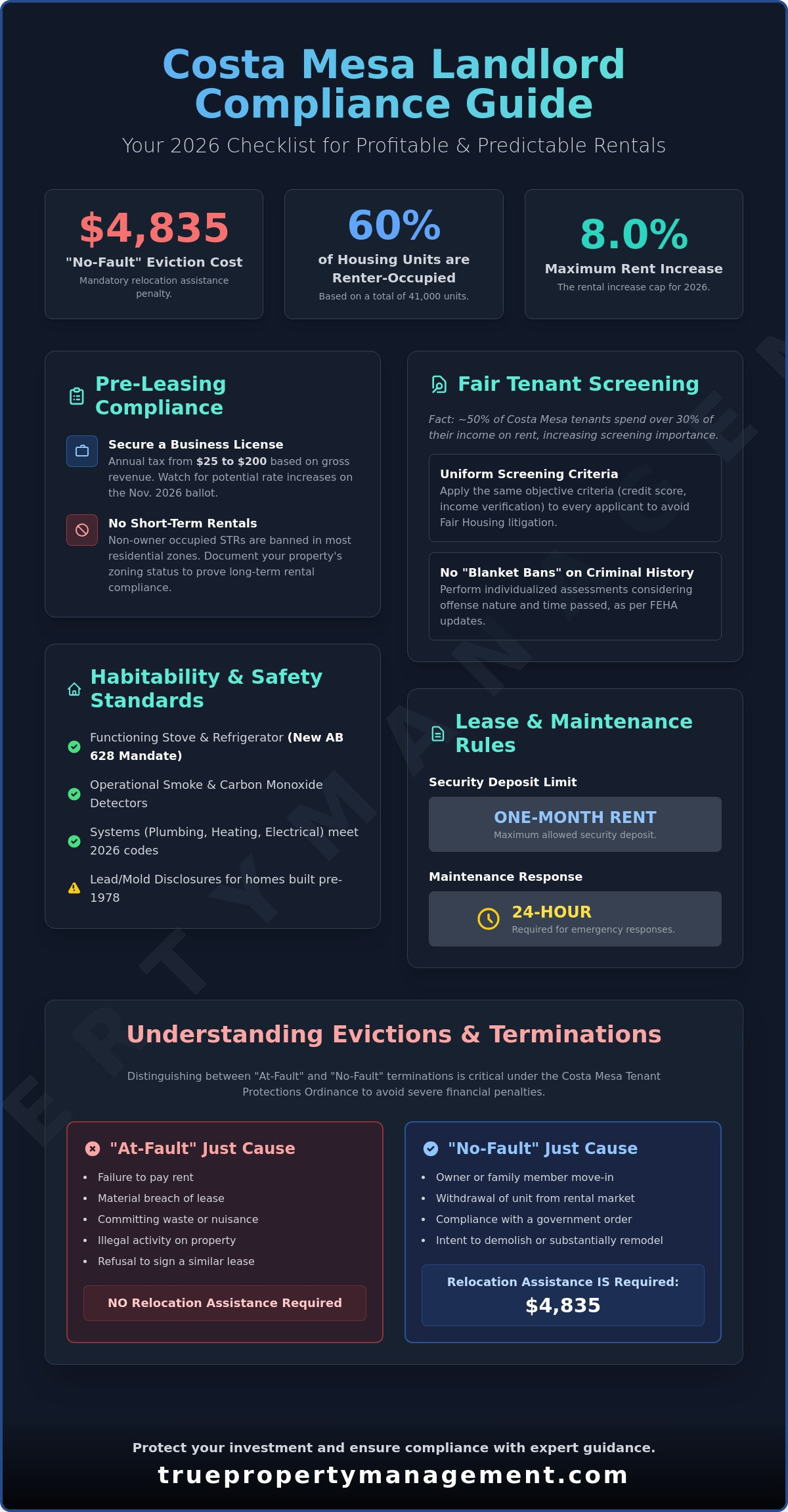
Did you know that a single “no-fault” eviction in Costa Mesa could now cost you as much as $4,835 in mandatory relocation assistance? With 60% of the city’s 41,000 housing units occupied by renters, local officials have tightened the rules to a point where standard state compliance is no longer enough to protect your investment. Understanding your specific Costa Mesa landlord responsibilities California requirements is the only way to shield your real estate asset from aggressive “Just Cause” litigation and unexpected city penalties.
It’s understandable if you feel overwhelmed by the 2026 rent increase cap of 8.0% or the new AB 628 mandate requiring landlords to provide functioning stoves and refrigerators. You deserve a rental process that’s profitable and predictable rather than a source of constant legal anxiety. This guide provides a definitive 2026 compliance checklist to help you master local ordinances and state laws with True Transparency. We’ll break down the latest HUD Fair Market Rent rates, explain the $25 to $200 business license tax structure, and show you how to maintain a high-performing property without the logistical headaches.
Key Takeaways
- Navigate the local short-term rental ban and habitability standards to ensure your property is legally ready for long-term tenants.
- Protect your investment by implementing screening protocols that align with California’s “Source of Income” laws and Fair Housing standards.
- Master your Costa Mesa landlord responsibilities California by including mandatory local disclosures and adhering to the one-month security deposit limit.
- Establish a proactive maintenance rhythm that meets 24-hour emergency response requirements while preserving your property’s long-term ROI.
- Learn to distinguish between “At-Fault” and “No-Fault” terminations to avoid costly relocation assistance penalties under the Costa Mesa Tenant Protections Ordinance.
Costa Mesa Landlord Compliance: The Pre-Leasing Checklist
Success in the Orange County rental market starts long before you hand over the keys. While the City of Costa Mesa recently rejected a proposal for a city-wide rental registry in March 2026, owners still face a web of local requirements that go beyond general U.S. landlord-tenant law. Meeting your Costa Mesa landlord responsibilities California begins with securing a local business license. This tax, which hasn’t seen a rate change since 1985, currently ranges from $25 to $200 based on your annual gross revenue. You should stay alert for the November 2026 ballot; the City Council is actively considering a measure to finally increase these long-standing rates.
Beyond the business license, you must verify if your property falls under the Costa Mesa Affordable Housing Ordinance. This is particularly relevant for those managing multi-unit developments, as it dictates specific inclusionary housing requirements that impact your bottom line. We believe in True Transparency, which means identifying these regulatory hurdles during the pre-leasing phase to protect your ROI from unexpected city citations.
Zoning and Short-Term Rental Restrictions
Costa Mesa maintains a firm stance against non-owner occupied short-term rentals in most residential zones. If you’re caught operating an unlicensed, “hotel-style” rental in 2026, the penalties are aggressive. You don’t want to find yourself on the wrong side of code enforcement. We recommend documenting your property’s specific zoning status immediately to prove compliance. This simple step prevents the city from flagging your long-term rental as an illegal short-term operation, ensuring your asset remains a stable source of income rather than a legal liability.
Habitability and Safety Standards
California Civil Code 1941.1 sets the baseline for habitability, but 2026 brings new, stricter hurdles for local owners. As of January 1, 2026, Assembly Bill 628 requires you to provide a functioning stove and refrigerator in qualifying units. This is a significant shift; these were previously viewed as optional amenities. You must also verify that smoke and carbon monoxide detectors are operational on every level of the home.
If you own one of the many charming older homes in Eastside Costa Mesa, your “True” compliance strategy must include updated disclosures. Lead-based paint and mold disclosures are non-negotiable for properties built before 1978. Ensuring that all plumbing, heating, and electrical systems meet the 2026 building codes isn’t just about following the law; it’s about protecting the long-term value of your real estate investment.
Tenant Screening and Fair Housing in Orange County
Finding the right tenant isn’t just about a gut feeling; it’s a rigorous legal process that requires precision to protect your investment. In Costa Mesa, where city data from March 2026 shows that approximately half of all tenants pay more than 30% of their income toward rent, the pressure to find financially stable residents is high. However, your desire for a reliable tenant must be balanced against strict anti-discrimination laws. Fulfilling your Costa Mesa landlord responsibilities California means implementing a uniform set of screening criteria that applies to every single applicant without exception.
A standardized approach is your best defense against costly Fair Housing Act litigation. When you utilize comprehensive tenant screening, you create a documented trail of objective decision-making. If you must reject an application, you should provide a written notice citing specific, non-discriminatory reasons, such as a credit score below your stated threshold or an inability to verify income. While the California Tenant Protection Act primarily addresses rent caps, the Attorney General’s office remains vigilant about fair access to housing, making your documentation process vital for legal safety.
Avoiding Discriminatory Pitfalls
The 2026 updates to the California Fair Employment and Housing Act (FEHA) have further clarified how landlords must handle criminal histories. You can’t use “blanket bans” that automatically disqualify anyone with a record. Instead, you’re required to perform an individualized assessment. This means considering the nature of the offense and how much time has passed. Your marketing materials should clearly state that you’re an equal housing opportunity provider to set a professional tone from the first interaction. If this level of detail feels daunting, partnering with a firm that provides expert tenant placement can help insulate you from these risks.
Standardizing the Application Process
Consistency is the hallmark of a professional landlord. You should collect the same documentation from every prospect: recent pay stubs, bank statements, and at least two prior landlord references. It’s also essential to understand “Source of Income” protections, which state that you cannot legally refuse a tenant because they use a Section 8 voucher or other government subsidies to pay their rent. Always run credit checks and eviction histories through verified, third-party services to ensure the data you’re using is both accurate and compliant with 2026 privacy standards. This proactive discipline ensures you’re building a community of high-quality residents while keeping your asset secure.
Lease Agreements and Required Costa Mesa Disclosures
Your lease agreement is the most critical document in your professional relationship with a tenant. In Costa Mesa, a generic lease from an online template simply won’t cut it. You’re legally required to include the “Costa Mesa Notice of Tenant Protections” in every new agreement or renewal. This isn’t a suggestion; it’s a core part of your Costa Mesa landlord responsibilities California compliance. Failure to include this local disclosure can jeopardize your ability to enforce “Just Cause” terminations later. By aligning your contracts with California landlord tenant law, you’re building a protective barrier around your real estate asset.
We’ve seen many owners struggle with the nuances of the Costa Mesa Tenant Protections Ordinance (TPO), which has been in effect since November 7, 2023. This ordinance requires you to be incredibly specific about why a lease might end. You must explicitly define “Just Cause” provisions within the lease text itself. This includes identifying whether the property is subject to the rent caps and eviction protections of AB 1482. Providing these notices upfront isn’t just about paperwork; it’s about establishing True Transparency from day one.
The 2026 Security Deposit Limit
The days of collecting two or three months’ rent as a security deposit are over for the vast majority of Orange County owners. Under the legislative shift effective throughout 2025 and 2026, security deposits are strictly limited to one month’s rent for residential units. There is a small exception for landlords who own no more than two properties with a total of four units or fewer, but most professional investors must stick to the one-month cap. You also have a non-negotiable 21-day window after a tenant moves out to return the deposit or provide an itemized list of deductions. California Civil Code Section 1950.5 governs the strict timeline and documentation required for these security deposit returns.
Mandatory Local Disclosures
Beyond security deposits, your lease must address the physical state of the property to meet the implied warranty of habitability. This means including mandatory disclosures for lead-based paint, mold, and bed bugs. If your property is located in a designated flood zone, that notification must be clearly presented in the lease to avoid future legal disputes. You should also provide the “Notice of Termination of Tenancy” form approved by the City of Costa Mesa as part of your move-in packet. These steps ensure you stay proactive and avoid the “unlicensed hotel” citations or habitability claims that can sink your ROI.
Property Maintenance and Habitability Standards
Maintaining a rental property in Orange County requires more than just fixing leaks as they happen. It’s about a disciplined approach to asset protection that keeps your investment profitable and your tenants satisfied. Your Costa Mesa landlord responsibilities California include a non-negotiable duty to respond to emergency repair requests within 24 hours. If you fail to address critical issues like a burst pipe or a total loss of heat, tenants may legally exercise “repair and deduct” rights. This can lead to unexpected deductions from your rent checks and complicated financial reporting at year-end. We believe in staying ahead of these issues by keeping meticulous records of every work order and maintenance request.
Every residential lease in California carries an “implied warranty of habitability.” This means you’re legally obligated to provide a unit that’s fit for human occupation, regardless of what the lease says. If a property falls below this standard, a tenant’s obligation to pay rent can be legally suspended. To avoid this scenario, you should implement a consistent rental property maintenance schedule that identifies small problems before they become expensive legal liabilities. If you want to ensure your property always meets these high standards without the 2:00 AM phone calls, you can protect your property with professional maintenance coordination.
Proactive vs. Reactive Maintenance
Reactive landlords wait for things to break, but professional investors look ahead. You should perform seasonal HVAC and roof inspections to prevent emergency failures during the peak of summer or the rainy winter months. It’s essential to document the property’s condition with high-resolution photos before and after every tenancy. This creates a clear evidence trail that protects your security deposit claims. We recommend establishing a “True” partnership with a network of licensed, insured contractors in Costa Mesa who understand the local building codes and can provide priority service when it matters most.
Tenant Rights Regarding Repairs
California law is very specific about when a unit is considered “untenantable.” This includes a lack of effective weatherproofing, plumbing that doesn’t meet code, or a lack of hot and cold running water. When you need to enter a unit for repairs, you must provide a 24-hour written notice unless it’s a true emergency. You also need to be extremely careful about “retaliatory eviction” claims. If a tenant makes a legitimate maintenance request, any attempt to increase rent or terminate the lease shortly after can be viewed as illegal retaliation in court. Staying proactive and communicative is the best way to maintain a high-level partnership with your residents while securing your ROI.
Handling Evictions and Just Cause Terminations in Costa Mesa
Eviction is the most challenging aspect of property ownership, and in Costa Mesa, the legal stakes are higher than in most other California cities. Since the Costa Mesa Tenant Protections Ordinance (TPO) took effect on November 7, 2023, owners have had to navigate a dual layer of compliance. You must satisfy both the statewide California Tenant Protection Act and the city’s specific “Just Cause” requirements. Fulfilling your Costa Mesa landlord responsibilities California means you can’t simply terminate a month-to-month lease without a recognized legal reason once a tenant has occupied the unit for 12 months.
You need to clearly distinguish between “At-Fault” and “No-Fault” terminations. An at-fault eviction occurs when a tenant violates the lease, such as through non-payment of rent or criminal activity. In these cases, you’ll typically serve a 3-Day Notice to Pay or Quit. Conversely, a no-fault termination happens for reasons outside the tenant’s control, such as an owner move-in or a government order to vacate. Because the legal landscape is so unforgiving, many owners choose to consult with Orange County property managers to ensure every form and timeline is executed with True precision.
Costa Mesa Relocation Assistance Requirements
The biggest financial hurdle for Costa Mesa owners is the local relocation assistance mandate. While state law (AB 1482) generally requires one month’s rent as relocation aid, Costa Mesa’s TPO uses the HUD Fair Market Rent (FMR) as the baseline. This often results in a higher payout for the owner. For the 2026 period starting October 1, 2025, the relocation assistance amounts are set at specific rates: $2,528 for a one-bedroom, $2,993 for a two-bedroom, and up to $4,835 for a four-bedroom unit. You must provide this payment within 15 days of serving the termination notice, or you can choose to waive the tenant’s final month of rent in writing. Missing this 15-day window can invalidate your entire eviction effort and leave you vulnerable to a lawsuit.
The Legal Eviction Process
The 2023 Costa Mesa Urgency Ordinance defines “Just Cause” as a mandatory prerequisite for ending a tenancy, removing the old “no-cause” flexibility landlords once enjoyed. If you’re proceeding with an at-fault eviction, you must follow the strict judicial process. This begins with the proper notice and ends with an unlawful detainer judgment. Only the Orange County Sheriff has the legal authority to perform the final “lockout” process; you must never attempt to change locks or cut off utilities yourself. By maintaining a disciplined, document-heavy approach, you protect your real estate asset’s ROI and avoid the costly legal penalties that come from procedural errors.
Securing Your Future in the Costa Mesa Market
The landscape for rental owners in 2026 is significantly more complex than it was even two years ago. From the one-month security deposit limit to the new appliance mandates under AB 628, staying compliant requires constant vigilance. Successfully managing your Costa Mesa landlord responsibilities California means more than just collecting rent. It involves navigating high-stakes relocation fees that can reach $4,835 and avoiding the pitfalls of “Just Cause” litigation that often follow procedural errors.
You don’t have to carry this legal burden alone. With over 10 years of dedicated Orange County expertise, we provide the protective barrier your investment needs to thrive. We offer expert legal compliance and risk management backed by our signature zero-hidden-fee guarantee. This ensures your ROI remains the priority while we handle the logistical headaches of property management with True Transparency. We’ve already anticipated the hurdles of the 2026 market so you don’t have to.
Protect your investment with True Property Management’s compliance-first services.
Take the next step toward a stress-free rental process. Your asset is valuable, and with the right local partner, you can achieve the financial security and peace of mind you deserve.
Frequently Asked Questions
Does Costa Mesa have rent control in 2026?
Yes, Costa Mesa follows the California Tenant Protection Act (AB 1482) for most multi-unit properties. For the period of August 1, 2025, through July 31, 2026, the maximum allowable rent increase is 8.0%. This is calculated by combining the 5% state base with the 3.0% Consumer Price Index (CPI) specific to the Los Angeles-Long Beach-Anaheim region. You must verify if your property is exempt before issuing any increase.
How much relocation assistance must I pay in Costa Mesa?
Relocation assistance in Costa Mesa is based on the current HUD Fair Market Rent (FMR) rather than the tenant’s actual rent. For 2026, these mandatory payments range from $2,418 for a studio to $4,835 for a four-bedroom home. You’re required to provide this payment within 15 days of serving a no-fault termination notice, or you can choose to waive the final month’s rent in writing to satisfy the requirement.
Can I evict a tenant in Costa Mesa to move into my own property?
Yes, an owner move-in is a recognized “No-Fault” just cause for eviction under local ordinances. However, you must intend to occupy the unit as your primary residence for at least 12 consecutive months. Because this is a no-fault termination, you’re still obligated to pay the city-mandated relocation assistance. Failing to follow these specific steps can lead to costly “Just Cause” lawsuits and administrative penalties.
What is the maximum security deposit I can charge in California now?
As of July 1, 2024, most landlords are limited to collecting a security deposit of one month’s rent. There’s a narrow exception for small landlords who own no more than two properties with a total of four units or fewer; they may collect up to two months’ rent. Understanding these limits is a vital part of your Costa Mesa landlord responsibilities California checklist to avoid legal disputes during the move-in process.
Are short-term rentals allowed in Costa Mesa?
Non-owner occupied short-term rentals are generally banned in Costa Mesa’s residential zones. The city enacted this ban to preserve housing for long-term residents and maintain neighborhood stability. Operating an unlicensed short-term rental can result in aggressive code enforcement citations. We recommend focusing on long-term leasing strategies that align with local zoning laws to protect your real estate asset’s long-term ROI and stability.
What happens if I fail to provide the Costa Mesa Tenant Protections notice?
Failing to include the mandatory “Costa Mesa Notice of Tenant Protections” in your lease can invalidate your ability to terminate a tenancy. The city requires this specific disclosure to ensure tenants are aware of their rights under the local ordinance. If you omit this document, a court may dismiss your eviction filing, forcing you to restart the process and potentially pay the tenant’s legal fees.
Do I need a business license to rent out a single-family home in Costa Mesa?
Yes, all landlords in Costa Mesa must pay a business license tax to the city. The annual rate has remained unchanged since 1985 and typically ranges from $25 to $200 based on your annual gross revenue. Staying current with this tax is a basic requirement for anyone managing Costa Mesa landlord responsibilities California. Be aware that the City Council is considering a ballot measure for November 2026 to increase these rates.
How does AB 1482 interact with Costa Mesa’s local ordinances?
You must maintain dual compliance with both state and local laws. While AB 1482 provides the statewide framework for rent caps and evictions, Costa Mesa’s Tenant Protections Ordinance often sets stricter requirements for relocation assistance and just-cause documentation. When the two laws overlap, you’re generally required to follow the provision that offers the tenant the highest level of protection. This proactive approach ensures your management process remains legally sound and hassle-free.