If a 3:00 a.m. tsunami warning or a sudden flash flood alert hit Surf City tonight, would your response be a frantic scramble or a controlled execution of your Huntington Beach rental property emergency plan? It’s a question that keeps many local owners awake, especially as coastal risks and California’s legal landscape become increasingly complex. You’ve worked hard to build your portfolio, and the last thing you want is for a single disaster to compromise your financial security or lead to a costly liability claim.
We understand that managing a property in a high-stakes environment requires more than just good intentions. With 2026 regulations like SB 610 mandating rent refunds during evacuations and stricter debris removal duties, the margin for error has disappeared. This guide provides the clarity you need to protect your tenants and your bottom line. We’ll walk through a localized checklist for property readiness, explain how to leverage state seismic grants, and show you how a proactive management strategy can turn a potential crisis into a well-handled event.
Key Takeaways
- Understand why a formalized Huntington Beach rental property emergency plan acts as a critical barrier against property devaluation and long-term liability.
- Identify high-risk zones, including tsunami evacuation routes and flood-prone areas near Huntington Harbour, to tailor your safety protocols.
- Learn the physical essentials of property readiness, from mapping critical utility shut-offs to establishing a 24/7 emergency contact hierarchy.
- Meet your legal obligations under California landlord-tenant law by implementing required emergency disclosures and a comprehensive “Tenant Emergency Handbook.”
- Discover how True Property Management leverages an elite vendor network to provide immediate restoration and professional oversight when disaster strikes.
Why Every Huntington Beach Landlord Needs a Formal Emergency Plan
A Huntington Beach rental property emergency plan is far more than a static checklist sitting in a desk drawer. It is a living document designed for active risk mitigation, evolving alongside our coastal environment and shifting state mandates. In 2026, the stakes for property owners have never been higher. Between a volatile insurance market and more stringent habitability requirements, your readiness directly dictates your financial resilience. Without a formalized strategy, a single localized event can spiral from a manageable repair into a catastrophic asset devaluation.
When we develop these protocols, we look to the comprehensive frameworks established by the California Governor’s Office of Emergency Services (Cal OES) to ensure local responses align with state-level recovery standards. This alignment is critical for more than just safety. It’s a financial necessity. Coastal property insurance carriers are increasingly scrutinizing landlord readiness when determining premiums. Owners who can demonstrate a documented, professional response plan are often positioned as lower-risk investments, which is vital for maintaining healthy margins in today’s economy.
Protecting Your Asset Value in Surf City
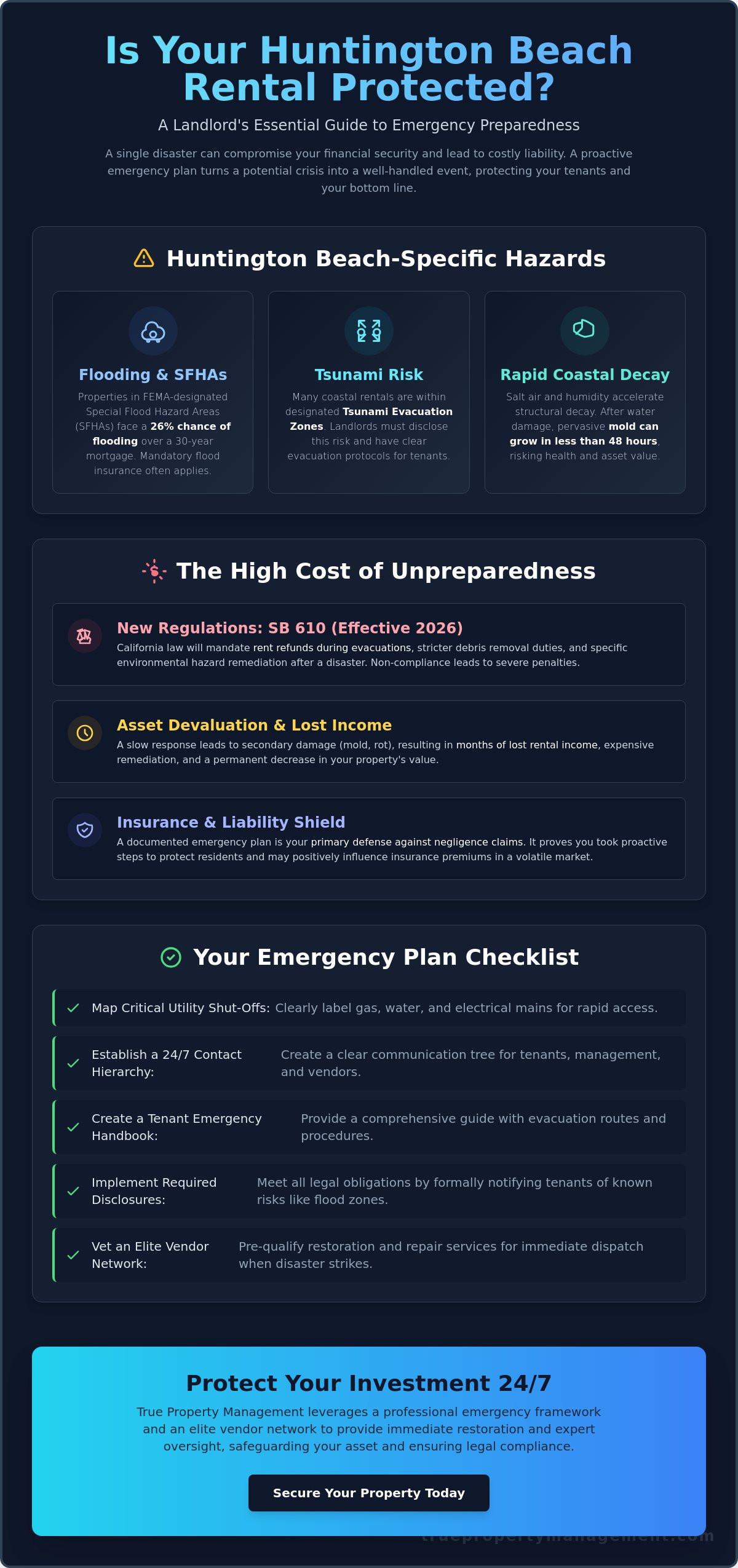
In our unique coastal climate, the window for effective damage control is incredibly narrow. Salt air and high humidity accelerate structural decay, meaning a minor flood or a burst pipe can lead to pervasive mold growth in less than 48 hours. Rapid restoration isn’t just about aesthetics; it’s about preserving the long-term structural integrity of your investment. A formal plan ensures that vetted vendors are dispatched immediately, preventing secondary issues that could lead to months of lost rental income and expensive remediation. By acting fast, you maintain the “habitability” standards required by California law, ensuring your property remains a performing asset rather than a liability.
The Legal Cost of Unpreparedness
The legal landscape for California landlords has shifted significantly as of January 1, 2026. Under SB 610, your responsibilities following a declared disaster, such as a wildfire or flood, now include mandatory debris removal and specific environmental hazard remediation. California courts hold owners to a high “duty of care,” and failing to provide functional safety equipment or clear emergency instructions can result in devastating negligence claims.
Verbal instructions to tenants are no longer sufficient in a modern legal environment. If a tenant is injured or their property is damaged, your Huntington Beach rental property emergency plan serves as your primary evidence of professional conduct. It proves you took reasonable, proactive steps to protect your residents. This documentation is your most effective shield against liability, transforming a chaotic situation into a managed, legally defensible process.
Identifying Coastal Risks: Huntington Beach-Specific Hazards
Developing a Huntington Beach rental property emergency plan requires a deep understanding of our city’s unique geography. Unlike inland Orange County, our properties face a distinct combination of oceanic and seismic threats. Failing to map these risks doesn’t just endanger your tenants; it creates significant gaps in your insurance coverage and legal compliance. Whether your asset is a beach house in Sunset Beach or a multi-unit complex near the downtown core, your preparation must be site-specific.
Tsunami and Flood Zone Awareness
Many local rentals sit within FEMA-designated Special Flood Hazard Areas (SFHAs). In these zones, there is a 26% chance of experiencing a flood during a standard 30-year mortgage. For owners in low-lying areas near the Huntington Harbour or Sunset Beach, this risk is a daily reality. You should regularly consult the official emergency maps provided by the City of Huntington Beach to confirm if your property falls within a Tsunami Evacuation Zone. Properties in these areas require mandatory flood insurance if they have federally backed mortgages. Additionally, any substantial improvements valued at 50% or more of the building’s value must comply with floodplain overlay regulations, which often require structure elevation.
Your disclosure obligations are equally critical. California law requires landlords to notify tenants if a property is in a flood hazard zone. To stay updated on evolving state requirements, you can reference the resources provided by California’s Office of Emergency Services. Proactive structural reinforcements, such as installing flood vents or using water-resistant building materials during renovations, can mitigate physical damage and potentially lower your long-term costs. If managing these technical requirements feels overwhelming, our team specializes in Legal Compliance and Risk Management to ensure your asset stays protected.
Seismic Safety for Older HB Rentals
The Newport-Inglewood Fault runs directly through our region, posing a significant seismic risk that could cause severe structural damage to unreinforced masonry or soft-story buildings during a major earthquake. While Huntington Beach doesn’t currently mandate seismic retrofits, proactive owners are taking advantage of state incentives to secure their investments. For example, owners of one- to four-unit wood-frame homes may qualify for Earthquake Brace + Bolt (EBB) grants of up to $3,000. Larger residential buildings with living spaces over garages, known as soft-story structures, may be eligible for up to $13,000 through the Earthquake Soft-Story (ESS) grant program.
Beyond structural bolting, simple interior safety measures are mandatory under California safety codes. All water heaters must be double-strapped to the wall studs to prevent fires or leaks during a tremor. Securing heavy appliances and ensuring gas shut-off valves are accessible are low-cost steps that significantly reduce your liability. High-wind events and coastal erosion also pose threats to beachside structures, necessitating regular inspections of roofs and balcony railings to prevent injury during a storm. Incorporating these details into your Huntington Beach rental property emergency plan ensures you are prepared for the specific geological realities of the California coast.
The Essential Components of Your Rental Property Emergency Plan
A robust Huntington Beach rental property emergency plan translates high-level risk assessment into tangible, on-site action. It’s the difference between a panicked tenant and a resident who knows exactly where to turn when the pressure rises. To build this framework effectively, you must standardize your property’s physical defenses and your communication hierarchy. This ensures that even if you aren’t physically present, your management system is working to mitigate damage and protect lives. Consistency in these details is what separates professional investors from casual landlords.
Following the Ready.gov emergency planning guidelines is a professional starting point, but your plan must also account for the specific street grid and coastal infrastructure of Huntington Beach. For instance, evacuation routes should be clearly mapped to high-ground assembly points that avoid congested beach boulevards during peak summer months. Beyond physical safety, your plan must include digital document storage. Keeping cloud-based copies of leases, tenant contact info, and insurance policies allows you to coordinate recovery and file claims from any location, even if the property is inaccessible.
Utility Management and Hardware Readiness
Confusion is the enemy of safety during a crisis. Every gas, water, and electrical main must be clearly labeled with durable, weather-resistant tags that any tenant can identify. In our seismic region, installing automatic gas shut-off valves is a critical upgrade that can prevent fires during a tremor. These valves sense significant vibration and disconnect the supply immediately, providing a layer of protection that manual valves cannot match. Regular maintenance isn’t just about repairs; it’s about readiness. Your schedule should include quarterly testing of backup power systems and sump pumps, especially for properties near the Huntington Harbour where rising tides can challenge drainage systems.
The Emergency Supply Kit for Landlords
Your preparation extends beyond the property’s walls. A professional landlord’s emergency kit should include universal shut-off tools, heavy-duty flashlights, and a high-capacity portable charger. More importantly, it must include your 24/7 emergency contact hierarchy. This isn’t just a list of names; it’s a tiered system that prioritizes “first-call” local contractors. When a storm hits, the contractors who handle board-ups and plumbing are flooded with requests. Having a pre-established relationship with a vetted vendor network ensures your property is a priority, not an afterthought.
Additionally, ensure all on-site safety hardware meets the 2026 California fire marshal standards. This includes verifying that smoke alarms and carbon monoxide detectors are not just functional, but within their expiration dates. By centralizing these components within your Huntington Beach rental property emergency plan, you transform a set of instructions into a reliable shield for your investment. This level of organization reduces your liability and provides the peace of mind that comes from knowing you’ve anticipated every hurdle.
Legal Obligations and Communication: Keeping Tenants Safe
Your Huntington Beach rental property emergency plan is only as effective as your ability to communicate it. In a legal environment where tenant protections are expanding, silence is a significant liability. California law requires more than just physical preparation; it mandates specific disclosures and proactive outreach. As of January 1, 2026, SB 610 has codified new responsibilities for landlords following declared disasters. You must now ensure that tenants are not charged rent during mandatory evacuations, and any prepaid rent for that period must be refunded within 10 days of the order being lifted. Failing to manage these financial and communicative nuances can lead to costly disputes and statutory penalties.
Establishing clear communication protocols is the backbone of risk mitigation. While email is excellent for documenting non-urgent updates, a crisis requires immediate action. We recommend using SMS alert systems for urgent property notifications, such as utility failures or localized flood warnings. This ensures the information is seen instantly, providing your residents with the best chance to follow the safety protocols you’ve established. A documented communication log serves as your primary defense if a tenant later claims they weren’t properly informed of a risk.
Tenant Education and Onboarding
Safety begins the moment a tenant receives their keys. A verbal explanation of where the water main is located isn’t enough in 2026. You should provide a comprehensive “Tenant Emergency Handbook” as part of the move-in packet, detailing shut-off locations, evacuation routes, and contact hierarchies. This education process is significantly smoother when you’ve utilized comprehensive tenant screening to place responsible, detail-oriented residents. To keep these details fresh, conduct annual safety walkthroughs. These brief inspections allow you to verify that smoke detectors are active and ensure that tenants still understand how to kill the gas or water in an emergency.
Managing Uninhabitable Conditions
When a disaster or major system failure makes a property uninhabitable, your legal obligations shift toward relocation. Under SB 567, “Just Cause” for temporary relocation includes substantial repairs that cannot be completed safely while the tenant is in possession. In these scenarios, you may be responsible for the tenant’s lodging costs or providing a rent waiver to facilitate the repair process. In 2026, Huntington Beach landlords are legally required to provide relocation assistance or a rent waiver when no-fault just cause circumstances, such as emergency structural repairs, necessitate a tenant’s temporary displacement. Navigating these high-stress transitions requires professional oversight to avoid litigation. If you want to ensure your property remains fully compliant with these evolving laws, our team provides expert Legal Compliance and Risk Management services to protect your interests.
How True Property Management Protects Your Investment 24/7
A Huntington Beach rental property emergency plan is only as strong as the team executing it. While a DIY landlord might struggle to find a plumber at 3:00 a.m. on a holiday weekend, our clients rest easy knowing a professional response is already in motion. We act as the definitive shield between you and the logistical burdens of property ownership. By standardizing emergency oversight, we transform potential disasters into managed incidents, ensuring your asset remains protected and your tenants stay safe without requiring your direct intervention.
Our 24/7 emergency response system is built on a foundation of local reliability and technological clarity. When a crisis occurs, our team follows a proprietary methodology to stabilize the situation immediately. We provide owners with real-time updates through our transparent owner portal, where you can track emergency repairs, view vendor invoices, and monitor financial reporting. This level of openness ensures you’re always informed but never burdened by the chaos of the moment. Our vetted vendor network is a key component of this success; because we provide consistent, high-volume work to our contractors, they prioritize our “first-call” requests even during city-wide events like major storms or seismic tremors.
Our Proactive Maintenance Philosophy
We believe the best emergency is the one that never happens. By utilizing detailed rental property maintenance checklists, we identify structural vulnerabilities and aging systems before they fail. Michael Chiusano’s team brings deep regional expertise to every inspection, understanding exactly how salt air and coastal humidity affect Huntington Beach infrastructure. We focus on immediate, expert intervention to reduce long-term costs. Whether it’s clearing drainage lines before a rainy season or verifying the integrity of seismic shut-off valves, our proactive stance keeps your investment in peak condition.
Seamless Emergency Coordination
True Property Management serves as a protective barrier, managing every aspect of tenant communication and vendor dispatch during a crisis. We don’t just fix the physical problem; we ensure full California landlord tenant law compliance throughout the process. From issuing required notices to managing temporary relocation if a unit becomes uninhabitable, we handle the legal complexities so you don’t have to. This comprehensive approach minimizes your liability and preserves the reputation of your rental business.
Don’t leave your coastal asset to chance. Our disciplined, technologically proficient team is ready to provide the security and peace of mind you deserve as an investor. Protect your Huntington Beach investment with True Property Management and experience the standard of excellence that distinguishes us from the rest.
Secure Your Coastal Investment for 2026 and Beyond
A resilient Huntington Beach rental property emergency plan is the most effective tool you have for balancing tenant safety with long-term asset protection. By identifying site-specific coastal hazards and standardizing your response protocols, you move from a position of vulnerability to one of controlled, professional management. You’ve seen how evolving state laws and environmental risks demand a higher standard of care. Now is the time to ensure your property meets that benchmark without compromise.
Since 2014, Michael Chiusano and the team at True Property Management have served as a reliable barrier between property owners and the stress of 3 a.m. maintenance calls. Our specialized local Huntington Beach expertise and 24/7 emergency maintenance coordination provide the security you need to scale your portfolio with confidence. We handle the logistical burdens and legal complexities so you can focus on your financial success. Take the first step toward total peace of mind today. Get a Free Rental Analysis and Emergency Risk Assessment and see how a dedicated local partner can elevate your management experience.
Frequently Asked Questions
Does a Huntington Beach landlord have to provide an emergency plan to tenants?
Yes, while California law doesn’t require a single specific document titled “emergency plan” for all long-term rentals, you are legally mandated to provide certain disclosures. This includes flood hazard notices and lead-based paint information. Providing a comprehensive Huntington Beach rental property emergency plan is a professional standard that reduces your liability and ensures tenants know how to respond to coastal-specific threats like tsunamis or seismic events.
What are the most common emergencies for Huntington Beach rental properties?
The most frequent emergencies we manage include water damage from coastal flooding or plumbing failures, seismic-related gas leaks, and structural damage from high-wind events. In older downtown areas, electrical system overloads are also common. A proactive approach involves regular inspections of water heaters and shut-off valves to prevent these common issues from escalating into a total loss of habitability for your residents.
Who is responsible for repairs if a natural disaster hits my rental property?
The landlord is responsible for maintaining the property’s habitability, which includes making all necessary structural and system repairs after a disaster. Under 2026 regulations like SB 610, your duties include debris removal and environmental remediation. While you handle the building, tenants are responsible for their personal belongings. This is why we recommend requiring renter’s insurance as a standard part of your tenant onboarding process.
How often should I update my rental property emergency plan?
You should audit and update your Huntington Beach rental property emergency plan at least once a year. This ensures your vendor contact list is current and your protocols align with the latest state mandates, such as the 2025 California Building Standards Code updates. An annual review is also the perfect time to verify that all on-site safety equipment, like fire extinguishers and smoke alarms, remains fully functional and compliant.
Do I need a separate flood insurance policy for my Huntington Beach rental?
Yes, standard landlord insurance policies typically exclude damage caused by rising water or tidal surges. If your property is located in a FEMA-designated Special Flood Hazard Area, a separate flood policy is often a requirement for your mortgage. Even outside these zones, the coastal geography of Huntington Beach makes flood coverage a wise investment to protect your equity from unpredictable weather patterns or storm surges.
What happens if my tenant refuses to evacuate during a city-mandated emergency?
You cannot legally force a tenant to leave the premises, but you must document that you provided the official evacuation order and safety instructions. Your primary responsibility is to ensure the tenant is informed of the risk and the city’s recommended evacuation routes. By keeping a log of these communications, you protect yourself from liability claims should the tenant choose to stay against official government advice.
Can I charge the tenant for emergency repairs caused by their negligence?
Yes, you can hold a tenant financially responsible if the emergency was caused by their direct actions or neglect. This includes incidents like kitchen fires from unattended cooking or floods caused by tampered plumbing. You must provide a detailed accounting of the repair costs and follow California’s legal procedures for security deposit deductions or damage claims to ensure the process is defensible in court.
How does a property manager handle emergencies differently than a DIY landlord?
A professional property manager acts as a 24/7 barrier, handling the logistics of a crisis so you don’t have to. We utilize a vetted vendor network that prioritizes our properties, ensuring faster response times during city-wide emergencies. While a DIY owner might struggle to find a contractor during a storm, our established relationships and standardized response protocols ensure your property is stabilized quickly and all legal compliance steps are followed.