
If you feel like California’s 13.3% top marginal income tax rate is working harder than your investment, it’s time to shift your strategy. Owning property in Orange County should build your personal wealth, yet many landlords find their net cash flow shrinking under the weight of local and state obligations. It’s natural to feel frustrated when you’re unsure if a specific maintenance call qualifies as a repair or a capital improvement. Navigating rental property tax deductions shouldn’t feel like a high-stakes gamble with the IRS.
We believe in a proactive approach that puts you back in control of your financial future. This 2026 guide provides the professional roadmap you need to leverage every legal deduction and maximize your ROI. We’ve compiled a clear checklist of deductible items to eliminate confusion and replace recordkeeping stress with True Transparency. You’ll learn how to protect your assets through rigorous compliance while ensuring your management process remains as profitable as possible. Let’s look at the specific strategies that will keep more money in your pocket this tax season.
Key Takeaways
- Protect your high-value Newport Beach or Irvine investments by identifying which ordinary and necessary expenses qualify as legitimate write-offs.
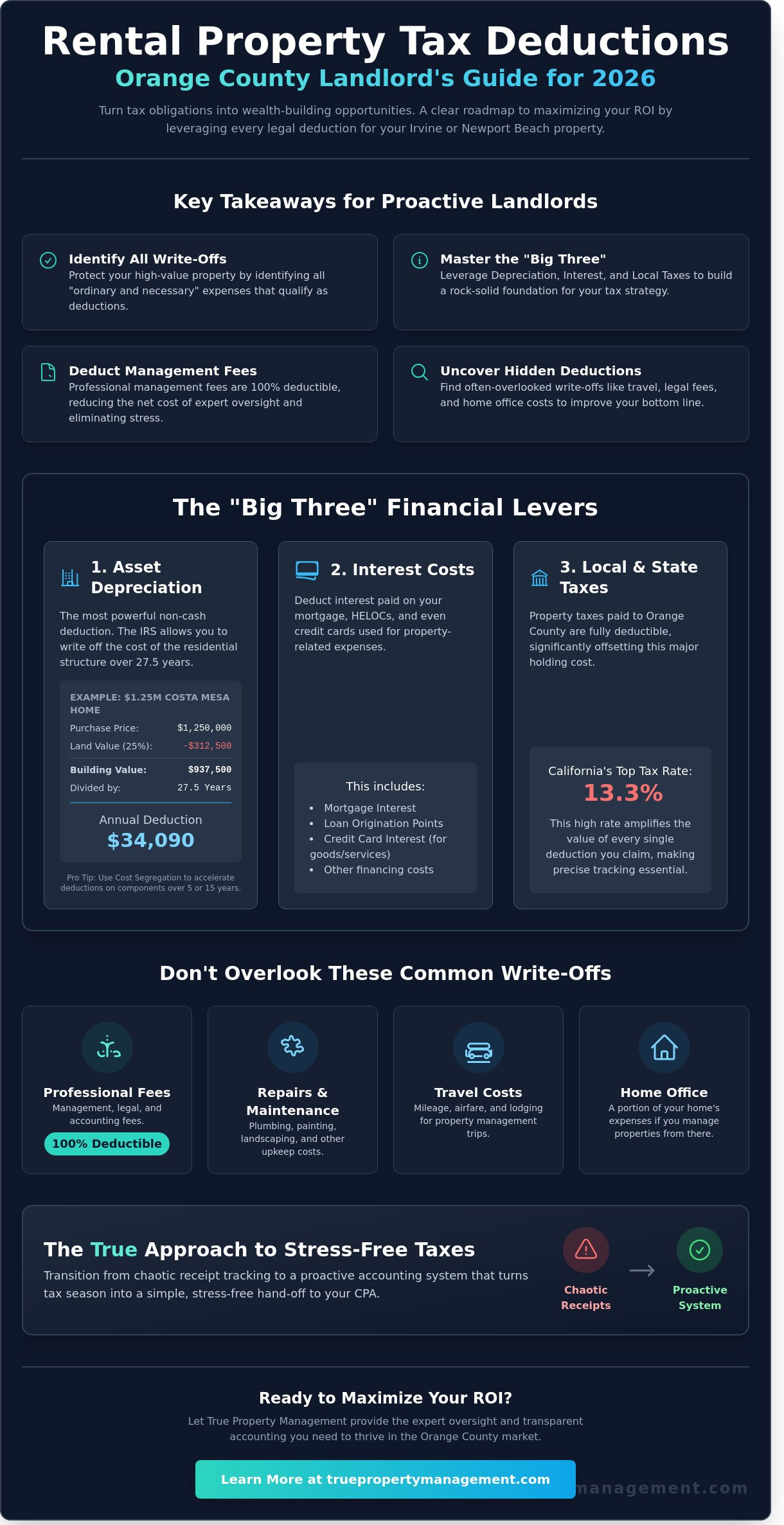
- Master the “Big Three” financial levers—depreciation, interest, and local taxes—to build a rock-solid foundation for your rental property tax deductions.
- Learn how professional management fees are 100% deductible, effectively reducing the net cost of expert oversight while eliminating the “stress tax” of self-management.
- Uncover often-overlooked write-offs like travel, legal fees, and home office costs that can significantly improve your annual bottom line.
- Transition from chaotic receipt tracking to a “True” proactive accounting system that turns tax season into a simple, stress-free hand-off to your CPA.
Understanding Rental Property Tax Deductions in Orange County (2026)
Managing a high-value asset in Irvine or Newport Beach isn’t just about collecting rent. It’s about protecting your bottom line from unnecessary erosion. Rental property tax deductions are the primary tools you have to offset the costs of ownership and preserve your ROI. These aren’t “loopholes” or aggressive accounting tricks. They are legitimate business expenses defined by the IRS as “ordinary and necessary” for managing, conserving, or maintaining your investment property.
2026 represents a pivotal year for landlords to audit their expense tracking. With the potential sunsetting of several provisions from previous tax acts, the margin for error has narrowed. You need a disciplined, proactive approach to ensure every dollar spent on your property is working for you. If you aren’t tracking your receipts with precision, you’re essentially giving away your profit to the state and federal government. At True Property Management, we believe transparency starts with your own ledger.
Federal vs. California State Tax Implications for Landlords
California’s tax environment is notoriously complex and demands a higher level of scrutiny than other states. While federal rules allow for significant write-offs, the California Franchise Tax Board (FTB) often maintains its own set of limitations. For example, California doesn’t always conform to federal “bonus” depreciation rules, which can create a discrepancy between your two returns. Understanding Depreciation is vital here, as it remains one of the most powerful non-cash rental property tax deductions available, even if the state and federal calculations differ slightly.
Working with a local expert helps you identify the “true” cost of ownership in Orange County. When you factor in California’s top individual tax rate of 13.3%, the value of every deduction is amplified. You don’t want to guess which federal deductions carry over to your state return. A mistake here doesn’t just result in a fine; it creates a logistical headache that steals your time and peace of mind.
The “Ordinary and Necessary” Standard for 2026
The IRS uses a specific two-part test to determine if an expense is deductible. An “ordinary” expense is one that’s common and accepted in the rental business. A “necessary” expense is one that’s helpful and appropriate for your trade. In the context of residential property, this includes everything from repairs and maintenance to insurance and professional management fees.
Luxury amenities in Newport Beach rentals often qualify under this standard where they wouldn’t in more modest markets. If you’re installing high-end smart home tech or professional landscaping to stay competitive, those costs directly contribute to maximizing rental income. You’re justifying these expenses as essential for attracting the caliber of tenant that Orange County demands. We focus on helping you document these costs so that your “ordinary” expenses are never questioned by an auditor.
The “Big Three” Deductions: Depreciation, Interest, and Local Taxes
Building a tax-efficient portfolio in Orange County requires mastering the “Big Three” financial levers. These aren’t just minor write-offs; they are the primary mechanisms that transform a high-value asset into a cash-flow machine. Because property values in cities like Irvine often exceed $1,100,000, the scale of these rental property tax deductions is significantly larger than in most national markets. Proactive planning ensures these mandatory or non-cash expenses are fully leveraged to protect your bottom line.
Asset Depreciation: The Landlord’s “Secret” Wealth Builder
Depreciation is the most powerful non-cash expense available to investors. The IRS allows you to write off the cost of the residential structure over a 27.5-year recovery period. For a typical Costa Mesa single-family home purchased for $1,250,000, you must first subtract the land value. If the land is valued at 25%, the remaining $937,500 building value generates a $34,090 annual deduction. For larger estates in Shady Canyon or Newport Coast, we often suggest cost segregation. This process “componentizes” the asset, allowing you to accelerate deductions on items like high-end flooring, cabinetry, and specialized landscaping over 5 or 15 years instead of the standard 27.5.
Mortgage Interest and the Cost of Financing in 2026
Financing remains the largest recurring expense for many Orange County investors. You can deduct 100% of the interest paid on mortgage loans used to acquire or improve your rental property. This is particularly impactful in Newport Beach, where high loan balances result in substantial interest payments. According to IRS guidelines on rental income and expenses, you can also deduct “points” and loan origination fees, though these are typically amortized over the life of the loan. Our team ensures that every cent of interest is documented through the True Transparency portal, making your year-end reporting seamless.
Navigating California Property Taxes and Supplemental Assessments
Orange County property taxes are a major line item, usually hovering around a 1.1% base rate. However, new owners often face “supplemental assessments” in their first year. These bills arrive months after closing to cover the difference between the previous owner’s assessed value and your new purchase price. It is vital to distinguish between deductible ad valorem taxes and non-deductible special assessments for specific local improvements. Missing a supplemental bill can lead to penalties that erode your ROI. A dedicated property manager acts as a protective barrier, tracking these deadlines so you never face a late fee.
These core rental property tax deductions provide the foundation for your 2026 tax strategy. By categorizing these expenses correctly from day one, you move from a reactive state of “handling bills” to a proactive state of wealth preservation. Reliability in your record-keeping is the only way to guarantee these benefits are realized.
Deducting Professional Management and Operational Costs
Hiring a professional team doesn’t just save you time; it changes your financial equation. Management fees are a 100% deductible expense that eliminates the “stress tax” of self-management. When you look at the actual property management fees in Orange County for 2026, remember that the IRS effectively subsidizes this service. If your marginal tax rate is 24 percent, every dollar spent on professional oversight reduces your tax bill by 24 cents. This includes leasing fees, tenant screening costs, and renewal charges. We believe in “True” transparency. Our clear fee structures mean your CPA won’t have to hunt for documentation. You get a clean, monthly statement that categorizes every dollar, making your annual rental property tax deductions simple to claim.
Maintenance, Repairs, and the “Improvement” Trap
Distinguishing between a repair and an improvement is critical for 2026 filings. A repair, like fixing a broken window in Irvine, is fully deductible in the year it occurs. A capital improvement, such as installing a new HVAC system, must be depreciated over 27.5 years. You can use the De Minimis Safe Harbor election to immediately deduct items under $2,500. This is why a rental property maintenance checklist serves as a vital tax document; it tracks the nature of every service call. The IRS provides specific guidelines on tax-deductible rental expenses to help you avoid the “improvement trap” that delays your tax benefits. Keeping these records organized ensures you don’t accidentally capitalize an expense that could have been deducted immediately.
Marketing, Tenant Screening, and Placement Costs
Finding the right tenant in the competitive OC market requires an investment, and the tax code supports this growth. All costs associated with marketing your property are deductible. This includes:
- Listing fees on platforms like Zillow or local Orange County listing services.
- Professional photography and staging for Newport Beach rentals to attract high-net-worth tenants.
- Costs for “For Rent” signage and local print advertising.
The tax treatment of background check fees and administrative placement costs is equally favorable. These are legitimate business expenses that lower your taxable income while you secure a reliable tenant. Because rental property tax deductions cover the full spectrum of tenant acquisition, you can afford to be rigorous in your screening process without worrying about the impact on your bottom line. We handle these logistics with precision, ensuring every receipt is captured for your year-end reporting.
Overlooked Write-Offs: Travel, Legal, and Home Office
DIY landlords often leave money on the table because they focus only on the “big” bills like roof repairs or new appliances. Real wealth in real estate is built through the disciplined tracking of every single dollar that leaves your pocket. These hidden expenses act as a slow leak in your ROI if you don’t account for them. Maintaining a proactive stance on your rental property tax deductions ensures your portfolio remains a high-performing asset rather than a source of financial stress. We see many owners overlook administrative costs that, when aggregated, represent thousands in potential savings.
Local Travel: Tracking Miles Between Irvine and Newport Beach
Your vehicle is a tool for your business. Every trip you take to inspect a condo in Irvine or meet a contractor at a Newport Beach duplex is a deductible event. For the 2026 tax year, you must choose between the standard mileage rate or the actual expense method. While the IRS set the 2024 rate at 67 cents per mile, you should verify the specific 2026 adjustment before filing. Tracking these miles manually is a headache. We recommend using GPS-based logs to prove the business purpose of every trip. When you partner with a manager, your personal travel time drops to zero. You trade the hassle of traffic for the True Transparency of a fully deductible management fee.
Legal Fees and Compliance Costs in a Pro-Tenant State
California is a complex environment for property owners. Navigating California landlord tenant law requires professional precision to avoid costly litigation. The good news is that the costs associated with staying compliant are fully deductible. You can write off:
- Professional fees for lease preparation and legal reviews.
- Consultation costs for local rent control ordinances.
- Legal defense fees and eviction coordination services.
- Court filing fees for tenant disputes.
Think of these fees as a deductible insurance policy for your assets. Professional compliance support protects your equity while lowering your taxable income. It’s a strategic move that reinforces your financial security.
Educational Expenses and Professional Dues
Staying informed is part of your business operation. You can deduct the cost of subscriptions to real estate investment publications or dues paid to local Orange County landlord associations. If you attend a seminar to learn about new rental property tax deductions or invest in specialized management software, those costs are typically 100% deductible. Even the professional fees you pay for the preparation of your Schedule E are part of the “cost of doing business.” At True Property Management, we believe in empowering our partners with clear data. We provide the detailed financial reporting you need to hand off to your CPA, making your tax season hassle-free.
Ready to experience a more profitable way to own property? Contact True Property Management today to see how we protect your investment.
The “True” Approach to Stress-Free Tax Preparation
Many landlords still rely on the “shoebox method,” where physical receipts are stuffed into a folder with the hope that everything balances out in April. This disorganized approach is a liability. It leads to missed opportunities and overlooked rental property tax deductions that directly impact your bottom line. At True Property Management, we replace this chaos with a proactive, digital accounting system. We believe that professional property management should act as a protective barrier between you and the logistical headaches of tax season.
Our process moves beyond simple recordkeeping. We provide a high-level partnership where your financial data is captured, categorized, and stored the moment an expense occurs. This ensures that when tax season arrives, you aren’t scrambling to reconstruct a year of maintenance calls and utility payments. You simply hand over a clean, professional report to your CPA and get back to your day.
Proactive Recordkeeping: The Foundation of Audit Protection
The IRS maintains strict requirements for documentary evidence. To successfully claim expenses, you must produce receipts, canceled checks, or bills that support your claims. Our digital owner portals create a permanent, time-stamped audit trail for every single dollar that moves through your property. This level of True Transparency means you never have to hunt for a missing invoice from a repair that happened eight months ago. We maintain the following records for every client:
- Digital copies of all vendor invoices and work orders.
- Detailed ledgers of all rental income received.
- Categorized expense reports aligned with IRS Schedule E categories.
- Historical data backups that remain accessible year-round.
By digitizing the paper trail, we ensure your records are audit-ready at a moment’s notice. It’s about providing the security and peace of mind that comes from knowing your documentation is bulletproof.
How True Property Management Simplifies Your Year-End
We provide our Newport Beach and Irvine clients with comprehensive financial reporting that turns a complex tax filing into a routine task. Our system automates the 1099-MISC process for vendors, ensuring you stay compliant with federal reporting laws without lifting a finger. By January 31st, you receive a consolidated year-end owner statement that summarizes every transaction from the previous calendar year. This single document serves as the roadmap for your rental property tax deductions, clearly outlining income and deductible costs.
Our local expertise in the Orange County market allows us to anticipate the specific needs of high-end investors. We handle the data so you can keep the profits. Don’t let tax season erode your ROI or consume your personal time. Let True Property Management protect your investment and simplify your financial life. Contact us today to experience the True difference in asset protection and professional management.
Master Your Orange County Investment Strategy for 2026
Navigating the 2026 tax landscape in Irvine and Newport Beach requires more than just basic record keeping. You’ve learned that the “Big Three” expenses and operational write-offs are the foundation of a healthy bottom line. Mastering your rental property tax deductions isn’t just about saving money today; it’s about building long-term asset protection. At True Property Management, we act as the protective barrier between you and the logistical headaches of property ownership. Our No Hidden Fees Guarantee ensures total transparency, while our Comprehensive Year-End Financial Reporting provides the exact data your CPA needs for a stress-free filing. We don’t just manage buildings; we manage your peace of mind through expert local knowledge and proactive communication. It’s time to stop worrying about the complexities of the tax code and start enjoying the rewards of your hard work. We’re here to ensure your investment stays profitable and protected.
Protect your ROI with True Property Management; See our deductible services
Frequently Asked Questions
Are property management fees tax-deductible in California?
Yes, professional property management fees are fully tax-deductible as a necessary business expense under IRS Publication 527. This includes your monthly management fees, leasing commissions, and any specialized service charges. By partnering with a firm that offers True Transparency, you ensure every dollar spent is documented and ready for your tax professional to help maximize your ROI.
What is the difference between a repair and an improvement for tax purposes?
Repairs are immediate expenses that keep your property in good working condition, such as fixing a leaky faucet or replacing a single broken window pane. Improvements are capital expenditures that add value or prolong the property’s life, like a $15,000 roof replacement or a full kitchen remodel. While you deduct repairs in the year they occur, you must depreciate improvements over 27.5 years according to current IRS guidelines.
Can I deduct the travel expenses I incur while visiting my Newport Beach rental?
You can deduct travel expenses if the primary purpose of the trip is to manage, conserve, or maintain your rental property. This includes the IRS standard mileage rate, which was 67 cents per mile in 2024, for trips to your Newport Beach unit. Keep a precise log of your odometer readings and the business purpose for every visit to satisfy potential audit requirements and protect your bottom line.
How does depreciation work for a residential rental property in 2026?
Depreciation allows you to deduct the cost of the building over a 27.5-year recovery period, excluding the value of the land. This is one of the most powerful rental property tax deductions because it provides a non-cash expense that reduces your taxable income. If your Orange County building is valued at $825,000, your annual depreciation deduction would be $30,000, providing a significant shield for your rental income.
Is interest on a home equity line of credit (HELOC) deductible if used for rental repairs?
HELOC interest is deductible when the funds are used specifically to improve or maintain your rental property. The IRS requires strict tracing of these funds to prove they weren’t used for personal expenses like vacations or credit card debt. This interest provides a direct path to asset protection by allowing you to reinvest in your property while lowering your overall tax burden.
What records do I need to keep to support my rental property deductions?
You should maintain digital or physical copies of all receipts, bank statements, and lease agreements for at least 3 years after filing your return. Our True Communication portal simplifies this by providing 24/7 access to your financial reports and expense tracking. Accurate record keeping ensures you don’t miss out on vital rental property tax deductions and protects you during a state or federal audit.
Can I deduct the cost of a home office used to manage my Orange County rentals?
You can deduct a home office if you use a specific portion of your residence regularly and exclusively for your rental business. The IRS offers a simplified option where you deduct $5 per square foot for up to 300 square feet of office space. This deduction is a legitimate way to recoup costs for the time you spend overseeing your local investment portfolio and managing tenant relationships.
What happens to my deductions if my rental property has a net loss for the year?
If your expenses exceed your income, you may have a passive activity loss. Landlords who actively participate and earn under $100,000 can typically deduct up to $25,000 in rental losses against other income sources. If your income exceeds $150,000, these losses are generally carried forward to future tax years. This ensures your long-term financial success even during high-vacancy periods or years with major renovation costs.