
Your security deposit is no longer just a financial buffer; it’s a legal minefield where one missed deadline can cost you three times the original amount in penalties. Following the implementation of Assembly Bill 12 on July 1, 2024, Orange County landlords now face stricter limits on how much they can collect and how they must justify every penny withheld. Understanding the california security deposit law is the only way to shield your investment from the 65 percent of landlord-tenant disputes that end up in small claims court over deposit disagreements.
We understand the frustration of staring at a damaged hardwood floor and wondering if it qualifies as normal wear and tear or if you’ll be sued for deducting the repair costs. You want to protect your property without the constant fear of a 21-day deadline looming over your head. This guide provides the True Transparency you need to master these regulations, ensuring you maintain full compliance while maximizing your ROI. We will break down the essential 2026 updates, provide a checklist for clear documentation, and show you how to handle tenant turnovers with absolute confidence.
Key Takeaways
- Navigate the landmark shift of AB 12 and learn why the new one-month limit now applies to nearly all Orange County rental properties.
- Protect your investment by mastering the four legal reasons for deductions under california security deposit law to ensure every charge is fully compliant.
- Avoid the costly risk of missing the strict 21-day return deadline, a mistake that can result in the total forfeiture of your rights to the deposit.
- Determine if your specific portfolio qualifies for the narrow “Small Landlord Exception,” allowing you to legally collect up to two months’ rent.
- Discover how professional oversight and True Transparency provide a protective barrier against litigation through rigorous move-in and move-out documentation.
California Security Deposit Limits in 2026: The 1-Month Rule
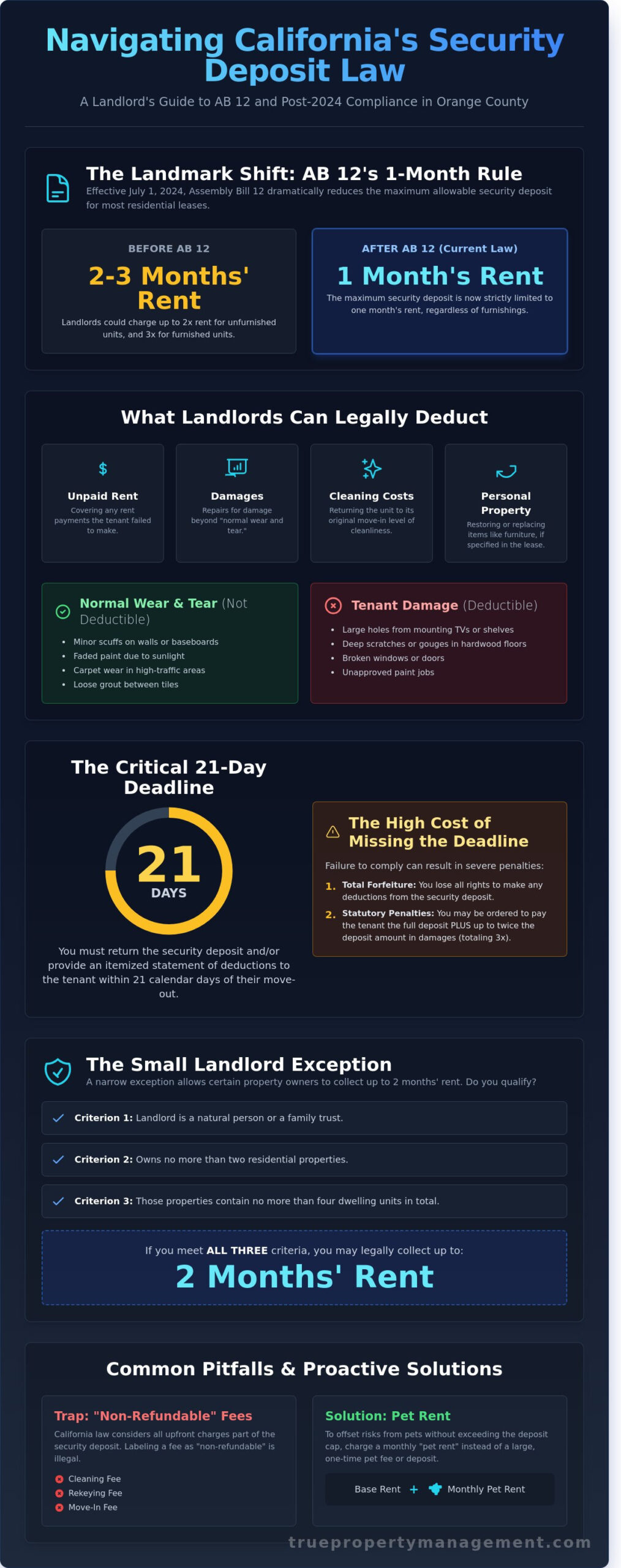
The landscape for local property owners changed permanently with the passage of AB 12. As of 2026, the california security deposit law mandates a strict one-month rent limit for nearly all residential leases. This legislation removed the long-standing ability to charge two months’ rent for unfurnished units or three months’ rent for furnished properties. Today, the law treats all rentals equally. If your Newport Beach rental is listed at $5,000 per month, you cannot legally collect more than $5,000 as a total security deposit. It doesn’t matter how high-end the appliances are or how much custom furniture you’ve provided.
Confusion often arises regarding “last month’s rent.” Under California law, any money you collect at the start of a lease that isn’t the first month’s rent is legally classified as a security deposit. Before you sign your next lease, it’s vital to understand What is a Security Deposit? in a legal context. If you collect one month as a deposit plus one month as “last month’s rent,” you’ve exceeded the legal limit and created a significant liability for your investment. We see this mistake often, and it’s a primary target for tenant attorneys in Orange County.
The Impact of AB 12 on Orange County Real Estate
High-value markets like Newport Beach and Huntington Beach feel this shift most acutely. For years, owners used higher deposits to mitigate the risk of damage to luxury finishes. That safety net has shrunk. You must update your 2026 lease templates immediately to reflect these changes. Continuing to use outdated “2-month” deposit language can trigger statutory penalties of up to twice the amount of the deposit. For deposits collected before July 1, 2024, the old rules typically apply. However, any lease renewal or new agreement made today must follow the one-month cap. True Property Management ensures your assets stay protected by keeping your documentation strictly compliant with the latest california security deposit law.
Prohibited Non-Refundable Fees
California law is clear: there’s no such thing as a non-refundable fee. Whether you call it a “cleaning fee,” “rekeying fee,” or a “move-in fee,” the court views it as a refundable security deposit. We recommend a “True” approach to transparency. Account for every dollar as part of the refundable deposit to avoid legal friction. If you want to offset the risk of pets, you can’t simply add a $500 non-refundable pet fee. Instead, many landlords utilize “pet rent,” a monthly premium added to the base rent. This keeps the total security deposit within the one-month limit while still protecting your ROI. This proactive strategy keeps you profitable without risking a lawsuit over illegal fee structures.
What Landlords Can Legally Deduct from a Security Deposit
Clarity is the foundation of a successful landlord-tenant relationship. Under California Civil Code Section 1950.5, you can’t simply guess at what to withhold from a tenant’s deposit. The california security deposit law specifies four distinct reasons for deductions: covering unpaid rent, repairing damage beyond normal wear and tear, cleaning the unit to its move-in state, and restoring personal property if the lease allows it. At True Property Management, we believe True Transparency starts with knowing these boundaries to protect your ROI and avoid costly litigation.
When a tenant leaves with a balance, calculating arrears must be precise. If a resident in a $3,200-per-month Costa Mesa condo fails to pay their final month, you must document the exact dates and amounts in your itemized statement. Cleaning costs are another common friction point. You’re legally entitled to charge for professional cleaning to bring the unit back to the exact level of cleanliness it had when the tenant first arrived. If you provided a pristine home, you shouldn’t have to pay out of pocket to return it to that standard. Keeping detailed “before” photos from the initial walkthrough is the best way to justify these costs during the 21-Day Deadline and Itemized Statements process.
Normal Wear and Tear vs. Tenant Damage
Normal wear and tear is the expected decline in condition from ordinary, everyday use. In high-end markets like Irvine, distinguishing between a lived-in home and a damaged one is vital for asset protection. Faded paint from sunlight or minor scuffs on a baseboard are standard aging. However, large holes in the drywall from a wall-mounted TV or deep scratches in hardwood floors from a heavy desk constitute damage. While a carpet might naturally thin over a five-year tenancy, large pet stains or cigarette burns are clear lease violations that justify a deduction from the security deposit.
The $125 Rule for Receipts and Invoices
The california security deposit law is strict about documentation. If your total deductions exceed $125, you must provide copies of receipts or invoices showing the actual costs of repairs or cleaning. This rule exists to prevent arbitrary charges and ensure fairness. If a repair is complex and won’t be finished within the 21-day window, you must provide a good faith estimate of the cost. You then have 14 days after the work is completed to provide the final invoice to the former tenant.
If you use your own employees to perform the work, you’re allowed to charge a reasonable hourly rate, but you must describe the work performed and the time spent on the itemized statement. Our proactive approach ensures every receipt is logged and every hour is accounted for, creating a paper trail that stands up in court. If managing these logistics feels like a burden, our comprehensive management services can act as your protective barrier, handling the entire move-out process with professional precision.
The 21-Day Deadline and Itemized Statement Requirements
The 21-day rule isn’t a suggestion; it’s a hard legal ceiling that defines your success as a property owner. Under california security deposit law, you have exactly three weeks from the date a tenant vacates the premises to either return the full deposit or provide a detailed itemized statement. This timeline is unforgiving. If you miss this window by even 24 hours, you forfeit your right to retain any portion of the deposit, even if the property sustained thousands of dollars in documented damage.
True Transparency in financial reporting is your best defense against bad faith claims. We’ve seen many landlords lose in small claims court not because the damages weren’t real, but because their paperwork was sloppy or late. In 2026, while electronic delivery is widely accepted, we recommend sending documents via certified mail to create a physical paper trail. This provides the “True” verification needed to prove you met your obligations. For a deeper look at legal requirements, the California Courts Self-Help Guide provides a clear breakdown of how these deadlines function in practice.
The Critical Move-Out Timeline for OC Landlords
Effective management begins the moment you receive a notice to vacate. You’re legally required to notify the tenant of their right to request an “Initial Inspection” before they move out. This inspection usually happens during the final two weeks of the lease. It allows the tenant to identify and fix issues to avoid deductions. Newport Beach landlords should never skip this notice. Failing to offer this inspection can be viewed as a “bad faith” move, which could lead to statutory damages of up to twice the amount of the security deposit. We standardize this process to ensure every owner is shielded from unnecessary litigation.
Crafting a Legally Defensible Itemized Statement
Your itemized statement must be a masterpiece of clarity. It needs to include a description of the work performed, the vendor’s name, and a specific cost breakdown. If a repair exceeds $126, you must attach the actual receipts or invoices to the statement. This level of detail is non-negotiable. Many disputes are settled before they reach a courtroom simply because the landlord provided an undeniable record of expenses.
To ensure your initial lease terms support these deductions, review the landlord disclosures california requirements. Proper setup at the start of the tenancy makes the move-out process significantly smoother. For owners looking for a comprehensive overview of their responsibilities, our California Landlord Tenant Law guide offers the broader context needed to maintain total compliance while protecting your ROI.
The Small Landlord Exception: Do You Qualify for 2 Months’ Rent?
While Assembly Bill 12 effectively capped most residential security deposits at one month’s rent on July 1, 2024, a specific group of owners can still request more. This isn’t a broad loophole. It’s a narrow exemption designed for small-scale investors. To qualify for the two-month deposit under current california security deposit law, you must meet strict ownership and unit count thresholds. If you step outside these boundaries, even by mistake, you face significant legal exposure.
The “Two Property / Four Unit” rule is the primary benchmark. To charge a two-month deposit, you must be a “natural person,” a family trust, or an LLC where all members are natural persons. Additionally, you cannot own more than two residential rental properties, and the total number of units across those properties cannot exceed four. If you own a duplex in Newport Beach and a condo in Irvine, you’re at three units. You qualify. If you add another duplex, your unit count hits five, and the one-month cap applies immediately to your entire portfolio.
Defining the Small Landlord in Newport Beach and Irvine
Ownership structure is the first place a legal challenge begins. If your property is held by a corporation or a multi-tier LLC with corporate members, you’re disqualified from the exception regardless of how many units you own. We’ve seen owners lose their exempt status simply by moving a property into a corporate entity for tax reasons without realizing the impact on their deposit limits. True Property Management provides the True Transparency needed to audit your current status before you sign a lease.
Claiming the exception when you don’t qualify is a high-stakes gamble. California courts don’t take kindly to “willful” violations. If a judge determines you intentionally overcharged a tenant, they can award the tenant treble damages. This means you could be forced to pay back three times the security deposit amount plus attorney fees. It’s a financial hit that can wipe out years of cash flow in a single ruling.
The Military Service Member Protections
Military status creates a hard ceiling that overrides the small landlord exception. Even if you only own one single-family home, you cannot charge an active-duty service member more than one month’s rent. This protection is a critical component of the california security deposit law and works in tandem with federal protections. You cannot bypass this rule, and failing to identify a tenant’s military status is not a valid legal defense.
Because of these nuances, comprehensive tenant screening is your best defense. You need a process that identifies military status early so you can adjust your lease terms accordingly. While you must gather this data, you have to do it while remaining fully compliant with the Fair Housing Act in California. We recommend using standardized screening tools that ask for military status as part of a routine background check to ensure every applicant is treated with the same level of professional scrutiny.
Don’t risk treble damages over a deposit mistake. Contact True Property Management today to ensure your Orange County portfolio remains fully compliant with the latest state laws.
Mitigating Risk with Professional Property Management in Orange County
Managing a rental in Irvine or Huntington Beach involves more than just collecting checks. It requires a robust insulation against legal liability. Under the california security deposit law, even a small clerical error can lead to a “bad faith” claim. This allows a judge to award the tenant up to three times the deposit amount as a penalty. For an Orange County landlord holding a $4,500 deposit, a single mistake could result in a $13,500 judgment. Professional oversight acts as a protective barrier. We handle the friction and the paperwork so you stay protected.
How “True Transparency” Prevents Security Deposit Disputes
Disputes usually start when there’s a lack of data. We eliminate guesswork by utilizing professional-grade software that tracks every dollar. Every deduction is backed by digital receipts and itemized accounting that stands up in court. We focus on proactive communication to resolve issues before they escalate into legal headaches. You can see how our full-service property management in Newport Beach handles the heavy lifting by maintaining a rigorous digital paper trail for every asset.
- Itemized Accounting: We provide clear, line-by-line breakdowns of all costs.
- Receipt Storage: All repair invoices are digitized and accessible for immediate verification.
- Tenant Communication: We set expectations early, reducing the likelihood of move-out day surprises.
Proactive Inspections: The Best Defense Against Liability
The “True” process relies on high-definition evidence. We capture comprehensive move-in and move-out photos and video to justify every deduction. This third-party documentation is the strongest defense against claims that a landlord is overcharging for normal wear and tear. Our local vendor network ensures repairs are finished and invoiced within the strict 21-day window required by the california security deposit law. We’ve built these relationships over years in the Orange County market to ensure fast, fair pricing for our clients.
Self-managing owners are often the easiest targets for litigation because they lack these disciplined systems. True Property Management provides the modern tech and local expertise needed to protect your investment. If you’re looking for hassle-free compliance and total peace of mind, we’re ready to secure your property’s future. Let’s ensure your management strategy is as reliable as your ROI.
Master Your Orange County Rental Strategy
Navigating the 2026 updates to california security deposit law requires more than just a passing glance at the headlines. You need to master the strict one-month limit on deposits while maintaining the rigorous 21-day window for delivering itemized statements. For landlords qualifying under the small owner exception, managing those specific two-month limits demands precise documentation to avoid costly penalties. These legislative shifts are complex; however, they don’t have to jeopardize your ROI or peace of mind.
Since 2014, Michael Chiusano has built True Property Management to act as a protective barrier for Orange County owners. We eliminate the friction of compliance with our No Hidden Fees Guarantee and a 24/7 Emergency Response system that keeps your assets secure at all hours. You can stop worrying about legal hurdles and start focusing on your long-term financial success. Our team handles the logistics so you can enjoy the benefits of ownership without the stress.
Protect your rental investment with True Property Management. Get a Free Rental Analysis today!
Your success in the local market is within reach when you have a reliable partner by your side.
Frequently Asked Questions
Can I charge a separate pet deposit on top of the one-month limit?
No, you can’t charge a separate pet deposit if the total amount exceeds the one-month rent limit. Under California AB 12, which took effect July 1, 2024, the maximum security deposit is capped at one month’s rent for most residential properties. This total includes all deposits, whether they’re for pets, keys, or general security. Keeping your lease agreements compliant with california security deposit law ensures you avoid legal disputes and maintain professional standards.
What happens if I don’t return the security deposit within 21 days?
If you miss the 21-day deadline, you forfeit your right to retain any portion of the deposit for repairs or cleaning. California Civil Code Section 1950.5 requires you to return the full amount or provide an itemized statement within 21 calendar days of move-out. Failing to act quickly often results in a small claims court summons. Judges may order you to pay the full deposit plus statutory damages to the tenant.
Is a tenant required to request a pre-move-out inspection?
Tenants aren’t required to request an inspection, but you must notify them of their right to one in writing. This notification should happen within a reasonable time after you receive notice of intent to vacate. If the tenant requests the inspection, it allows them to fix identified issues before moving out. Our True Transparency process ensures these notifications are documented, protecting your rights as a landlord while providing clarity for the tenant.
Can I use the security deposit to pay for professional carpet cleaning?
You can only deduct for professional carpet cleaning if the carpet is dirtier than it was when the tenant moved in. California law prohibits deductions for ordinary wear and tear, which includes minor traffic patterns or aging. If a tenant leaves significant stains or pet odors, you can use the deposit to restore the unit’s condition. Always keep the receipts from the cleaning service to justify the deduction if it’s challenged.
Does the 1-month limit apply to existing leases signed before 2024?
The one-month limit doesn’t apply to existing leases signed before July 1, 2024. Those older agreements remain valid under the previous rules until the lease expires or is modified. However, once you sign a new lease or a renewal in 2026, you must align with the current california security deposit law standards. We help Orange County owners transition these older accounts to ensure ongoing compliance and asset protection for their portfolios.
What is the maximum penalty for a “bad faith” withholding of a deposit?
The maximum penalty for bad faith withholding is twice the amount of the security deposit in statutory damages. This is in addition to the actual amount of the deposit you must return. California Civil Code Section 1950.5(l) empowers judges to award these damages if they find a landlord intentionally ignored the 21-day rule or fabricated repair costs. Avoiding these 200 percent penalties is vital for maintaining your investment’s long-term financial success.
Can I deduct for my own labor if I do the repairs myself?
You can deduct for your own labor, but you must charge a reasonable hourly rate and describe the work performed. If the total cost for repairs and cleaning exceeds $126, you’re legally required to provide copies of receipts or invoices. For your own work, document the time spent and the specific tasks completed. Our True Communication approach involves detailed logging of all maintenance to ensure every deduction stands up to legal scrutiny.
How do I handle a deposit if the property is sold during the lease?
When you sell your property, you must either transfer the security deposits to the new owner or return them to the tenants. You’re required by California Civil Code Section 1950.5(h) to notify the tenant via personal delivery or certified mail about the transfer. This notice must include the new owner’s contact information and the specific amount transferred. Handling this transition correctly prevents future liability and ensures the new owner starts with a clean slate.