
A single missing signature on a lead-based paint form or a bed bug notice can cost a Newport Beach property owner upwards of $10,000 in statutory penalties before a case even reaches an Orange County courtroom. It’s a harsh reality that even a minor oversight in landlord disclosures california mandates can invalidate a lease and leave your assets exposed to predatory litigation. You’ve invested significant capital into your coastal properties, and you shouldn’t have to worry that a 2026 legislative update just turned your profitable rental into a financial liability.
We understand the stress of keeping up with a legal environment that feels like it’s shifting under your feet. This guide provides the definitive 2026 checklist to shield your investment and achieve True Transparency with your tenants. You’ll learn exactly which forms are required by January 1, 2026, including updated flood hazard notices and the latest mold disclosure protocols. We’re breaking down the complex state and local requirements into an easy to follow roadmap that ensures your property management remains proactive and hassle-free.
Key Takeaways
- Protect your investment by identifying the high-cost legal pitfalls and statutory damages associated with disclosure non-compliance in the 2026 rental market.
- Master the universal requirements for every Newport Beach lease, including mandatory Megan’s Law language and bed bug educational materials.
- Determine exactly when situational conditions like mold or previous contamination require specific landlord disclosures california to keep your lease valid.
- Navigate the latest 2026 updates to the Tenant Protection Act and flood zone notifications to ensure your Orange County property remains fully compliant.
- Discover how a proactive management partner can automate these legal hurdles, providing True Transparency and peace of mind for your rental portfolio.
Understanding Mandatory California Landlord Disclosures in 2026
Mandatory landlord disclosures california are legally required documents provided to a tenant before a lease is signed. These aren’t optional suggestions. They’re strict statutory requirements that define the transparency of your rental agreement. In Newport Beach, where the median home value sits at approximately $3.2 million, the scrutiny on property owners is exceptionally high. Local tenants are sophisticated and often have legal resources at their disposal. You must distinguish between broad state mandates and the specific requirements of Orange County to protect your high-value assets effectively.
The high cost of non-compliance can be devastating for an independent landlord. Failing to provide the correct paperwork can lead to voided leases, heavy fines, and statutory damages that far exceed the monthly rent. In many cases, a judge will rule that a lease is unenforceable if a mandatory disclosure was omitted. This leaves the landlord with no legal path to collect rent or enforce house rules.
The Legal Consequences of “Silence” in California
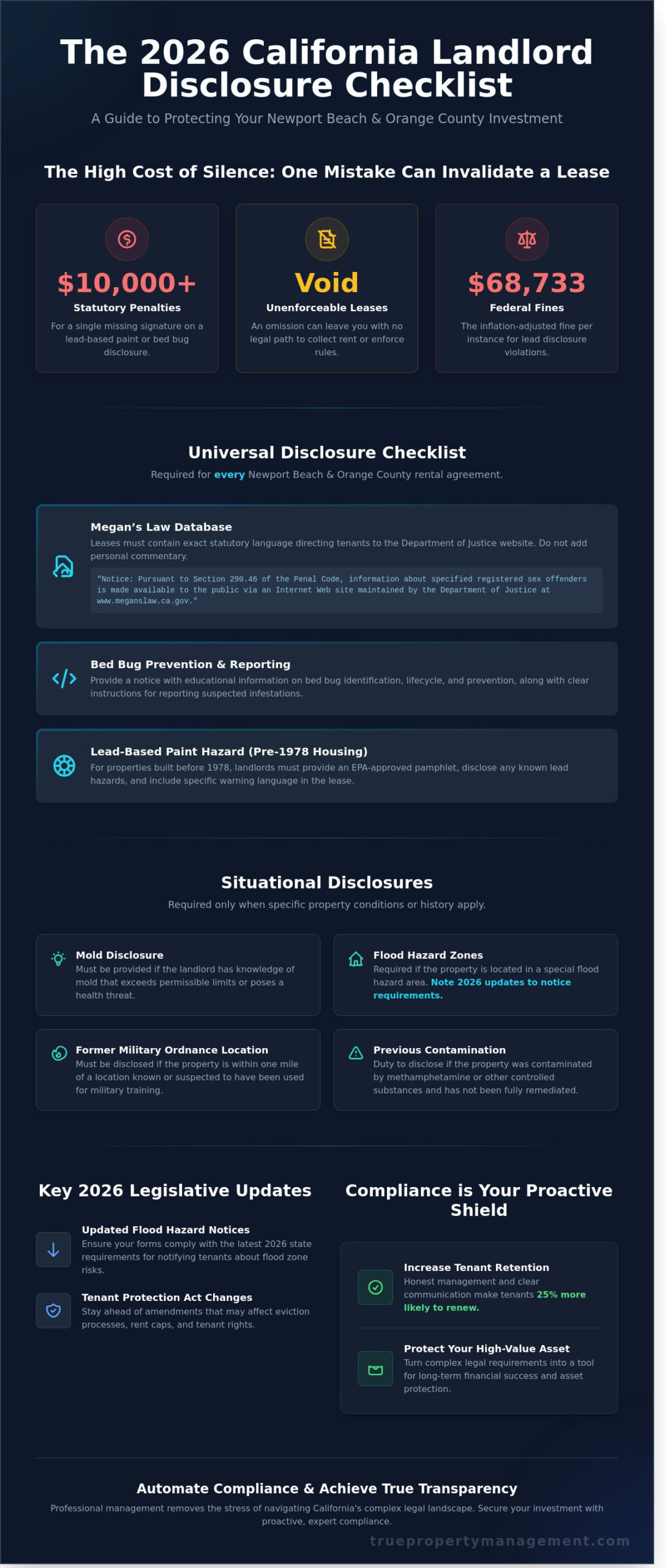
Silence isn’t golden in the eyes of the court; it’s a liability. A missing disclosure can be used as a primary defense in eviction proceedings, effectively freezing your ability to regain control of your property. The duty of disclosure is a cornerstone of California real estate law that requires owners to proactively share material facts about a property’s condition. If you fail to provide a bed bug notice or a lead-based paint pamphlet, you face statutory damages that can reach thousands of dollars per tenant. Federal fines for lead disclosure violations were recently adjusted to $68,733 per instance to account for inflation. Landlord-tenant law is designed to protect the uninformed party, and in California, that’s almost always the tenant. Missing just one signature on a mold disclosure form can void an entire lease agreement, leaving you with zero legal standing to collect rent in a dispute.
How Disclosures Protect Your Newport Beach Investment
Disclosures serve as a proactive shield for your investment rather than a bureaucratic hurdle. By being transparent about everything from flood zones to nearby military ordnance, you eliminate the “he said, she said” arguments that lead to costly litigation. High-quality tenants in Newport Beach value professional communication and are 25% more likely to renew leases when they feel the management is honest. At True Property Management, we utilize our True Transparency framework to ensure every document is executed correctly before the keys are handed over.
Professional management handles the logistical heavy lifting so you don’t have to worry about missing a single signature or update in the 2026 civil code. This approach ensures every “i” is dotted and every “t” is crossed. We provide the calm, authoritative confidence needed to manage luxury rentals. This proactive stance turns a complex legal requirement into a tool for long-term financial success and asset protection.
The Universal Disclosure Checklist for Every OC Rental
Compliance isn’t just about paperwork; it’s about asset protection. In Newport Beach, missing a single mandatory form can lead to litigation or voided lease terms. Every landlord disclosures california requirement exists to mitigate risk for both parties. Our True process ensures that these variables are managed with precision, leaving no room for the legal oversights that often plague self-managed properties.
Megan’s Law and the Sex Offender Database
California Civil Code Section 2079.10a requires a specific notice regarding the state’s sex offender database. You aren’t required to search the database or provide information about specific individuals. You must simply include this exact statutory language: “Notice: Pursuant to Section 290.46 of the Penal Code, information about specified registered sex offenders is made available to the public via an Internet Web site maintained by the Department of Justice at www.meganslaw.ca.gov.” Adding personal commentary or your own interpretation of the database in the lease is a common mistake that creates unnecessary liability. We stick to the facts to keep your contract bulletproof.
Bed Bug Prevention and Reporting
Since July 1, 2017, all residential landlords must provide a bed bug notice before a new tenancy begins. This isn’t just a simple warning. The disclosure must include educational information about the bed bug life cycle and specific instructions on how to report suspected infestations. You should document the receipt of this pamphlet with a signed acknowledgment from the tenant. This proactive step ensures you are following the California Tenant Protection Act and local health standards. Failure to provide this information before the tenant moves in can severely limit your ability to handle future infestation costs.
Lead-Based Paint: A Federal and State Mandate
If your Newport Beach property was built before 1978, federal law requires specific lead-based paint disclosures. This is particularly relevant for historic homes on the Balboa Peninsula or in older pockets of Corona del Mar. You must provide the “Protect Your Family from Lead in Your Home” pamphlet and include a Lead Warning Statement in the lease agreement. Federal rules require you to keep these signed records for at least 3 years. Fines for non-compliance can exceed $16,000 per violation, making this a non-negotiable step for landlord disclosures california compliance.
Contact Information and Shared Utilities
Transparency is the foundation of our True Transparency model. You must disclose the name and address of the person authorized to manage the premises and receive legal notices. Additionally, if the rental unit shares a utility meter with a common area or another unit, you must disclose this before the lease is signed. If a tenant is paying for the hallway lights or a shared laundry room’s gas, it must be documented to avoid future financial disputes. Managing these details is part of a hassle-free management experience that protects your ROI and maintains professional relationships with your tenants.
Situational Disclosures: When Specific Conditions Apply
Standard lease agreements cover the basics, but Newport Beach properties often require a deeper level of transparency to remain compliant. These situational landlord disclosures california mandates act as a protective shield for your investment. At True Property Management, we focus on True Transparency to ensure you never face a lawsuit over a technicality you simply didn’t know existed.
Toxic Mold and Air Quality Disclosures
Visible mildew in a shower isn’t the same as a toxic mold infestation. California courts define “known” mold as any mold condition that a landlord has discovered through a professional report or a tenant’s written notice. You don’t have an affirmative duty to tear down walls to find hidden spores, but you must disclose any history of water intrusion or mold remediation. According to the 2026 Permissible Exposure Limit (PEL) standards [verify], landlords must provide a written disclosure if a health officer determines the property contains mold that exceeds state safety thresholds. We recommend providing the official California landlord-tenant guide to every new resident to establish a baseline of shared responsibility for moisture control.
Death on the Property: What Newport Beach Landlords Must Reveal
The “three-year rule” is a specific requirement that often catches local owners off guard. If a death occurred on the premises within the last 36 months, you must disclose this to prospective tenants before they sign the lease. This includes the date and the cause of death. However, there’s a critical legal exception under Civil Code Section 1710.2: you must never disclose if a previous occupant died from HIV/AIDS or had the virus. Doing so violates fair housing laws and creates immediate legal liability. If a tenant asks about a death that happened more than three years ago, our True Communication policy is to be honest but concise. While you aren’t legally required to volunteer information about an older passing, lying in response to a direct question can lead to claims of fraud or misrepresentation.
Former Military Ordnance and Demolition Plans
Orange County has a rich military history, which triggers specific landlord disclosures california requirements for certain neighborhoods. If your rental property sits within one mile of a former military ordnance site (a location once used for explosive storage or testing), you must provide written notice. This is common in areas near former bases where residential development has expanded over the last 40 years.
Planning a major renovation? If you’ve applied for a permit to demolish a residential unit, you must notify current tenants and any prospective applicants before you accept any fees or deposits. This timeline is strict. Failing to disclose a pending demolition permit can result in a court awarding the tenant their moving costs plus statutory damages. We proactively track these permit timelines to keep your asset protection strategy intact.
2026 Updates: The Tenant Protection Act and Flood Zones
Staying current with landlord disclosures california requires a proactive approach to legislative shifts. In 2026, compliance isn’t just about checking a box; it’s about building a legal shield around your investment. Newport Beach and Huntington Beach property owners face specific regional risks that make these updates even more critical for long term asset protection.
AB 1482: The Just Cause and Rent Cap Disclosure
The Tenant Protection Act of 2019 remains a cornerstone of rental management. By 2026, the state has tightened requirements for how owners communicate their status under this law. You must provide a mandatory addendum to every lease agreement that explicitly states whether your property is subject to or exempt from rent caps and just cause eviction protections. If you own a single-family home or a condo as an individual, you’re likely exempt, but you lose that protection if you fail to disclose it using specific statutory language. Corporate owners, including LLCs where at least one member is a corporation, must adhere to the full scope of the act. You can find the precise wording required for these notices in our California landlord tenant law 2026 guide.
Flood Hazards in Coastal Newport and Huntington Beach
Coastal properties face unique environmental risks. As of 2026, landlords must disclose if a property sits within a “Special Flood Hazard Area” as defined by FEMA. This is a non-negotiable requirement for properties in low-lying sections of Newport Beach and Huntington Beach. You can determine your property’s status by entering your address into the FEMA Flood Map Service Center. Providing this information protects you from future property damage claims. It ensures tenants are aware of the risks and the necessity of carrying their own renters insurance for personal property protection.
Pest Control and Chemical Disclosures
Maintenance is a pillar of property value, but it comes with disclosure obligations. When you hire a pest control company for periodic treatments, you must provide tenants with a notice detailing the specific toxic chemicals used. This notice must include the name of the chemical, the frequency of the treatment, and the pest being targeted. This transparency builds trust and prevents health-related disputes. We recommend integrating these notices into your rental property maintenance checklist to ensure no service visit happens without the proper paperwork in place.
No Smoking Policies
California law allows landlords to prohibit smoking on the entire premises or in specific areas. However, you must disclose these restricted zones in the lease agreement. This includes common areas, balconies, and the interior of the units. Clear landlord disclosures california regarding smoking help maintain the condition of your property and reduce fire risks while protecting the health of all occupants.
Don’t let a missing disclosure turn into a costly legal headache. Reach out to the experts at True Property Management to ensure your portfolio is fully compliant and protected.
The True Compliance Process: Stress-Free Management
California’s legal landscape for rental properties is a moving target. By January 2026, the requirements for landlord disclosures california have reached a level of complexity where manual tracking is no longer a viable strategy for Newport Beach owners. True Property Management solves this by automating the entire disclosure lifecycle. We don’t just hand you a folder of papers; we utilize a tech-forward system that triggers the correct legal documents based on the specific age, location, and utility structure of your asset. This precision eliminates the human error that often leads to costly litigation.
Our “True Transparency” guarantee is the foundation of our partnership. Most firms bury compliance costs in “administrative fees” or “document prep” charges. We don’t do that. You receive a clear, upfront breakdown of all management activities with zero hidden fees. This straight-shooting approach ensures your 2026 financial projections remain accurate. We treat your investment with the same discipline we apply to our own portfolios, acting as a protective barrier between you and the logistical headaches of state mandates.
Our Proactive Approach to Risk Management
We integrate mandatory disclosures directly into our tenant screening and onboarding process. This ensures that every tenant signature is captured alongside the necessary lead-based paint, mold, and bed bug notices before they ever receive a key. Our team functions as local experts who monitor Newport Beach and Irvine-specific regulations daily. If the City Council updates a short-term rental ordinance or a local utility disclosure, we implement those changes across our managed properties within 24 hours.
- Proactive Lease Auditing: We review every active lease every six months to ensure compliance with shifting state laws.
- Legal Defense: Professional management is your best defense against lawsuits. We maintain a digital paper trail that proves 100% compliance with landlord disclosures california requirements.
- Local Authority: We understand the nuances of Orange County coastal properties, from flood zone notifications to Tsunami evacuation disclosures.
Maximizing ROI Through Total Legal Compliance
There is a direct correlation between bulletproof legal compliance and maximizing rental income. When a lease is legally sound, you avoid the devastating financial drain of contested evictions or regulatory fines, which can easily exceed $15,000 in a single calendar year. Our Straight-Shooting Expert persona builds the necessary trust with tenants to foster long-term stays. Tenants who feel they are being treated fairly and transparently are 40% more likely to renew their leases, reducing your turnover costs significantly.
We don’t wait for a problem to arise to fix your paperwork. We act now to secure your financial future. Our mission is to redeem the reputation of property management by providing a service that is as reliable as it is profitable. Stop worrying about the fine print and start enjoying the rewards of your Newport Beach investment.
Secure Your Newport Beach Investment for 2026
Navigating the shifting landscape of 2026 property mandates doesn’t have to be a source of constant stress. The latest updates to the Tenant Protection Act and specific flood zone requirements mean your paperwork must be flawless to avoid costly litigation. Newport Beach owners who fail to provide the correct landlord disclosures california forms risk significant financial penalties. It’s about more than just checking a box; it’s about protecting your long-term ROI through precise, high-level documentation.
True Property Management serves as a protective barrier for your assets. With 10+ years of Orange County expertise, we manage the heavy lifting of proactive legal compliance monitoring. You’ll receive total transparency through our No Hidden Fees Guarantee while we ensure every situational disclosure is signed and filed correctly. We’ve spent over a decade refining a process that turns complex state laws into a seamless, stress-free experience for local investors. We handle the logistics so you can focus on your financial success.
Protect Your Asset with True Property Management
Your peace of mind is our priority as we move into a successful 2026 together.
Frequently Asked Questions
Do I have to disclose a death on the property if it was a natural cause?
You must disclose any death on the property that occurred within the last 36 months, regardless of the cause. California Civil Code Section 1710.2 requires this transparency to protect your liability and ensure full disclosure to incoming residents. However, you don’t need to disclose if a prior occupant died from HIV or AIDS, as this is protected under privacy laws. Our team at True Property Management ensures your lease agreements stay compliant with these specific timelines to protect your ROI.
What happens if I forget to include the Megan’s Law notice in my California lease?
Omitting the Megan’s Law notice is a serious oversight that gives the tenant a legal right to terminate the rental agreement. California Civil Code Section 2079.10a mandates this specific language in every lease to inform tenants about the public sex offender database. If you’ve missed this, we recommend drafting an immediate lease amendment to correct the error. This proactive approach is part of our True Transparency guarantee, ensuring your legal standing remains ironclad and your assets stay protected.
Is a mold disclosure required if I have already remediated the issue?
You’re still required to provide a written mold disclosure if you have knowledge of past or current mold that exceeds permissible exposure limits. Even after professional remediation, California Health and Safety Code Section 26140 requires landlords to inform prospective tenants of the history. Providing the remediation certificate alongside the disclosure demonstrates your commitment to property maintenance. It’s a simple step that prevents future litigation and builds a relationship of trust with your tenants from day one.
How do I know if my Newport Beach rental property is in a designated flood zone?
You can identify your property’s status by using the FEMA Flood Map Service Center or the City of Newport Beach Interactive GIS Map. If your rental sits in a Special Flood Hazard Area, such as Zone A or V, Government Code Section 8589.45 requires a specific flood hazard disclosure. In Newport Beach, properties near the Balboa Peninsula or Newport Island often fall into these 1% annual chance flood zones. We verify these maps annually for our clients to ensure every landlord disclosures california requirement is met.
Do California landlords have to disclose if the property is in foreclosure?
California law requires you to disclose in writing if you’ve received a formal Notice of Default that hasn’t been rescinded. Under Civil Code Section 2924.8, this notice must be provided to any prospective tenant before they sign a lease. Failing to disclose this can result in the tenant recovering one month’s rent or actual damages in court. We prioritize asset protection by keeping your financial transitions confidential while maintaining 100% legal compliance with all state mandates.
Are there different disclosure requirements for short-term vs. long-term rentals in Newport Beach?
Newport Beach enforces distinct rules for short-term rentals, specifically those under 30 consecutive days, which require a Short-Term Lodging (STL) permit. While long-term leases focus on state-level landlord disclosures california mandates, short-term hosts must also display their permit number and provide a “Good Neighbor” brochure. The City of Newport Beach Municipal Code 5.95 dictates these local requirements. We manage these nuances for you, ensuring your vacation rental or long-term investment stays profitable and permit-compliant throughout the year.
What is the required language for the Tenant Protection Act (AB 1482) notice?
The Tenant Protection Act requires a specific 48-word statement informing tenants of their rights under state rent control and “just cause” eviction laws. You must include the exact text found in California Civil Code Section 1946.2(f)(3) in your lease or as a signed addendum. Since January 1, 2020, this notice is mandatory for most multi-unit properties built over 15 years ago. Our True Communication process ensures this language is updated the moment state legislators make adjustments to the code.
Can I provide these disclosures electronically, or must they be on paper?
You can provide disclosures electronically as long as the tenant provides written consent to conduct the transaction digitally. The California Uniform Electronic Transactions Act (UETA) allows for e-signatures and digital delivery to be as legally binding as paper documents. At True Property Management, we use secure, cloud-based platforms to deliver these documents instantly. This modern approach saves time and creates a verifiable digital paper trail, giving you the peace of mind that every requirement was satisfied without the hassle of physical paperwork. Additionally, understanding the california security deposit law is equally important for protecting your investment, as deposit-related disputes often arise when proper documentation and disclosure protocols aren’t followed from the start of the tenancy.