
Did you know that a single procedural error in an Orange County eviction filing can delay your case by 90 days and cost upwards of $5,000 in lost revenue? You’ve likely felt the growing weight of responsibility as california landlord tenant law becomes more intricate with each legislative cycle. It’s stressful to manage your portfolio when the rules for AB 1482 rent caps and just-cause evictions shift every January 1st. We believe your property isn’t just a building; it’s a financial legacy that requires proactive protection.
This 2026 guide delivers the authoritative clarity you need to master these evolving regulations and secure your Orange County investment against legal pitfalls. Our goal is to provide a protective barrier between you and the logistical headaches of modern management, ensuring True Transparency in every transaction. You’ll receive a clear roadmap for maintaining a profitable, compliant rental business while avoiding the litigation that often blindsides local owners. We’ll examine the latest rent control percentages, updated disclosure requirements, and the specific court procedures currently governing the OC market.
Key Takeaways
- Stay ahead of the 2026 regulatory curve by mastering the complex hierarchy of federal, state, and local Orange County ordinances that impact your investment.
- Protect your revenue by learning to calculate maximum rent increases and execute the mandatory “two-step” notice rule required by current california landlord tenant law.
- Adapt to the end of the traditional security deposit and ensure your lease disclosures meet the strict new standards of AB 12 to avoid legal friction.
- Eliminate the risk of costly lawsuits by replacing dangerous “self-help” eviction tactics with the precise legal protocols required for Newport Beach property owners.
- Secure your peace of mind through True Transparency and proactive maintenance strategies that shield your ROI from common habitability claims.
Navigating the 2026 Landscape of California Landlord-Tenant Law
Owning rental property in Newport Beach is a sophisticated investment that requires a precise legal strategy. California remains the most tenant-friendly state in the country, and for a property owner, mastery of california landlord tenant law is no longer optional. You’re operating within a strict hierarchy where Federal Fair Housing laws set the baseline, while the California Tenant Protection Act of 2019 and specific Orange County ordinances create a complex web of compliance. Understanding the hierarchy of california landlord tenant law ensures your investment remains profitable and protected from avoidable litigation.
Generic leases from big-box websites or national templates often fail Newport Beach landlords in 2026. These “standard” documents frequently lack the specific statutory disclosures required by the latest state updates, such as the revised SB 567 requirements. If your lease doesn’t include the exact legally mandated language for exemptions, you’re governed by state rent control by default; even if your property should be exempt. The financial stakes are high. A single clerical error in a 3-day notice can lead to a dismissed eviction case and a court order to pay the tenant’s attorney fees, which often exceed $10,000 in Southern California courts. At True Property Management, we provide True Protection by ensuring every document meets these rigorous standards.
The Tenant Protection Act of 2019 (AB 1482) in 2026
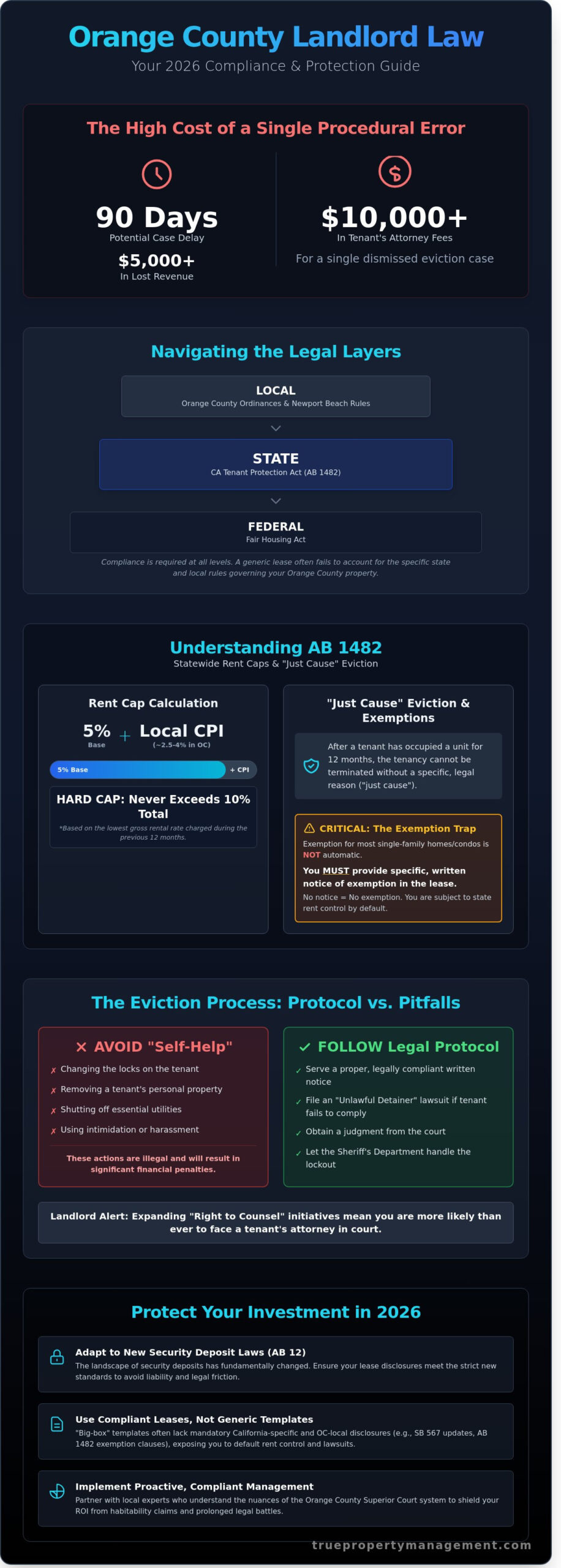
The Tenant Protection Act of 2019 (AB 1482) serves as the primary regulatory framework for California rentals by establishing statewide rent caps and mandatory “just cause” eviction protocols. This law prevents landlords from terminating a tenancy without a specific legal reason once a tenant has occupied the unit for 12 months. Rent increases are strictly capped at 5% plus the local Consumer Price Index (CPI), and they can never exceed a total of 10% within any 12-month period.
Claiming an exemption is not automatic. While most single-family homes and condos are exempt if they aren’t owned by a REIT or corporation, you must provide the tenant with a specific written notice of this exemption. If this notice wasn’t included in the lease or provided by the January 1, 2020 deadline (or at the start of a new tenancy), you lose those protections. True Property Management handles these notifications proactively so you never lose your right to manage your property’s value.
Orange County Local Nuances
Newport Beach and Irvine landlords must look beyond state law to address local zoning and short-term rules. Newport Beach Ordinance No. 2020-17, for example, strictly regulates short-term lodging permits and requires active management that many out-of-area firms can’t provide. You also have to account for the Orange County Superior Court’s specific interpretation of “no-fault” just cause evictions, which are scrutinized more heavily than in previous years.
Local “Right to Counsel” initiatives are expanding across Southern California, providing tenants with free legal representation in eviction cases. This shift means landlords face professional legal opposition in almost every dispute. Having a local partner who understands the specific tendencies of the Orange County court system is the only way to maintain the balance of power and ensure your ROI isn’t drained by prolonged legal battles.
Statewide Rent Control and Eviction Protections
Statewide regulations under AB 1482 create a complex framework for Newport Beach property owners. You need to master these rules to protect your investment and maintain strict compliance with california landlord tenant law. This legislation limits how much you can raise rent and dictates the specific circumstances under which you can terminate a lease. Ignoring these nuances doesn’t just lead to tenant friction; it opens the door to statutory damages and legal fees that can wipe out your annual ROI.
Rent Cap Mechanics for Newport Beach Rentals
For 2026, the maximum rent increase remains 5% plus the local Consumer Price Index (CPI) change, with a hard ceiling of 10%. In Orange County, the CPI typically fluctuates between 2.5% and 4% annually. You must calculate this increase based on the lowest gross rental rate charged during the previous 12 month period. Many landlords mistakenly include one-time pet fees or utility reimbursements in this calculation. This error can invalidate the entire increase and trigger a refund requirement.
Exemptions apply to most single-family homes and condos, provided they aren’t owned by a REIT, a corporation, or an LLC with a corporate member. However, this exemption isn’t automatic. You must provide your tenant with a specific, legally worded written notice of this exemption. If you fail to include this language in your lease or a separate disclosure, the state treats your property as a rent-controlled unit. Our team at True Property Management ensures every disclosure is present to safeguard your exempt status.
- Frequency: You can only implement two rent increases within any 12 month period, provided the total doesn’t exceed the cap.
- Notice: Increases of 10% or less require a 30 day notice; any increase above 10% (where applicable) requires a 90 day notice.
No-Fault Just Cause Evictions
Ending a tenancy isn’t as simple as letting a lease expire. Under Just Cause provisions, you need a legal reason to ask a tenant to leave if they’ve occupied the unit for 12 months or more. At-fault reasons include non-payment or lease violations. No-fault reasons, such as owner move-ins or substantial renovations, now require strict documentation and intent.
If you plan to move a family member into the unit, they must occupy the property for at least 12 months as their primary residence. For renovations, the work must be extensive enough to require a permit and at least 30 days of vacancy. When utilizing no-fault causes, you must provide relocation assistance equal to one month of the tenant’s rent. This payment is due within 15 days of serving the notice. If the tenant refuses to leave after a lease expires, you cannot simply change the locks. You must follow the formal unlawful detainer process to maintain legal integrity and asset protection.
Security Deposits and Mandatory Disclosures in 2026
Compliance with california landlord tenant law starts with understanding that your lease isn’t just a contract; it’s a legal shield. In Newport Beach, landlords must return security deposits within 21 calendar days of a tenant vacating the property. You can’t simply mail a check and move on. You must provide a detailed itemized statement along with copies of receipts for any repairs or cleaning charges that exceed $125. If you fail to meet this 21-day deadline, you lose the right to withhold any portion of the deposit, regardless of the property’s condition. We’ve seen owners face “bad faith” claims where judges award tenants three times the original deposit amount for simple clerical delays. Staying ahead of california security deposit law ensures your Newport Beach asset remains protected and your reputation stays intact.
Certain lease clauses are strictly prohibited and will be rendered void by a court. You cannot legally ask a tenant to waive their right to a jury trial, their right to notice before entry, or their right to the 21-day deposit return rule. Attempting to include these “waivers” doesn’t just invalidate the clause; it signals to a tenant’s attorney that you aren’t operating with True Transparency.
New Limits on Security Deposits (AB 12)
Since July 1, 2024, the financial barrier to entry for tenants has lowered significantly. Under AB 12, most California landlords are limited to collecting just one month’s rent for a security deposit, even if the unit is fully furnished. This creates a tighter margin for error regarding potential damages. There is a specific exception for small landlords who own no more than two residential properties with a combined total of no more than four units. These owners may still collect up to two months’ rent. Because you can no longer rely on a large cash buffer for risk mitigation, our comprehensive tenant screening in Orange County process has become more vital. We focus on verifying income at 3x the monthly rent and analyzing five years of rental history to ensure we place high-quality residents who respect the property.
Mandatory Disclosures and Paperwork
Disclosures are a non-negotiable part of the onboarding process in Orange County. The Bedbug Disclosure (AB 551) is a mandatory document that provides tenants with information on how to identify and report infestations. In high-density coastal areas, this is an essential tool for early detection and cost containment. Additionally, AB 646 requires landlords to notify tenants if the property is located in a FEMA-designated flood hazard zone. You must also disclose any death that occurred on the premises within the last three years to any prospective renter before they sign the lease. Failure to provide these documents, along with the federal lead-based paint disclosure for properties built before 1978, can lead to statutory penalties and the potential for a tenant to terminate their lease without notice. For a comprehensive overview of all required forms and their specific requirements, review our detailed guide on landlord disclosures california to ensure your property remains fully compliant.
The Legal Eviction Process: Avoiding “Self-Help” Pitfalls
Managing a non-performing asset is one of the most stressful experiences a Newport Beach property owner can face. When a tenant stops paying rent, your instinct might be to take immediate action to protect your cash flow. However, taking matters into your own hands through “self-help” evictions is a guaranteed way to turn a tenant issue into a legal nightmare. Under california landlord tenant law, actions like changing locks, removing a tenant’s belongings, or shutting off utilities are strictly prohibited. California Civil Code Section 789.3 allows tenants to sue for actual damages plus statutory penalties of up to $100 for each day the violation continues.
True Property Management acts as your shield, ensuring every step follows the letter of the law. We replace the emotional volatility of a dispute with a disciplined, proactive process. Instead of risking a lawsuit that could cost you thousands in legal fees, we focus on True Asset Protection. We handle the friction so you can maintain your peace of mind while we restore your property’s profitability.
Proper Notice Procedures
Precision is the only way to win in the Orange County court system. If your 3-Day Notice to Pay or Quit contains a single math error or an incorrect address, a judge will likely dismiss your case, forcing you to start over from day one. In 2026, compliance with the Tenant Protection Act remains mandatory for most Newport Beach rentals. You must correctly identify whether the tenancy requires “Just Cause” for termination. Whether you are serving a 3-day, 30-day, or 60-day notice, your proof of service must be impeccable. Our team ensures every document is served and documented to withstand the scrutiny of a contested hearing.
The Unlawful Detainer Timeline
The path to recovering your property begins with filing an Unlawful Detainer complaint in the Orange County Superior Court. Once served, a tenant typically has 5 days to file a written response. If they “answer” the complaint, the court will schedule a trial, usually within 20 days. Delays are common when tenants use procedural tactics to extend their stay, which is why professional eviction coordination is vital for minimizing vacancy loss. After a judgment is won, the Orange County Sheriff’s Department handles the final lockout. They provide the legal authority to physically remove the occupant, ensuring the transition is handled safely and professionally.
Don’t let a bad tenant drain your resources. Contact the experts at True Property Management to secure your rental income today.
Protecting Your Investment Through Professional Compliance
Owning a Newport Beach rental is a high-stakes financial play. One legal misstep can erase a year of profits. We view professional management as a shield; it’s the difference between a thriving asset and a legal liability. Our “True” approach ensures every lease and notice aligns with the latest california landlord tenant law updates. We don’t just react to problems; we anticipate them. By implementing rigorous screening and clear communication, we remove the friction that often leads to costly disputes.
Proactive maintenance is your best defense against “Warranty of Habitability” claims. California courts are increasingly strict about property conditions. If a plumbing issue or heating failure isn’t addressed within the required 24 to 48-hour window, you risk a lawsuit. We track every work order with timestamped digital records. This creates an audit trail that proves your compliance. True Transparency means you see every repair and every receipt, ensuring your property meets the standards set by the 2026 legislative updates.
Risk Mitigation for OC Investors
Regular property inspections prevent “Constructive Eviction” lawsuits. These claims often arise when a tenant feels a property is unlivable due to neglect. We conduct biannual walkthroughs to document the home’s condition. Every team member undergoes annual fair housing act california training. This ensures every interaction, from the first showing to the final move-out, is legally sound. This level of detail is essential for maximizing rental income and preserving your asset’s long-term value in a competitive market.
Why True Property Management is the Standard
We believe in True Transparency. Our “No Hidden Fees” guarantee simplifies your legal accounting. Many firms bury costs in the fine print, making it hard to track where your money goes. We provide clear, monthly financial statements that are ready for your tax professional. Our team monitors the 2026 legislative sessions in Sacramento to stay ahead of new bills. You get total peace of mind knowing a dedicated partner is managing your property management fees and compliance requirements. We handle the logistics so you can focus on your portfolio’s growth. When evaluating property management companies in orange county, it’s essential to find a partner that understands the complex regulatory landscape and provides the transparency you need to protect your investment.
- Are your security deposit limits compliant with AB 12’s one-month rent cap?
- Do your lease agreements reflect the latest “Just Cause” eviction protections?
- Is there a documented 24-hour response protocol for emergency maintenance?
- Have you conducted a biannual property inspection with photo evidence?
- Are security deposit dispositions sent within the strict 21-day legal limit?
Securing Your Orange County Portfolio in 2026
Navigating the evolving complexities of california landlord tenant law requires more than just a basic understanding of the rules. By 2026, stricter rent caps and expanded eviction protections have made the margin for error razor-thin for local property owners. Missing a single mandatory disclosure or mishandling a security deposit can trigger lawsuits that threaten your entire investment. You don’t have to face these legal hurdles alone.
True Property Management has served the local community since 2014. We provide over 10 years of specific Orange County expertise to ensure your rentals remain profitable and compliant. Our strict “No Hidden Fees” guarantee delivers the total transparency you deserve, while our 24/7 emergency response team handles issues before they escalate. We offer proactive legal compliance that acts as a protective barrier for your assets. It’s time to trade your management headaches for professional peace of mind and reliable financial success.
Protect your Orange County investment with True Property Management
You’ve built a valuable legacy in Southern California. We’re here to help you grow it with confidence and clarity.
Frequently Asked Questions
Is there rent control in Orange County for 2026?
Yes, Orange County follows statewide rent control under AB 1482 through 2030. This law limits annual increases to 5% plus the local Consumer Price Index or 10% total, whichever is lower. While Newport Beach doesn’t have a separate local rent board, you must still follow these state mandates for multi-family properties built more than 15 years ago. It’s vital to track the April CPI figures to ensure your 2026 adjustments remain legal.
Can a landlord in California enter without notice?
No, you can’t enter a unit without notice except in a true emergency like a fire or major flood. For routine inspections or repairs, California law requires you to provide at least 24 hours of written notice. We recommend using a digital portal to track these notices, ensuring you maintain a clear paper trail and respect your tenant’s privacy. This proactive approach prevents friction and builds a high-trust relationship with your residents.
How much can a landlord increase rent in California in 2026?
In 2026, most landlords can increase rent by a maximum of 10% or the 5% plus CPI threshold. Under california landlord tenant law, these calculations depend on the regional inflation data released every April. If your property is an exempt single-family home, you must still provide a 30-day notice for increases under 10% and a 90-day notice for anything higher. We handle these calculations to protect your asset’s ROI.
What is the maximum security deposit allowed in California now?
The maximum security deposit you can collect is one month’s rent for both furnished and unfurnished units. This change took effect on July 1, 2024, under Assembly Bill 12. There’s a small exception for small landlords who own no more than two rental properties with a total of four units; they can still request up to two months’ rent. We help you navigate these limits while still ensuring your property stays protected.
How long does the eviction process take in Orange County?
An uncontested eviction in Orange County typically takes 60 to 90 days from the initial notice to the final lockout. If a tenant files an answer or requests a jury trial, the timeline can stretch to 120 days or longer. We focus on proactive communication to resolve disputes early, as court delays in Santa Ana can quickly erode your annual ROI. It’s why our True Communication strategy is so effective.
Do I have to pay relocation assistance to my tenant in Newport Beach?
Yes, you must pay relocation assistance equal to one month’s rent if you terminate a tenancy for a no-fault reason. This includes situations like owner move-ins or substantial renovations required for safety. You can either provide the payment within 15 days of the notice or waive the final month’s rent in writing to stay compliant. Our team manages these transitions to ensure you don’t face costly legal pushback.
What are the required disclosures for a new lease in California?
You must provide disclosures for bed bugs, lead-based paint for pre-1978 builds, and methamphetamine contamination. Modern california landlord tenant law also requires a flood hazard disclosure if the property sits in a designated zone. Missing even one of these forms can lead to legal penalties; we double-check every lease packet for 100% compliance before signing. This True Transparency approach ensures your paperwork is bulletproof against future litigation.
Can I evict a tenant in California if I want to sell the property?
You can evict a tenant to sell the property only if you’ve a signed contract with a buyer who intends to occupy the unit. This falls under a no-fault just cause reason. You’ll need to provide a 60-day notice and pay the required relocation assistance. Selling a tenanted property is often easier, as it maintains your cash flow until the closing date. We provide the clarity you need to make these big moves.