
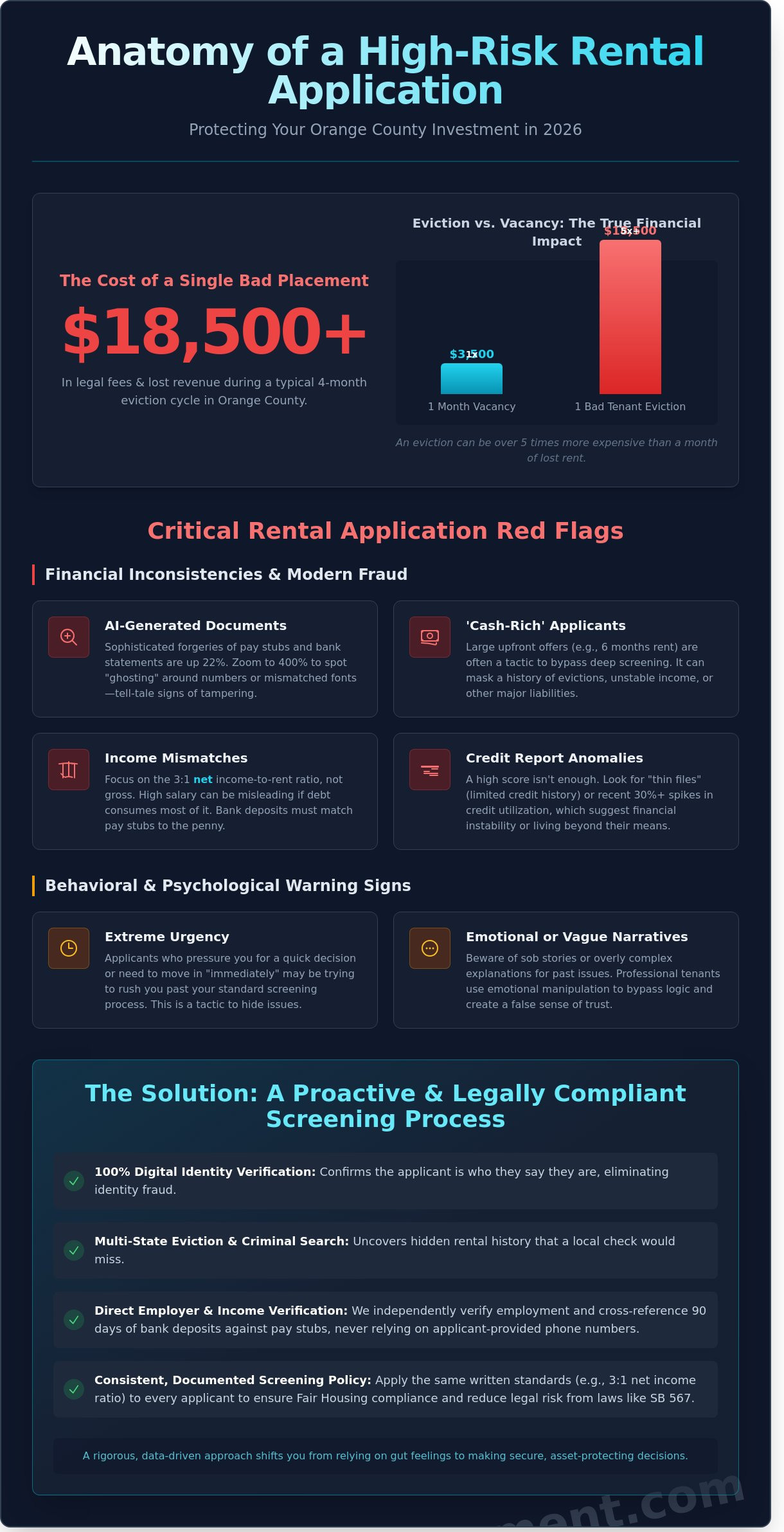
What if the “perfect” applicant offering six months of rent in advance is actually your biggest financial liability? In 2026, a single bad placement in Orange County can cost a landlord $18,500 in legal fees and lost revenue during a typical four month eviction cycle. You’ve worked hard to build your Newport Beach or Irvine portfolio; it’s natural to feel guarded when California laws make it increasingly difficult to remove a non-performing tenant who knows how to exploit the system.
We believe you deserve a management partner who prioritizes asset protection over a quick commission. This guide will teach you how to identify subtle rental application red flags that often signal high-risk behavior before it compromises your investment. We’ll walk you through our True Transparency framework for screening applicants, verifying documentation, and maintaining a clear path to a reliable, long-term tenancy. You’ll gain the confidence to reject unqualified prospects legally while securing the peace of mind that comes with a professional, proactive management strategy.
Key Takeaways
- Identify sophisticated financial fraud by learning to spot AI-generated documentation and verifying net income for your Newport Beach or Irvine luxury rentals.
- Understand the psychology of high-risk applicants to recognize when extreme urgency or emotional narratives are used to bypass your standard screening logic.
- Navigate the 2026 legal landscape, including SB 567, to protect your investment from the high legal costs and delays associated with professional tenants.
- Strengthen your vetting process by learning to identify subtle rental application red flags through 100% digital identity verification and multi-state eviction searches.
- Discover how the proprietary “True” screening process eliminates guesswork and secures your asset with proactive, high-trust verification tools.
Why Screening for Rental Application Red Flags is Critical in 2026
In 2026, the margin for error in property management has disappeared. A single bad placement in Orange County can now cost a landlord upwards of $20,000 in legal fees and lost revenue. While a vacant unit in Costa Mesa might cost $3,500 a month in unrealized rent, an eviction is five times more expensive. High-value markets require a shift from gut feelings to a rigorous, data-driven approach. Identifying rental application red flags before the keys are handed over is the only way to maintain your ROI.
California’s legal environment has become increasingly complex for independent owners. Laws like SB 567, which went into effect on April 1, 2024, along with specific Newport Beach ordinances, have redefined how owners must handle lease terminations and applicant selections. You need a partner who understands these nuances to ensure 100% compliance. Our True Transparency model ensures you aren’t just filling a vacancy; you’re securing a reliable financial asset.
The ‘Professional Tenant’ Phenomenon in Orange County
High-demand hubs like Irvine and Tustin are primary targets for a specific type of fraud: the professional tenant. These individuals often present a high-income appearance but have zero intent to pay. They look for self-managing owners who skip the deep-dive tenant screening process. By the time you realize the paystubs were forged, they’ve already cost you months of income. We use advanced verification tech to spot these rental application red flags that the human eye often misses.
California Compliance: Screening Without Violating Fair Housing
Rigorous screening must coexist with strict Fair Housing laws. In 2026, a lack of a written, consistent screening policy is a massive legal liability. To protect your investment, you must apply the same standards to every applicant. This includes:
- Documented income-to-rent ratios, typically 3:1 in the Orange County market.
- Verified credit history without discriminatory bias.
- Consistent background checks that follow the latest 2026 state updates.
Our True Communication approach keeps you informed at every step. We ensure your screening process is both effective and legally bulletproof. We act as your protective barrier against the logistical and legal headaches of modern property ownership.
Financial Inconsistencies: Detecting Modern Income Fraud
The 2024 rental market has seen a 22% increase in sophisticated document tampering. High-resolution PDFs can look flawless at first glance. However, zooming in to 400% often reveals “ghosting” around numbers or mismatched font kerning that indicates AI-generated pay stubs. These digital forgeries are common rental application red flags that untrained property owners often miss. In Newport Beach, where luxury rentals frequently exceed $10,000 monthly, we prioritize net income over gross figures. A high gross salary means little if tax liens or high-interest debt eat 55% of their take-home pay. We look for a 3:1 net income-to-rent ratio to ensure long-term stability.
Beware of the “cash-rich” applicant. Someone offering six months of rent upfront is usually trying to bypass a deep background check. While a large lump sum feels like security, it’s often a mask for a history of evictions or unstable income sources. Our True Property Management team treats these offers as a signal to dig deeper, not a reason to skip the screening process. We value consistent, verifiable cash flow over one-time payments that might precede a legal battle.
Verifying the Unverifiable: Income and Employment
Never trust the phone number provided on an application. Fraudsters often list a friend’s cell phone as their supervisor. We use the California Secretary of State portal to verify business legitimacy for applicants in the OC tech and consulting sectors. We then cross-reference reported pay with actual bank deposits over a 90-day period. This True Transparency ensures the numbers are real, not just pixels on a screen. If the deposits don’t match the pay stubs to the penny, it’s a disqualifying discrepancy.
Credit Report Anomalies You Can’t Ignore
A score of 720 doesn’t tell the whole story. We look for “thin files” or recent 30% spikes in credit utilization that suggest an applicant is living beyond their means. Under the Fair Credit Reporting Act, landlords must handle this sensitive data with strict legal compliance. We prioritize utility collections over medical debt. A candidate who ignores their power or water bill is a much higher risk than one with an old hospital invoice. We also watch for a revolving door of high-interest, short-term loans. These rental application red flags signal a volatile financial situation that threatens your monthly ROI.
Behavioral Warning Signs: The Subtle Psychology of Risk
Financial documents tell one story, but human behavior often reveals the subtext. At True Property Management, we’ve found that the most sophisticated rental application red flags aren’t found on a bank statement; they’re found in the interaction. An applicant who insists on moving in within 48 hours is rarely just excited. This artificial urgency is a classic tactic used to bypass a rigorous “True” screening process, often masking a pending eviction or a collapsed living situation. While speed is vital in the Orange County market, rushing the process is a recipe for a 12-month headache.
Professional tenants often rely on “The Sob Story” to trigger an emotional response that clouds a landlord’s judgment. They use empathy as a tool to explain away a 550 credit score or a lack of verifiable income. Our team maintains a protective barrier by sticking to objective data. We ensure every screening remains compliant with California fair housing laws, which protects both the owner and the applicant. If a tenant spent the entire showing criticizing their previous landlord, take it as a warning. Disgruntled tenants usually bring that same conflict to their next lease agreement.
The Anatomy of a Fake Reference
Distinguishing a legitimate property manager from a friend posing as a landlord requires a specific line of questioning. A friend won’t know the exact dates of a 2022 lease or the specific amount of the security deposit held. We always look for the “previous-previous” landlord. A current landlord might give a glowing review just to get a problem tenant out of their property; however, a landlord from two years ago has no incentive to be anything but honest. This “True” verification method uncovers gaps in rental history that don’t align with job changes.
Communication Patterns of High-Risk Tenants
- Aggressive Negotiation: Applicants who haggle over the security deposit or lease terms before they’re even approved often become high-maintenance tenants who ignore rules later.
- The Ghosting Pattern: If an applicant takes more than 72 hours to provide a requested W-2 or ID, they’re likely shopping for other properties or struggling to forge documentation.
- Inconsistent Narratives: Watch for stories about moving from Costa Mesa to Irvine that don’t match the commute or lifestyle needs described in their initial email.
Reliability starts at the first point of contact. If the communication is inconsistent during the honeymoon phase of the application, the rent checks likely will be too. We prioritize “True Communication” to ensure every applicant is vetted for both their creditworthiness and their character.
The ‘True’ Professional Screening Checklist for OC Landlords
Identifying rental application red flags requires more than a gut feeling; it demands a rigorous, data-driven process. At True Property Management, we utilize a five-step protocol to protect your asset from high-risk tenants. We start with 100% digital identity verification. This prevents synthetic identity fraud, a crime that increased by 25% in the financial sector over the last 24 months. We don’t just look at a physical ID; we verify the data against credit bureau headers in real-time to ensure the person is who they claim to be.
Our process moves beyond basic checks to provide a protective barrier for your investment. We follow these specific steps for every adult occupant:
- Multi-State Eviction Searches: We look beyond California borders. A tenant might have a clean record in Orange County but two filings in Nevada or Arizona from 2022.
- Employment Cross-Referencing: We compare reported history against social media and professional profiles. Discrepancies between an application and a LinkedIn profile often signal a fabricated work history.
- Ownership Verification: We use property tax records to confirm the person listed as the “current landlord” actually owns the property. This stops the common “friend-as-landlord” scheme.
- Legal Documentation: Every approval or denial is logged against pre-set, legal criteria to ensure 100% compliance with Fair Housing laws.
Essential Documents Every Applicant Must Provide
To catch rental application red flags early, we require specific, unalterable documentation. This includes a government-issued ID verified against credit data and the last 90 days of consecutive bank statements. We never accept screenshots, as these are easily manipulated with basic software. We also insist on direct contact info for the actual property owner of their current rental to ensure we’re getting a True reference.
Local Verification: The Newport Beach & Irvine Advantage
Local expertise is our strongest filter. In markets like Newport Beach and Irvine, we know the specific residential layouts and complexes. If an applicant lists an address that we know is a commercial building or a short-term vacation rental, we flag it immediately. We also monitor local court records for civil litigation. This helps us spot “neighborhood hoppers” who move every 12 months to stay one step ahead of legal repercussions.
Protecting Your Asset with True Property Management
Identifying rental application red flags is a vital skill, but most owners don’t have the hours required to investigate every suspicious detail. Our “True” Screening process eliminates the guesswork for Orange County owners by using 24/7 digital tools. We leverage high-trust verification systems that cross-reference identity and income data against real-time financial records. This proactive approach has allowed us to maintain a zero-eviction history for our Newport Beach property management clients throughout 2023 and 2024. Transparency is our lead principle, ensuring you get reliable placements without any hidden fees or surprise costs that eat into your monthly cash flow.
The True Shield: Our Multi-Layered Defense
We use industry-leading technology to catch subtle inconsistencies that standard background checks often miss. This system utilizes AI-driven document verification to detect forged pay stubs and altered bank statements instantly. Legal compliance is a priority, and we manage all Fair Housing risks to keep your investment safe. Our team acts as a protective barrier between you and the logistical headaches of tenant management. Asset protection and ROI are our focus, as we treat your property like our own investment rather than just another unit on a spreadsheet.
Ready for Stress-Free Ownership?
The peace of mind that comes with professional, full-service management is life-changing for local investors. You can stop being a stressed landlord and transition into the role of a successful investor. We handle the 2:00 AM maintenance calls and the complex legal paperwork so you don’t have to. Our team is trained to spot rental application red flags before they become costly legal battles. Local expertise in the Orange County market ensures your rental stays profitable and protected. It’s time to experience a high-level partnership built on mutual respect and veracity. Take the first step toward a more secure investment today.
Future-Proof Your Orange County Rental Strategy
Navigating the local market in 2026 requires more than a gut feeling; it demands a data-driven defense against increasingly sophisticated fraud. We’ve explored how identifying rental application red flags, from digital income manipulation to subtle behavioral inconsistencies, can save you thousands in lost revenue and legal fees. Protecting your investment means staying ahead of these evolving risks with a strategy that prioritizes asset protection and proactive communication.
True Property Management provides that essential protective barrier for your peace of mind. Led by Michael Chiusano, our team acts as your dedicated OC local expert, applying a rigorous 10-Point Tenant Screening Process to every single applicant. We’ve eliminated the typical industry coldness by offering a high-level partnership backed by our signature No Hidden Fees Guarantee. It’s time to move past the logistical headaches of DIY management and embrace a system designed to maximize your ROI. You deserve a management style that’s as disciplined as it is effective. Let’s ensure your property remains a source of financial success rather than a burden of risk.
Learn more about comprehensive tenant screening strategies for Orange County landlords
Frequently Asked Questions
Can I legally reject a tenant for having a low credit score in California?
You can legally reject an applicant for a low credit score in California as long as you apply the same standards to every candidate consistently. Most Orange County landlords set a minimum threshold of 650 to ensure financial stability. If you deny someone based on their report, you’re required by the Fair Credit Reporting Act to provide an adverse action notice citing the specific credit agency used.
Is it a red flag if a tenant offers to pay 6 months of rent in advance?
Offering 6 months of rent upfront is a major rental application red flag because it often serves to bypass standard income verification. While it looks like a windfall, it can hide a lack of steady employment or a history of lease violations. Under California AB 12, effective July 1, 2024, security deposits are limited to one month’s rent, making these lump sum offers even more scrutinized by professional managers.
How do I verify a self-employed applicant’s income in Newport Beach?
You should verify a self-employed applicant’s income by requesting the last 2 years of federal tax returns and 3 consecutive months of personal bank statements. In Newport Beach, where median rents often exceed $4,500, we look for a consistent 3:1 income-to-rent ratio. Cross-referencing 1099 forms with bank deposits ensures the applicant has the liquid cash flow to sustain a long-term lease in a high-cost market.
What should I do if a rental reference sounds like a friend or relative?
If a reference sounds like a friend, verify the property ownership through the Orange County Tax Assessor records to confirm they actually own the rental. Ask the reference for the exact monthly rent amount and the specific dates of the lease agreement. Real landlords have these figures ready, while friends usually stumble over the financial details. This step prevents you from being misled by a staged recommendation.
Are there specific red flags for tenants moving from out of state to Orange County?
The biggest red flag for out-of-state applicants is the absence of a verified local employment offer or a transfer letter on company letterhead. Moving 2,500 miles without a secured income source is a high-risk scenario for any property owner. We also look for sight unseen requests where the tenant refuses a live video walkthrough, as this can signal a potential sub-leasing scam or identity fraud.
What is the most common lie found on rental applications in 2026?
The most common lie on rental applications in 2026 is the use of sophisticated, AI-generated pay stubs to inflate monthly earnings. Industry data shows a 15% rise in document tampering over the last 12 months. Our True Verification process catches these discrepancies by calling HR departments directly and using digital screening tools that flag inconsistencies in font and metadata on uploaded PDF documents.
How can I check an applicant’s eviction history if it doesn’t show on a credit report?
You can uncover hidden evictions by searching the Orange County Superior Court civil index for unlawful detainer filings. Since many evictions end in no-fault settlements, they don’t always appear as a judgment on a credit report. A thorough background check should include a nationwide eviction database search to catch filings from other jurisdictions where the applicant previously resided during the last 7 years.
Is ‘job hopping’ still considered a major red flag in the current economy?
Job hopping remains a concern if an applicant has held 3 or more positions within a 12-month period without a clear career progression. While the modern economy is more fluid, we prioritize tenants who show at least 2 years of stability in their current field. Frequent gaps in employment suggest a volatile income stream, which increases the risk of late payments and financial stress for the landlord.