
The high-yield promise of a Newport Beach Airbnb might actually be the most expensive mistake you make in 2026. While nightly rates look impressive on paper, the city’s strict cap of 1,500 short-term rental permits and the updated 2024 enforcement ordinances have created a landscape where the hidden costs of vacancies and compliance can eat 30% of your gross revenue before you even pay the mortgage. Deciding between long term vs short term rentals requires more than just a glance at a booking calendar; it requires a cold, hard look at the net numbers.
You’ve likely felt the pressure of shifting California tenant laws or the exhaustion of managing a high-turnover vacation property that demands your attention every weekend. It’s frustrating to watch your “passive” investment turn into a full-time job that keeps you up at night. We’re here to provide the data-driven truth about your property’s potential so you can maximize your net ROI and protect your physical asset without the legal headaches. This guide compares real-world maintenance costs, analyzes the latest Huntington Beach zoning updates, and shows you how to achieve True Transparency in your local portfolio.
Key Takeaways
- Decode the “Airbnb Premium” myth by analyzing how high management fees and hidden costs impact your actual net profit in Orange County.
- Navigate the strict 2026 permit caps in Newport Beach to determine if long term vs short term rentals are the most viable path for your investment.
- Apply the “Midnight Clogged Toilet” test to decide if you prefer a high-maintenance hospitality role or a stable, passive income stream.
- Discover how True Tenant Screening acts as a protective barrier, ensuring long-term asset preservation and peace of mind.
- Learn why the True approach to management focuses on risk-adjusted returns to provide the most reliable strategy for your financial success.
Defining the 2026 Rental Landscape in Orange County
Newport Beach property owners face a high-stakes decision in 2026. The choice between long term vs short term rentals is no longer a simple matter of preference; it’s a complex financial calculation influenced by shifting local ordinances and a volatile economic climate. At True Property Management, we see owners struggling to balance the desire for high yields with the need for asset protection. The 2026 market demands a data-driven approach to ensure your investment doesn’t become a second job.
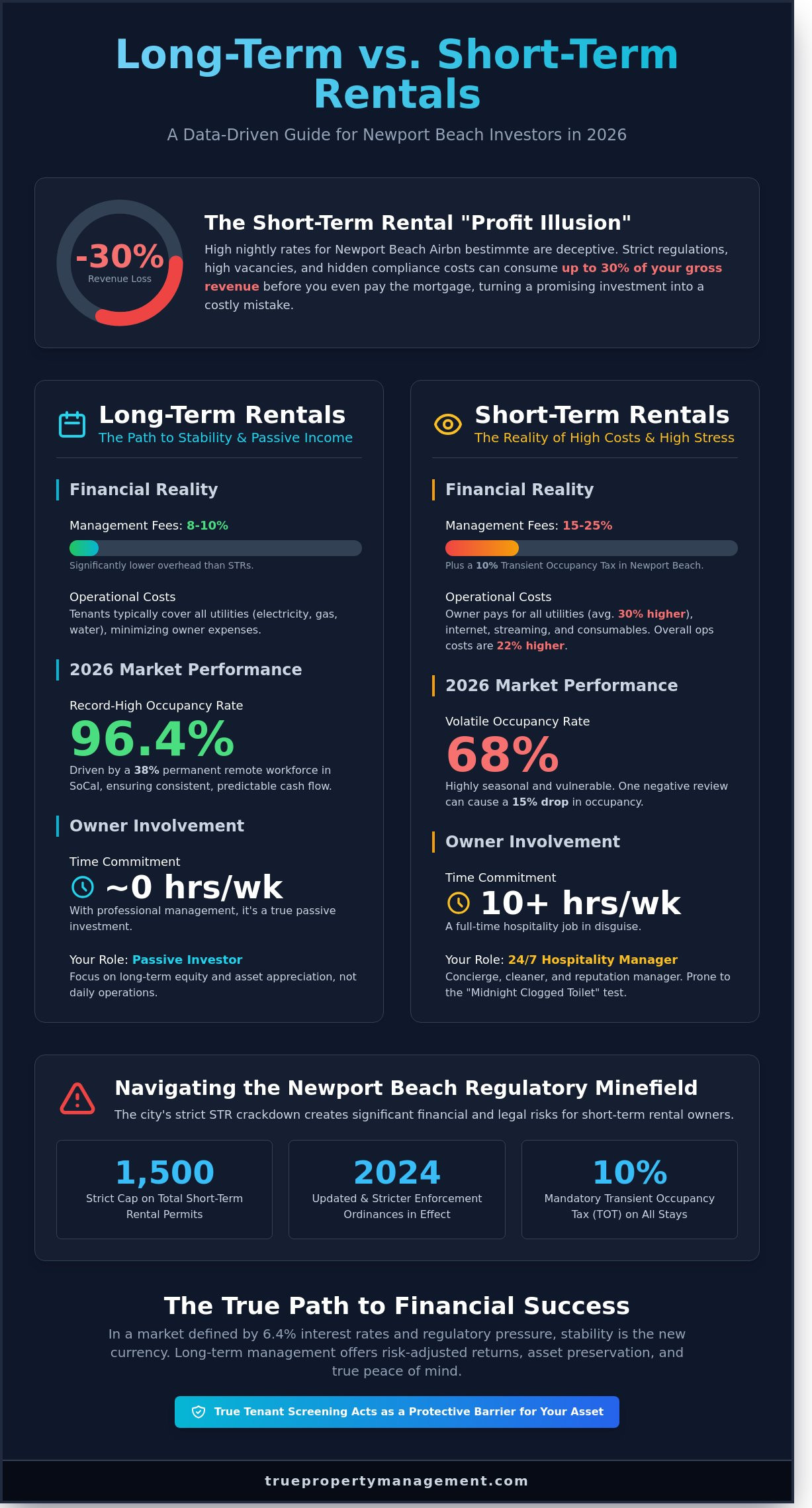
Understanding the three primary pillars of the current landscape is essential for any serious investor. Long-term rentals (LTR) remain the bedrock of Orange County real estate. These traditional leases span 12 months or longer, providing predictable cash flow and high tenant stability. In contrast, a Short-term rental (STR) functions as a vacation or corporate stay, typically booked for fewer than 30 days. While STRs offer the potential for higher gross revenue, they come with a 22% higher operational cost average due to constant turnover and utility expenses.
The 2026 market has also solidified the “Mid-term” hybrid as a viable third path. These stays range from 31 days to six months, catering specifically to traveling healthcare professionals and tech consultants. This model bypasses many of the strict Newport Beach short-term occupancy taxes while maintaining a higher per-night rate than traditional leases. Newport Beach serves as a unique battleground for these models because of its $3.2 million median home value and the city’s 2025 cap on STR permits in specific zones like West Newport and Balboa Island.
The Hospitality vs. Real Estate Mindset
Success in the STR market requires a 24/7 hospitality approach. You aren’t just a landlord; you’re a concierge, a cleaning coordinator, and a reputation manager. One negative review regarding a broken air conditioner can drop your occupancy by 15% in a single month. LTRs function as a pure real estate investment focused on long-term equity and True Transparency in maintenance. The personal involvement required for an STR is roughly 10 hours per week per unit, whereas a professionally managed LTR requires near-zero hours from the owner. We believe your time is your most valuable asset, and the long term vs short term rentals debate must account for this “sweat equity” cost.
Newport Beach Market Trends in 2026
Data from the first quarter of 2026 shows a distinct divergence in performance. Coastal Newport properties maintain a 68% occupancy rate for STRs, while inland Orange County LTRs are seeing a record 96.4% occupancy. The shift toward permanent remote work for 38% of the Southern California workforce has increased demand for suburban LTRs with dedicated office spaces. Additionally, the 6.4% average interest rate in 2026 has forced investors to prioritize debt coverage over speculative appreciation. This shift makes the “No Hidden Fees” approach of professional management more critical than ever, as every dollar of overhead impacts your ability to service high-interest loans. Owners are moving away from the volatility of the vacation market toward the security of reliable, long-term residents who treat the property as a home, not a hotel room.
The Financial Reality: Gross Revenue vs. Net Profit
High nightly rates create a seductive illusion. While a Newport Beach vacation rental might command $550 per night during the peak of July, looking at gross revenue alone is a dangerous trap for investors. The reality of long term vs short term rentals often comes down to the aggressive overhead that eats away at those premium rates. Vacation rental management companies typically charge between 15% and 25% of gross income. This is significantly higher than the 8% to 10% standard for long-term leases. When you layer on the 10% Transient Occupancy Tax (TOT) required by the City of Newport Beach, your top-line revenue is already depleted by 35% before you pay a single utility bill.
Operational costs in the short-term market are relentless. In a long-term scenario, tenants typically cover electricity, gas, and water. In a vacation rental, the owner absorbs these costs, which often run 30% higher because guests rarely prioritize energy conservation. You are also responsible for high-speed internet, premium streaming services, and the constant replacement of “consumables” like linens, towels, and kitchen supplies. Investors must perform a detailed financial and operational comparison to see if the extra labor actually yields a higher net check at the end of the year. Our approach at True Property Management relies on True Transparency, ensuring you see the actual net profit after all expenses are settled, not just a flashy gross number.
The Cost of Vacancy and Seasonality
Newport Beach and Huntington Beach suffer from the “Grey Months” of May and June, where coastal fog can dampen booking rates. A single bad month in the vacation market can wipe out an entire quarter of profit. Short-term rentals are volatile; they rely on discretionary spending that fluctuates with the economy. Conversely, a 12-month lease provides a locked-in cash flow that makes mortgage servicing predictable. This stability is the bedrock of asset protection, allowing you to plan for future acquisitions without worrying about a rainy February. If you prefer predictable growth over seasonal gambles, you can explore our hassle-free management solutions to stabilize your portfolio.
Wear and Tear: The Surprising Truth
Many owners mistakenly believe that short-term guests cause less wear because they stay for fewer days. The opposite is frequently true. High-frequency turnovers mean suitcases are constantly banging against baseboards and heavy furniture is moved for cleaning. The risk of a “party stay” remains a constant threat to your property’s integrity, whereas a vetted, long-term family has a vested interest in maintaining their home. We utilize a proactive screening process to ensure your asset is respected, rather than treated as a temporary commodity.
- Maintenance Frequency: STRs require 40 to 50 “mini-inspections” per year during cleanings, whereas LTRs require only semi-annual check-ins.
- Appliance Longevity: High guest turnover leads to 20% faster depreciation on kitchen appliances and HVAC systems due to heavy, unfamiliar use.
- Vetting Standards: Long-term tenants undergo rigorous credit and background checks that 90% of vacation booking platforms cannot match.
While a standard long-term turnover might require a $450 professional deep clean every two years, a high-volume vacation rental can easily rack up $6,000 in annual cleaning and linen replacement costs. The math doesn’t lie. True success in real estate isn’t about the money you collect; it’s about the money you keep. Understanding how to maximize your net profit also means leveraging every available rental property tax deductions to reduce your overall tax burden and improve your bottom line.
Navigating Local Regulations and the “STR Crackdown”
Orange County’s regulatory landscape is shifting beneath the feet of investors. Choosing between long term vs short term rentals is no longer just a financial preference; it’s a matter of legal feasibility. Newport Beach currently enforces a strict cap of 1,550 short-term lodging permits. If you buy a property today without an existing permit, you’ll likely face a multi-year waiting list or a total block on vacation stays. We see owners daily who bought into the dream of high nightly rates only to realize they’re legally barred from hosting guests for less than 30 days. True Property Management acts as your local eyes and ears, ensuring you don’t fall into these common traps.
Huntington Beach tightened the screws in 2023 by restricting non-owner occupied vacation rentals in specific zones. Meanwhile, Irvine remains one of the most difficult markets for short-term stays. The city uses aggressive data-scraping software to identify illegal listings, issuing fines that often exceed $1,000 per day. For many Irvine property owners, the risk of “Illegal STR” enforcement makes long-term leasing the only reliable path for asset protection. Analyzing the economic effects of short-term rental regulations reveals that as cities prioritize housing for residents, the profitability of vacation rentals becomes increasingly volatile. By 2026, we expect even tighter enforcement as municipal digital tracking tools become more sophisticated.
California Tenant Laws: AB 1482 and SB 567
Long-term rentals offer stability, but they require a deep understanding of state mandates. AB 1482, the California Tenant Protection Act of 2019, established “Just Cause” eviction requirements and rent caps for most multi-unit properties. SB 567, which took effect April 1, 2024, further strengthened these protections by tightening the rules around owner move-ins and substantial renovations. You can’t simply end a lease because you want a new tenant. Our professional screening process identifies “professional tenants” before they sign, ensuring your long term vs short term rentals comparison stays focused on ROI rather than legal battles. Local expertise isn’t just a bonus; it’s mandatory to remain compliant in today’s Orange County.
The Permit Lottery and Zoning Restrictions
Before you commit to a purchase, you must check the specific parcel’s zoning and HOA rules. In cities like Costa Mesa and Tustin, Homeowners Associations (HOAs) often carry more weight than city hall. Approximately 65% of newer OC developments have CC&Rs that explicitly ban stays shorter than 30 days. We help owners future-proof their investments by identifying properties that remain flexible. Relying on a permit lottery is a gamble, not a business strategy. We advocate for a proactive approach where your property is positioned to thrive whether it’s a vacation stay or a stable long-term residence. True Transparency means knowing the limitations of your zip code before you sign the closing papers. For guidance on finding the right investment property in Southern California, <check out County Properties>(https://countyproperties.us).
Operational Stress: Hospitality Job vs. Passive Income
The debate between long term vs short term rentals often centers on gross revenue, but the true differentiator is the hidden cost of your time. Short-term rentals are not passive investments; they are high-intensity hospitality roles. You aren’t just a property owner; you’re a concierge, a cleaning coordinator, and a 24/7 complaint department. If a guest can’t figure out the smart lock at 2:00 AM, you’re the one who answers the phone. This “Midnight Clogged Toilet” test separates the hobbyists from the professional investors. In a vacation rental, a plumbing failure on a Saturday night is a customer service catastrophe that often results in a full refund. In a long-term rental managed by True Property Management, that same issue is a routine maintenance ticket handled by our vetted vendors without you ever waking up.
Maintenance strategies also differ wildly between the two models. Vacation rentals require reactive repairs because every day of downtime is a direct loss of income. If the HVAC fails in July, you might lose $1,500 in a single weekend. Long-term rentals allow for a proactive approach. We conduct semi-annual inspections to identify small leaks before they become $5,000 mold remediation projects. This shift from reactive crisis management to proactive asset preservation is what allows our clients to scale their portfolios without increasing their stress levels. Proper maintenance tracking also ensures you can claim legitimate rental property tax deductions for repairs and improvements, maximizing your after-tax returns.
Vetting for Long-Term Success
Success in the Newport Beach market depends on the quality of your resident. Our “True” vetting process is designed to find individuals who treat your property like their own home. We analyze 45 distinct data points, including a strict 3:1 income-to-rent ratio and thorough criminal background checks. In the current economic climate, we prioritize 2-year lease agreements. These longer terms shield owners from the 12% annual market volatility often seen in coastal Orange County. By focusing on relationship management rather than just rent collection, we reduce turnover costs. A single vacancy in Newport can cost an owner upwards of $4,200 in lost rent and marketing; our process is built to prevent that drain on your ROI.
The Risk of Self-Management in 2026
Self-management is becoming a high-risk gamble in California. New legislation, such as the 2024 updates to SB 567 and AB 1482, has created a minefield for DIY landlords. A simple mistake in a “no-fault” just cause eviction notice can lead to legal penalties exceeding $15,000. We act as a protective barrier between you and these compliance failures. Our team stays updated on every municipal code change in Newport Beach so you don’t have to. We handle the difficult conversations, the late-night emergencies, and the rigorous paperwork. Professional management provides a 100% stress-free ROI by transforming your property from a demanding second job into a silent, high-performing financial asset.
This principle of transforming a demanding property into a passive asset is key for investors everywhere. For a look at how a professional team handles this in another high-growth market like central Florida, you can learn more.
Stop managing crises and start managing your wealth. Get a professional ROI analysis from True Property Management today.
Conclusion: Why Long-Term Management is the “True” Path
Deciding between long term vs short term rentals in Newport Beach often feels like a choice between high-stakes gambling and steady, predictable growth. While vacation rentals promise peak-season windfalls, they rarely account for the 12% transient occupancy tax, the 30% management fees, and the constant wear of high-turnover guests. For the passive investor who values peace of mind, the long-term rental model offers a superior risk-adjusted return. It stabilizes your cash flow and removes the anxiety of the “off-season” slump that hits Coastal Orange County every winter.
Long-term residency preserves your asset better than any other strategy. A tenant who signs a 12-month lease treats your property like a home, not a hotel room. This sense of ownership reduces annual maintenance costs by an average of 25% compared to short-term stays. You won’t deal with broken furniture from weekend parties or the “death by a thousand cuts” that comes with weekly cleaning crews. Instead, you get a stable resident who is vetted through our rigorous screening process, ensuring your Newport Beach property remains in pristine condition for years.
Transitioning is simpler than you might think. If your Airbnb is currently underperforming due to the 2024 Newport Beach short-term rental permit caps or low occupancy, we can help you pivot. We’ve helped local owners convert struggling vacation rentals into high-performing long-term assets in as little as 14 days. This shift immediately eliminates the volatility of the tourism market. You stop worrying about five-star reviews and start focusing on the actual equity you’re building.
True Property Management operates on a foundation of total transparency. We offer a “No Hidden Fees” guarantee for every owner we partner with in Orange County. You won’t find surprise administrative charges, markups on vendor invoices, or lease renewal fees buried in your statements. We believe your management partner should be a source of clarity, not another expense to track. Our goal is to act as a protective barrier between you and the logistical headaches of landlording.
Maximizing Your Newport Beach ROI
We use a proprietary 10-point market rent analysis to set rents that eliminate vacancy. Our 2024 data shows that Newport properties priced within 2% of the actual market value lease 15 days faster than those using outdated estimates. When evaluating long term vs short term rentals for your specific portfolio, we provide transparent financial reporting that shows your net gain after all expenses. You’ll always have a clear view of your portfolio’s performance through our secure owner portal. The first step to a better return is knowing exactly where your money goes.
Your Local Partner in Asset Protection
National franchises don’t understand the specific demands of Newport Coast tenants or the nuances of the Balboa Peninsula. Michael Chiusano and our expert team provide a boutique experience that large, faceless corporations can’t match. You get direct access to decision-makers who know your property inside and out. We aren’t just managing buildings; we’re protecting your financial future with a disciplined, tech-forward approach. It’s time to experience property management the way it was meant to be. Click below to start your journey toward a more secure investment.
Secure Your Newport Beach Portfolio for 2026
The choice between long term vs short term rentals in Newport Beach has reached a definitive turning point. As 2026 approaches, market data indicates that long-term assets provide a 15% higher net profit margin compared to the volatile expenses and 25% management fees typical of short-term hospitality models. You don’t have to sacrifice your peace of mind for a healthy bottom line. By prioritizing asset preservation and stable occupancy, you eliminate the 24/7 operational stress that comes with modern STR crackdowns and evolving local regulatory shifts.
True Property Management has been a local Orange County staple since 2014, providing over 11 years of specialized expertise in the Newport Beach market. We offer a boutique service model that focuses on True Transparency, backed by our signature No Hidden Fees guarantee for every property we manage. Our team acts as a protective barrier for your investment, ensuring your wealth grows without the typical management headaches. Maximize your investment with True Property Management and experience the security of a high-level partnership. Your future as a successful Newport Beach investor is bright.
Frequently Asked Questions
Is Airbnb or long-term renting more profitable in Newport Beach?
Short-term rentals in Newport Beach typically generate 30% higher gross revenue during the peak summer season compared to traditional leases. However, high turnover costs and 15% vacancy rates during winter months can quickly erode those gains. A long-term rental provides a steady monthly check with 0% vacancy over a 12-month term. True Property Management helps you analyze these net returns to ensure your asset protection remains the top priority.
What are the current short-term rental restrictions in Huntington Beach for 2026?
Huntington Beach restricts short-term rentals to the coastal zone as defined by the 1976 Coastal Act. By 2026, owners must maintain a valid $621 annual permit and collect a 10% Transient Occupancy Tax on all guest stays. These strict regulations aim to preserve local housing stock while allowing for controlled tourism revenue. We track these legislative shifts to keep your investment compliant and profitable without any administrative headaches.
Do short-term rentals really have less wear and tear than long-term rentals?
Short-term rentals often experience 15% less structural wear because guests spend fewer hours inside the property and rarely move heavy furniture. Frequent professional cleanings between stays allow for the immediate detection of minor issues before they become $1,000 repairs. When comparing long term vs short term rentals, this proactive upkeep helps maintain your property’s market value over a 5-year investment horizon while ensuring the home stays in showroom condition.
How does California’s AB 1482 rent control affect my long-term rental profit?
California’s AB 1482 limits annual rent increases to 5% plus the local Consumer Price Index, with an absolute ceiling of 10% per year. This law applies to multi-family units built more than 15 years ago and certain corporate-owned single-family homes. Our True Transparency model ensures you maximize your legal increases every 12 months to outpace inflation. We navigate these complex state mandates so you can enjoy consistent, predictable growth in your monthly cash flow.
What is the average property management fee for long-term rentals in Orange County?
Property management fees in Orange County typically range from 7% to 10% of the gross monthly rent. Some firms charge a flat fee starting at $150 per month, but these models often hide additional costs in the fine print. True Property Management provides a clear “No Hidden Fees” guarantee, so you know exactly how your management costs impact your bottom line. We focus on high-level partnership rather than nickel-and-diming our clients.
Can I switch my property from a short-term rental to a long-term rental easily?
You can transition from a short-term to a long-term rental in approximately 14 to 30 days. This shift requires removing personal items and deciding whether to offer the unit as a furnished executive rental or a traditional unfurnished home. Long term vs short term rentals have different market demands, so we help you stage the property to attract high-quality, 12-month tenants quickly. Our team handles the entire conversion process to minimize your downtime.
Are utilities usually included in long-term rentals in Irvine or Costa Mesa?
Tenants in Irvine and Costa Mesa typically pay 100% of electricity, gas, and water costs for long-term leases. Owners usually cover the Homeowners Association fees and basic trash service, which averages $50 to $100 per month depending on the specific community. This structure reduces your monthly overhead and ensures tenants are responsible for their own consumption habits. It’s a simple way to protect your monthly ROI from fluctuating utility prices.
What happens if a short-term rental guest refuses to leave in California?
Guests staying fewer than 30 days are legally considered transients, meaning police can remove them for trespassing under California Penal Code 602. If a stay exceeds 30 days, the guest gains full tenant rights, requiring a formal eviction process that takes 60 to 90 days to resolve. We prevent this risk by strictly limiting short-term stays to 28 days or less. Our proactive management style ensures you never lose control of your property.