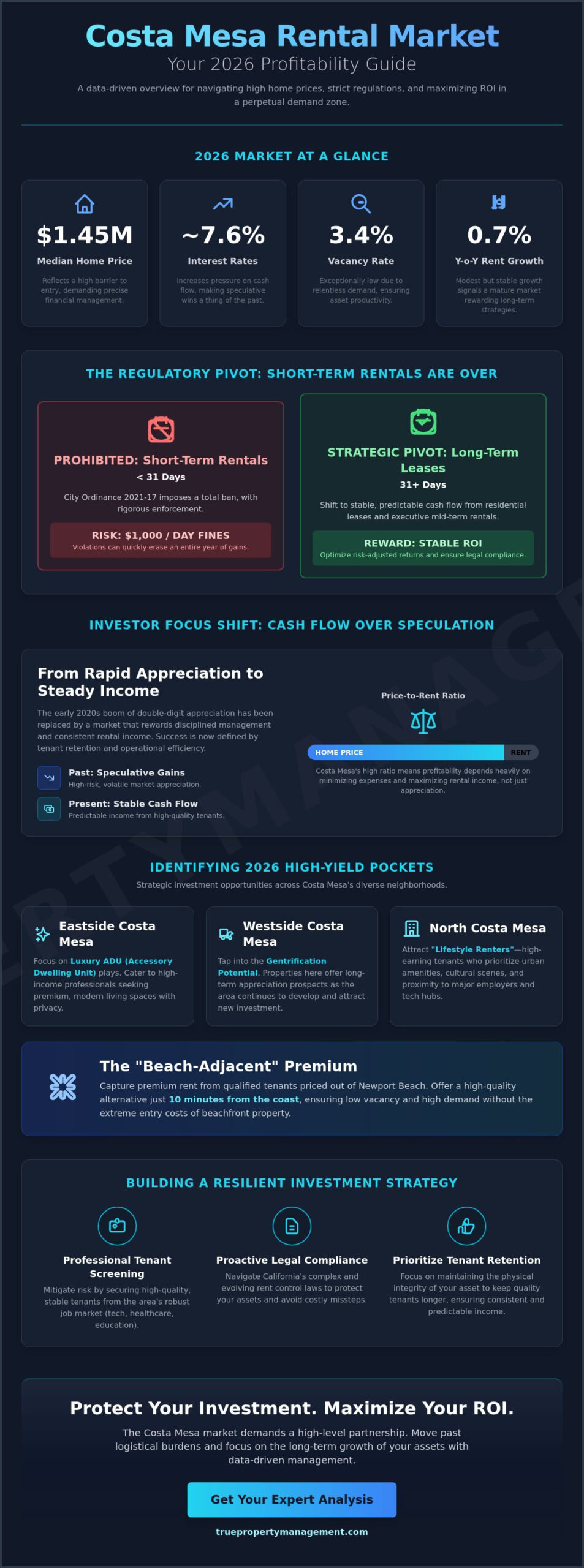
In a market where the median home price has hit $1.45 million and interest rates hover near 7.6%, the era of speculative “easy wins” in Orange County is officially over. Assessing Costa Mesa rental property profitability 2026 requires more than just a spreadsheet; it demands a fundamental shift in how you view your portfolio. You’re likely feeling the squeeze of the city’s total ban on short-term rentals and the complexity of California’s latest rent control caps. It’s a challenging environment where one regulatory misstep can erase a year’s worth of gains.
We’re here to provide the data-driven clarity you need to protect your investment and maximize your ROI despite these local hurdles. You deserve the peace of mind that comes from a high-level partnership rooted in financial success. This guide explores the transition from vacation rentals to stable residential leases, the realities of current cap rates, and the strategies necessary to maintain financial security in an increasingly regulated landscape. We will help you move past the logistical burdens so you can focus on the long-term growth of your assets.
Key Takeaways
- Learn why a strategic pivot to long-term leases is the only viable path under current city ordinances and how to protect your assets from escalating fines.
- Gain a clear understanding of Costa Mesa rental property profitability 2026 by benchmarking your expected cap rates and operating expenses against local data.
- Pinpoint high-yield opportunities in specific neighborhoods, from luxury ADU plays in Eastside to the gentrification potential found in Westside Costa Mesa.
- Discover how professional tenant screening and legal compliance management can mitigate the risks associated with California’s evolving rent control laws.
- Build a resilient investment strategy that prioritizes long-term appreciation and stable cash flow in a high-demand, low-vacancy market.
The 2026 Market Landscape for Costa Mesa Landlords
The 2026 housing market in Costa Mesa, California, is defined by a distinct lack of inventory paired with relentless demand. While the post-pandemic frenzy has cooled, the fundamental appeal of the area hasn’t. You’re operating in a “perpetual demand” zone. High-income professionals are drawn to the city’s proximity to South Coast Plaza and the tech hubs of Irvine. This creates a stable tenant base that values reliability and quality. The local job market provides a sturdy backbone for your investment. Proximity to major healthcare centers like Hoag and educational institutions ensures a steady stream of high-quality applicants who prioritize long-term stability over transient living.
For owners, the focus has shifted. The rapid, double-digit appreciation of the early 2020s has been replaced by a more predictable, steady growth in rental income. This transition requires a disciplined approach to management to ensure your margins remain healthy. Success in this environment isn’t about chasing the next “boom” but about securing high-quality placements and maintaining the physical integrity of your asset. When you understand these shifts, you can position your portfolio to thrive despite the high barriers to entry.
Current Appreciation vs. Cash Flow Trends
In 2026, the price-to-rent ratio in Costa Mesa remains one of the highest in Orange County. With median home prices at $1.45 million, achieving Costa Mesa rental property profitability 2026 isn’t a matter of luck; it’s a result of precise financial management. We’re seeing a rise in “lifestyle renters.” These are high-earning individuals who choose to rent in the North Costa Mesa District or Eastside because they prefer the urban amenities and cultural scene over coastal isolation. Local economic indicators suggest a 0.7% year-over-year rent growth. While modest, this signals a stabilized market that rewards investors who prioritize tenant retention and risk mitigation.
The “Beach-Adjacent” Premium
Costa Mesa serves as the primary beneficiary of the pricing crisis in Newport Beach. Many qualified tenants are priced out of coastal zip codes but still demand proximity to the Pacific. By positioning your property as a high-quality alternative just ten minutes from the sand, you capture a premium rent without the extreme entry costs of beachfront real estate. This “beach-adjacent” effect keeps vacancy rates exceptionally low, currently hovering around 3.4%. This stability is a cornerstone of Costa Mesa rental property profitability 2026. It ensures your asset remains productive while you benefit from the long-term compounding of property values in a land-constrained market.
Navigating Local Regulations: The Strategic Pivot to Long-Term Rentals
Costa Mesa has taken a firm stance on short-term rentals, and by 2026, the enforcement of Ordinance 2021-17 is more rigorous than ever. If you’ve been relying on platforms like Airbnb for high-yield returns, the current regulatory climate requires a strategic pivot. The city’s ban on rentals under 31 days isn’t a temporary hurdle; it’s a permanent fixture of the local market. Violations now carry fines of up to $1,000 per day. These penalties can quickly turn a high-performing asset into a financial liability. To maintain Costa Mesa rental property profitability 2026, successful investors are shifting their focus toward long-term residential stability and executive mid-term stays.
This transition isn’t just about avoiding fines. It’s about optimizing your risk-adjusted returns. While short-term rentals offer higher gross revenue on paper, they come with significant volatility and operational overhead. In contrast, long-term leases provide the predictable cash flow necessary for sound financial planning. This is especially true when considering the latest California Economic Forecast, which highlights the importance of steady income streams in a fluctuating housing market. For those seeking a middle ground, the executive mid-term rental (31+ days) has emerged as a lucrative niche. It caters to corporate relocations and healthcare professionals who need temporary housing without the legal risks of short-term stays.
Understanding the Short-Term Rental Ban
The core of the city’s regulation is the 31-day minimum stay requirement. This applies to all residential zones unless the property qualifies for specific owner-adjacent home-sharing exceptions. Even then, the rules are narrow and strictly monitored. Navigating these nuances is critical, as state-level changes often overlap with local rules. You can find more detail on these interactions in our california landlord tenant law guide. Ensuring your property remains compliant is the first step in protecting your long-term equity and maintaining peace of mind.
The Advantages of Residential Stability
Choosing residential stability over transient guests significantly reduces your operational friction. Long-term tenants typically treat the property with more care, leading to lower maintenance costs and reduced wear and tear. You’ll also benefit from simplified financial reporting and a much lower turnover rate, which is essential for maximizing Costa Mesa rental property profitability 2026. The 2026 tenant in Costa Mesa is often looking for a sense of community and longevity. By providing a high-quality, long-term home, you attract reliable residents who contribute to the property’s value over time. Our team provides the legal compliance and risk management needed to shield your portfolio from unnecessary exposure.
Key Financial Metrics: Benchmarking Your Costa Mesa ROI
Calculating your potential return in the current market requires a move away from broad generalizations toward hyper-local data. Understanding Costa Mesa rental property profitability 2026 means looking beyond gross rent and diving into the net operating income (NOI) that sustains your lifestyle and future goals. In a high-cost environment, your success is measured by the precision of your pro-forma. We see many investors struggle when they fail to account for the specific tax and insurance burdens unique to Orange County, but with the right benchmarks, you can build a portfolio that thrives on stability rather than speculation.
Total return in 2026 is a combination of monthly cash flow, significant tax benefits through depreciation, and the steady compounding of property values. While negative leverage is a reality for some high-debt acquisitions, those with a long-term hold strategy find that professional management fees are quickly offset by reduced vacancy rates and higher tenant retention. A well-managed property doesn’t just collect rent; it operates as a streamlined financial asset that minimizes risk while maximizing your net worth.
Calculating Cap Rates and Cash-on-Cash Return
In 2026, capitalization rates in the area have stabilized, reflecting the city’s status as a mature, high-demand market. While some inland value-add properties might touch 5.5%, most residential assets in prime neighborhoods fall into a tighter range. A 4-5% cap rate in Costa Mesa is often safer than an 8% return in lower-tier markets because it’s backed by 60% renter occupancy and consistent long-term appreciation. When running your numbers, you must include the local property tax rate of 1.1% to 1.25% of the assessed value to ensure your cash-on-cash projections remain realistic.
- Eastside: 3.8% – 4.2% (High demand, luxury profile)
- Westside: 4.5% – 5.1% (Yield-focused, higher yield potential)
- Mesa Verde: 4.1% – 4.6% (Stable, established inventory)
Expense Management and Tax Deductions
Operating expenses typically consume 25% to 35% of gross income for single-family homes and condos in the area. Proactive maintenance isn’t just a cost; it’s a strategy to shield your asset from the aggressive wear and tear of the coastal environment. By staying ahead of repairs, you preserve the home’s value for a long-term hold strategy. You can also maximize rental income by leveraging 2026 depreciation rules to offset your taxable gains. This financial clarity is what separates a professional investor from a casual landlord.
The Cost of Vacancy in 2026
With an average monthly rent of $3,000, a single month of vacancy can erase over 8% of your annual profit margin. This makes aggressive marketing and rapid tenant placement non-negotiable. It’s easy to fall into the “overpricing trap” by chasing a number the market won’t support, which only leads to extended vacancy periods. We prioritize a market rent analysis that balances high yield with immediate occupancy. By securing a high-quality tenant quickly through rigorous screening, you protect your cash flow and ensure that your Costa Mesa rental property profitability 2026 remains on track for the entire fiscal year.
Neighborhood Performance: Identifying 2026 High-Yield Pockets
Selecting the right neighborhood is the most consequential decision you’ll make in this market. While the citywide vacancy rate remains low, the drivers of Costa Mesa rental property profitability 2026 vary significantly between the Eastside’s luxury corridors and the Westside’s industrial-chic pockets. You aren’t just buying a building; you’re buying into a specific demographic’s lifestyle. Understanding these nuances allows you to hedge against market shifts and secure tenants who view your property as a long-term home rather than a temporary stop. Each district requires a tailored management approach to protect your margins and ensure reliable returns.
The Eastside ADU Strategy
The Eastside remains the city’s premier investment destination, but the high entry price requires a sophisticated approach to yield. The real opportunity here lies in the “density play.” Many properties in this district sit on large lots that are perfect for Accessory Dwelling Units (ADUs). By adding a secondary unit, you can effectively double your rental income on a single parcel of land. Navigating the 2026 permitting process has become more streamlined, yet it still requires a deep understanding of local setbacks and utility requirements. This strategy doesn’t just improve cash flow; it significantly boosts your property’s total valuation, providing a clear exit strategy for future wealth building.
Westside: The Value-Add Frontier
If you’re looking for higher initial yields, the Westside is your primary target. This area has become a magnet for the “creative class” and remote workers who appreciate the proximity to local breweries and boutique fitness studios. The profitability here is often found in “forced appreciation.” By executing targeted cosmetic upgrades, you can command rents that rival more expensive neighborhoods while maintaining a lower cost basis. However, these properties often require more intensive management to maintain their appeal. You need a partner who understands the specific needs of this demographic to ensure your investment remains competitive and your Costa Mesa rental property profitability 2026 stays secure.
For those prioritizing stability, Mesa Verde and College Park offer a different kind of security. These neighborhoods attract families who value quiet streets and proximity to high-ranking schools. The turnover rate here is historically low, which protects your margins from the high cost of vacancy. Conversely, South Coast Metro provides a high-density urban alternative. It caters to young professionals who want to be steps away from the cultural hub of the Segerstrom Center. Each pocket offers a unique risk-reward profile that must align with your broader financial goals. To ensure your asset is positioned correctly in these competitive pockets, consider our full-service property management to maximize your long-term success.
Optimizing Operations: The True Property Management Edge
Owning a rental asset in this region is a high-level financial venture that shouldn’t be a source of constant stress. We act as a protective barrier between you and the logistical friction of modern landlording. Achieving Costa Mesa rental property profitability 2026 requires more than just collecting a check; it requires a disciplined methodology that handles everything from legal compliance to maintenance coordination. Local expertise in the 92626 and 92627 zip codes is non-negotiable because the regulations here are specific and strictly enforced. We provide the stability you need to focus on your financial success while we manage the daily complexities with calm, authoritative confidence.
Our communication rhythm is steady and logical, moving your investment through a narrative of growth and risk mitigation. We don’t believe in the coldness of corporate speech. Instead, we offer a high-level partnership based on mutual respect. By leveraging our intimate regional knowledge, we ensure your property isn’t just another unit on the market, but a high-performing asset that stands out to the most qualified applicants in Orange County.
Rigorous Tenant Screening and Placement
Your ROI is directly tied to the quality of the person living in your home. Our True approach to tenant screening goes beyond basic credit scores. We vet 2026 applicants through a proprietary process that analyzes financial stability and rental history with extreme precision. This ensures that we place only high-quality residents who respect your property and fulfill their lease obligations. We handle the entire process while ensuring strict adherence to Fair Housing and California state laws, protecting you from the risk of costly litigation. If you’re curious about how these services are structured, you can review our guide on property management fees to understand the value of a high-level partnership.
Proactive Maintenance and Asset Preservation
Repairs are inevitable, but they shouldn’t be profit-killers. We coordinate maintenance and repair coordination through a network of vetted Orange County contractors who understand the need for efficiency and quality. By staying ahead of issues through regular property inspections and detailed reporting, we preserve your asset’s value for the long haul. This proactive stance is essential for maintaining Costa Mesa rental property profitability 2026, as it prevents minor leaks from turning into major structural expenses. You’ll receive transparent financial reporting and accounting that keeps your investment on track, providing the peace of mind that comes from knowing every dollar is accounted for.
Our goal is to elevate the reputation of our industry by providing a service that is both technologically proficient and deeply human. We don’t just manage buildings; we manage wealth. When you partner with a local authority that understands the nuances of the Costa Mesa market, you remove the burdens of management and reclaim your time. It’s a straightforward approach designed for the modern investor who values efficiency and financial clarity above all else.
Securing Your Financial Future in Costa Mesa
The transition from short-term speculation to residential stability is no longer optional; it’s the foundation of a resilient portfolio. By focusing on long-term leases and high-density opportunities like ADUs, you can turn regulatory hurdles into a competitive advantage. Maintaining Costa Mesa rental property profitability 2026 requires a disciplined approach to both legal compliance and financial oversight. You deserve a partnership that acts as a protective barrier between your investment and the friction of daily management.
We have provided expert local management in Costa Mesa since 2014, offering the regional authority needed to navigate this complex market. Our methodology includes rigorous tenant screening to ensure a 99% rent collection rate, paired with transparent financial reporting via our secure Owner Portal. This level of clarity and reliability is what allows our clients to enjoy true peace of mind while their assets grow. Take the next step toward a more efficient and secure investment strategy. Maximize your Costa Mesa rental ROI with True Property Management and experience the standard of veracity your portfolio deserves. Your path to long-term success starts with the right local partner.
Frequently Asked Questions
Is Airbnb allowed in Costa Mesa in 2026?
No, short term rentals under 30 days are prohibited in Costa Mesa under Ordinance 2021-17. This regulation remains strictly enforced in 2026 with fines reaching up to $1,000 per day for violations. Investors have successfully pivoted to long term residential leases or executive stays of 31 days or more to maintain compliance and avoid legal friction.
What is the average rent for a 3-bedroom house in Costa Mesa in 2026?
The average rent for a three bedroom property in Costa Mesa is approximately $3,331 per month as of June 2026. Rates can fluctuate based on the specific neighborhood and proximity to the coast. Higher end homes in the Eastside often command a significant premium over these averages due to their luxury finishes and larger lot sizes.
How does California rent control (AB 1482) affect Costa Mesa properties?
The Tenant Protection Act of 2019 caps annual rent increases at 5% plus the local Consumer Price Index, not to exceed a total of 10%. Understanding these limits is essential for calculating Costa Mesa rental property profitability 2026. While these caps provide tenant stability, they require landlords to be more strategic with initial pricing and long term expense management.
What are the best neighborhoods in Costa Mesa for first-time investors?
Westside Costa Mesa remains a top choice for first time investors due to its relative affordability and high potential for forced appreciation through cosmetic upgrades. For those prioritizing stability over high yields, Mesa Verde offers a consistent family oriented tenant base. Each area provides a different entry point depending on your specific financial goals and risk tolerance.
How much does property management cost in Costa Mesa?
Property management fees in the Costa Mesa and broader Orange County area typically range from 7% to 12% of the monthly collected rent. Many firms also charge additional fees for leasing new tenants or handling lease renewals. These costs are generally offset by the value of professional tenant screening and the reduction of expensive vacancy periods.
Can I build an ADU on my Costa Mesa rental property to increase profit?
Yes, building an Accessory Dwelling Unit is one of the most effective ways to increase your property’s density and total monthly income. Large lots in the Eastside are particularly well suited for this strategy. Adding an ADU can effectively double your rental units on a single parcel, significantly boosting your long term equity and cash flow.
What is the vacancy rate in Costa Mesa for 2026?
The rental vacancy rate in Costa Mesa is approximately 3.4% as of June 2026. This low rate reflects the high demand for housing in a city where renters occupy 60% of all units. Maintaining low vacancy is a critical pillar of Costa Mesa rental property profitability 2026, as even one month of lost rent can impact your annual margins.
Do I need a business license to rent out a property in Costa Mesa?
As of early 2026, the city council has considered a citywide rental registry program that would require landlords to report data and pay registration fees. While a final ordinance for a mandatory registry has not been passed, you should always verify current local business license requirements. Staying ahead of these local ordinances is vital for maintaining a compliant and stress free investment.