
A single bad placement in California can cost an Orange County landlord upwards of $15,000 in legal fees and lost rent. In 2026, a handshake and a gut feeling are no longer enough to protect your real estate asset. We understand the anxiety that comes with California’s complex legal climate, especially when professional squatters are becoming more sophisticated. You shouldn’t have to spend your weekends manually vetting applications or worrying about the next eviction notice.
Effective tenant screening is your primary defense against financial loss and unnecessary stress. We’re going to show you how to master the essential steps to secure reliable, long-term renters who respect your property and pay on time. This guide provides a clear roadmap of our True process, from verifying income to navigating state-specific compliance, ensuring your investment remains a source of passive income rather than a legal headache.
Key Takeaways
- Safeguard your Orange County investment by understanding the high stakes of modern vetting and how to avoid $20,000 mistakes in high-value markets like Newport Beach.
- Navigate the evolving 2026 legal landscape with confidence, ensuring your tenant screening process complies with the latest California Fair Housing and Source of Income regulations.
- Go beyond the data to master manual vetting techniques that expose gig-economy fraud and identify red flags in landlord references that automated reports often miss.
- Learn how to interpret ResidentScore and debt-to-income ratios to gain a proactive understanding of an applicant’s financial reliability rather than relying on a single three-digit number.
- Discover how True Property Management uses proprietary databases and local expertise to maximize your ROI and fill vacancies significantly faster than traditional DIY methods.
What is Tenant Screening and Why is it Critical in Orange County?
Tenant screening is no longer just a background check; it’s a multi-layered defensive strategy designed to protect your most valuable assets. In the 2026 Orange County market, this process involves a deep dive into an applicant’s financial stability, criminal history, and past rental behavior. Understanding what tenant screening entails allows you to move beyond basic credit scores and look at the full picture of risk. It’s the difference between a high-performing investment and a costly legal nightmare.
The stakes in Orange County are exceptionally high. A single bad placement in Newport Beach can result in over $20,000 in lost rent and legal fees within a six-month period. We view tenant screening as your primary shield. It’s the most effective risk management tool available to combat professional squatters who understand how to exploit California’s complex legal loopholes. Without a rigorous vetting process, your property is vulnerable to individuals who view your investment as a free place to stay.
By 2026, the DIY approach of running a simple credit pull is no longer sufficient for serious investors. Professional vetting now requires verifying income sources through digital banking data and cross-referencing court records across multiple jurisdictions. True Property Management provides this level of True Transparency to ensure your asset remains protected. We’ve shifted toward comprehensive vetting because the cost of being wrong is simply too high for any landlord to absorb.
The Financial Impact of Poor Screening
Evicting a tenant in 2026 involves more than just unpaid rent. In Newport Beach, legal costs alone often exceed $5,000, while property damage and vacancy loss can strip 15% to 20% off your annual ROI. Beyond the numbers, the psychological toll on self-managing landlords is immense. Dealing with late-night disputes and broken promises causes burnout that often leads to premature property sales. Effective tenant screening eliminates these headaches before they start, ensuring your cash flow remains steady and predictable.
Screening as a Legal Necessity
Fair housing laws are stricter than ever. Relying on gut feelings in Irvine or Costa Mesa is a liability that invites discrimination claims. You must establish a uniform screening policy that treats every applicant exactly the same. Documentation is your first line of defense. By maintaining clear records of why an applicant was approved or denied, you create a True Protection barrier against legal disputes. Consistent, data-driven decisions aren’t just good for your bottom line; they’re your best defense in a litigious rental market.
The Anatomy of a Comprehensive Rental Background Check
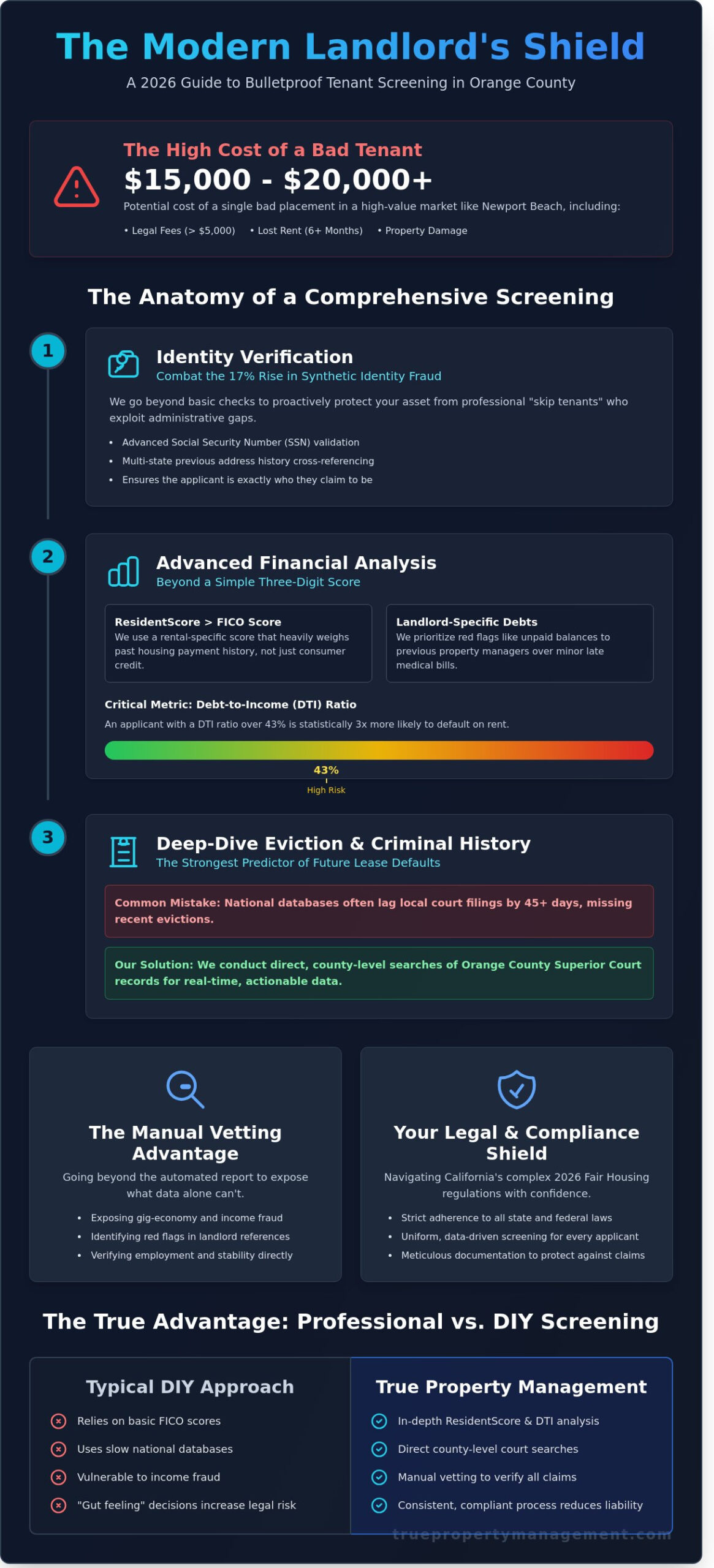
Effective tenant screening in Orange County requires looking past surface-level data. In 2026, landlords must combat a 17% rise in synthetic identity fraud, where applicants blend real and fake information to bypass traditional checks. We utilize advanced verification tools to confirm social security numbers and previous addresses before the process even begins. This proactive step protects your investment from professional “skip tenants” who specialize in exploiting administrative gaps. We verify every identity against multi-state records to ensure the person signing your lease is exactly who they claim to be.
Decoding the Credit Report
A standard FICO score is designed for banks, not property owners. ResidentScore is a specialized metric for rental risk that weighs previous housing payment history more heavily than consumer credit. While a high utilization rate on a credit card might lower a score, we focus on debt-to-income ratios. In a market where Orange County rents often exceed $2,850, an applicant with a debt-to-income ratio over 43% is statistically three times more likely to default. We look for specific landlord-specific debts, such as unpaid balances to previous management companies, which are far more telling than a late medical bill from 2023. This level of True Transparency ensures you understand the financial character of your tenant, not just their balance sheet.
Criminal and Eviction Records
Relying on national databases is a common mistake that leaves landlords vulnerable. These systems often lag behind local Orange County Superior Court filings by 45 days or more. We conduct direct county-level searches to identify recent Unlawful Detainers that haven’t hit national reports yet. Eviction history remains the strongest predictor of future lease defaults, making this data point non-negotiable for asset protection. It’s the single most important factor in maintaining the long-term health of your rental portfolio.
Compliance is just as vital as the data itself. You must strictly adhere to California fair housing laws when evaluating an applicant’s past. Current 2026 regulations generally prohibit the use of criminal records older than seven years in housing decisions. Our process ensures you remain within these legal boundaries while still filtering for serious safety risks. This balance provides the security you need without the threat of a costly discrimination lawsuit. Our True Property Management team provides the professional oversight required to navigate these local nuances with total confidence, giving you back your time and peace of mind.
Beyond the Data: The ‘True’ Manual Vetting Process
Automated credit reports and background checks are the baseline of modern property management, but they aren’t the finish line. In 2026, a high-integrity tenant screening process requires a human touch to catch sophisticated fraud that software often misses. Digital forgery of financial documents has become increasingly accessible; industry data from late 2025 suggests that nearly 15% of independent rental applications contain some form of modified income documentation. At True Property Management, we act as your protective barrier by manually cross-referencing every data point. We match LinkedIn profiles to IDs and verify that employment history aligns with the professional footprint found online. This level of True Transparency ensures the person moving into your Irvine or Huntington Beach investment is exactly who they claim to be.
Verifying Income and Employment
Maintaining a strict 3x rent-to-income ratio is essential for long-term asset protection in the Orange County market. While a paystub was once sufficient, the gig economy and remote work have complicated the verification landscape. We don’t just glance at a PDF. We look for the red flags of doctored documents, such as inconsistent font alignments or rounded-off tax withholdings that don’t match California state requirements. For self-employed applicants, we require two years of 1099s and at least six months of consecutive bank statements to confirm cash flow stability. Understanding landlords’ rights and responsibilities allows us to perform these deep dives while remaining fully compliant with state fair housing regulations.
Mastering the Landlord Reference Call
The reference call is where most DIY landlords lose their leverage. A “glowing” reference from a current landlord in Costa Mesa might actually be a strategic move to get a problematic tenant out of their unit. Our team is trained to listen for what isn’t being said. We ask three specific questions: “How many times did you serve a notice to pay or quit in the last year?”, “Were there any unauthorized pets or occupants discovered during inspections?”, and “Would you lease to this individual again without hesitation?”
We also take the proactive step of verifying that the “landlord” listed isn’t just a friend of the applicant. We check property tax records to ensure the person on the phone actually owns or manages the previous residence. This disciplined approach uncovers rental application red flags that a standard computer-generated report would never flag. This manual vetting is the core of our “True” process; it provides the peace of mind that comes from knowing your tenant screening is handled by local experts who value your financial success as much as you do.
Navigating California Fair Housing and 2026 Legal Compliance
Compliance isn’t a suggestion; it’s the foundation of your investment’s safety. In Orange County, the legal environment for 2026 demands a proactive approach to risk management. You’re likely familiar with the Fair Housing Act’s protected classes, but California extends these protections significantly. Under SB 329, you cannot reject an applicant because they use a Section 8 voucher or other housing choice vouchers. Treating these “source of income” applicants differently than market-rate tenants is a fast track to a costly lawsuit.
The implementation of AB 12 has fundamentally shifted how landlords mitigate risk. As of July 1, 2024, security deposits are capped at one month’s rent for the vast majority of residential properties. You no longer have the luxury of a double deposit to offset a marginal credit score. Because your financial cushion is now limited by law, a rigorous tenant screening process is your only reliable defense against high-risk placements. You must rely on data, not deposits, to protect your asset.
If your screening results lead you to deny an applicant or require a co-signer, the Fair Credit Reporting Act (FCRA) requires you to issue a formal Adverse Action Letter. This document must state the reason for the denial and provide the contact information for the credit reporting agency used. Failing to provide this isn’t just a lapse in communication; it’s a federal compliance violation that leaves you vulnerable.
Local OC Regulations and Rent Control
While AB 1482 sets statewide limits on rent increases and eviction “just cause” requirements, local municipalities often add their own layers. Tustin landlords, for instance, must be hyper-aware of specific just-cause ordinances that may exceed state standards. Newport Beach continues to enforce strict distinctions between long-term residents and short-term vacation rentals, which impacts your zoning and tax liabilities. For a deeper look at these regional nuances, read our comprehensive guide on California landlord tenant law.
Avoiding Discrimination Pitfalls
Inconsistency is the enemy of compliance. To protect yourself, implement the “First Qualified Applicant” rule. Define your written criteria before you list the property, then sign the first person who meets those exact standards. This removes subjective bias from the equation. Additionally, you must handle Service Animal and Emotional Support Animal (ESA) requests with care. Under 2026 guidelines, these are not “pets,” and you cannot charge pet rent or additional deposits for them. Using a standardized, data-driven tenant screening workflow ensures every applicant is treated with the same True Transparency.
The True Advantage: Why Professional Management Outperforms DIY Screening
DIY landlords in Newport Beach often spend 40 hours or more per vacancy on manual tenant screening. This labor intensive process leads to extended vacancies that eat into your annual profits. Professional management firms reduce vacancy periods by 50% compared to self-managed properties. We fill homes faster because we leverage a pre-vetted pipeline of renters and 24/7 automated showing technology. Speed doesn’t mean cutting corners. It means having the infrastructure to process applications in hours rather than days.
True Property Management utilizes proprietary databases that go far beyond a basic credit score. We access specialized risk-assessment tools that flag “professional tenants” who know how to manipulate standard DIY platforms. By removing the emotional bias from the equation, we serve as your professional barrier. Handling a denial is a delicate legal matter. Our team acts as the straight-shooting expert, delivering firm decisions that protect your reputation and keep you compliant with 2026 fair housing regulations. Our ultimate focus is maximizing rental income by securing high-quality, long-term placements.
Our ‘True’ Screening Pillars
We believe in True Transparency. You shouldn’t have to wonder who is applying for your home. Our owner portal provides real-time updates so you stay informed without the stress of the legwork. We focus on proactive vetting to identify red flags like inconsistent employment history or undisclosed pets. This rigor helps you avoid the costly eviction process in Orange County before it even starts. Asset protection is our priority. Whether your property is in Irvine or Huntington Beach, we ensure it remains in pristine condition by selecting tenants who respect the lease terms.
Getting Started with a Local Partner
Moving from a DIY tenant screening headache to professional oversight is a seamless transition. The ROI of hiring a Newport Beach expert is clear when you calculate the cost of a single month of vacancy or one bad placement. We handle the transition, the paperwork, and the ongoing management so you can enjoy the passive nature of your investment. Stop chasing paystubs and start scaling your portfolio. Our team is ready to protect your asset with the discipline it deserves. Schedule your free rental analysis with True Property Management today.
Protect Your Orange County Portfolio
Navigating California’s strict 2026 rental laws requires more than just a basic credit check. You need a rigorous tenant screening strategy that combines deep manual vetting with absolute legal compliance. As regional regulations tighten, the gap between DIY efforts and professional oversight continues to widen. Success in the Newport Beach market depends on your ability to filter out high-risk applicants while protecting your asset from the rising costs of litigation and vacancy loss.
True Property Management provides the protective barrier you need between your investment and the stress of daily operations. Our boutique local expertise in Newport Beach ensures your property remains a top-performing asset. We eliminate the guesswork with our signature No Hidden Fees Guarantee and provide peace of mind through a proactive 24/7 emergency response system. You don’t have to manage these hurdles alone when you have a partner dedicated to True Transparency and your financial success.
Secure Your Investment with True Tenant Screening
Take the next step toward a hassle-free ownership experience and watch your portfolio thrive under expert care.
Frequently Asked Questions
Is it legal to ask for a tenant’s credit score in California in 2026?
Yes, you can legally request a credit score for most applicants in 2026. Under California Senate Bill 267, landlords must offer alternative evidence of the ability to pay for tenants with government subsidies like Section 8. For traditional applicants, a credit check remains a standard part of our True Screening process to ensure your asset protection. We focus on a 620 minimum score to maintain high-quality placements.
How much can I charge for a tenant screening fee in Orange County?
You can charge a maximum of $62.02 per applicant as of 2024, but this figure increases every year based on the Consumer Price Index. By 2026, the limit will be slightly higher. This fee must only cover the actual out-of-pocket costs of the tenant screening and the time you spend gathering information. You’re legally required to provide a receipt and return any portion of the fee not used for the report.
Can I deny a tenant because they have a Section 8 voucher in Irvine?
No, you cannot deny an applicant solely because they have a Section 8 voucher in Irvine or anywhere in California. Senate Bill 329 defines “source of income” to include public assistance. Discriminating against voucher holders violates the Fair Employment and Housing Act. Instead, evaluate these applicants based on the same financial and background criteria you apply to every other prospective tenant to ensure compliance and avoid costly legal penalties.
What happens if I find a criminal record on a rental application?
You must perform an individualized assessment if a criminal record appears during the application process. California’s Fair Employment and Housing Act prohibits blanket bans on applicants with criminal histories. You’re required to consider the nature and severity of the offense and how much time has passed since the conviction. This proactive approach ensures you stay compliant while still protecting your Newport Beach or Irvine investment property from unnecessary risk.
How long does the tenant screening process typically take for a Newport Beach property?
A comprehensive tenant screening for a Newport Beach property typically takes 24 to 72 hours. Delays usually happen when previous landlords or employers are slow to respond to verification requests. Our True process prioritizes speed without sacrificing depth. We verify income and rental history immediately to keep your vacancy periods short and your ROI high. This efficiency ensures we secure top-tier residents before they move on to other listings.
What are the most common red flags to look for during a property showing?
Look for applicants who arrive more than 15 minutes late or provide inconsistent details about their current living situation. These behaviors often signal future communication issues or a lack of reliability. We also watch for people who pressure you to skip the application process or offer cash to move in immediately. These are common tactics used to bypass our rigorous True Transparency verification standards and can lead to long-term management headaches.
Do I have to provide a reason if I deny a rental applicant?
Yes, you must provide a written Adverse Action Notice if you deny an applicant based on their credit report. This is a federal requirement under the Fair Credit Reporting Act. The notice needs to include the name of the credit reporting agency used and instructions on how the applicant can dispute the information. Providing this documentation protects you from legal claims and maintains professional transparency throughout your management operations.
How has California’s security deposit law changed for 2026?
California Assembly Bill 12 changed the landscape on July 1, 2024, by capping security deposits at one month’s rent. This limit applies to both furnished and unfurnished units across the state. Small landlords who own no more than two rental properties with a total of four units or fewer may be exempt under specific conditions. This change makes rigorous background checks even more critical for your financial security and peace of mind.